Using Fused Glass with Metal Clay
My knowledge about glass fusing is limited but a lot of the students that I have taught over the years are glass fusers. Naturally they wanted to combine their glass work with metal clay. In most cases they ended up constructing a bezel for their glass from low-shrinkage silver clay fired at a low temperature.
But how do we do this with base metal clay, which has to be fired in carbon? The temperature is too high for the glass and it gets pitted by the carbon (I have tried).
Here is my suggestion, and I would love to hear what you think about it and if you have further ideas: fire your copper and/or bronze piece first, leaving a space, or more than one space, for the glass. Then fill these spaces with your glass, and fuse it in open air as you would naturally do. There will be a black coat of oxidation on the surface of the metal, which can be removed by buffing or sanding.
You may get good results right away, but it is also possible that the glass will cab and pull away from the walls of the space in which it is laid. In this case, add more glass, or just clear glass, and re-fuse.
Here are the first results of my student, Ann, who experimented with this technique:
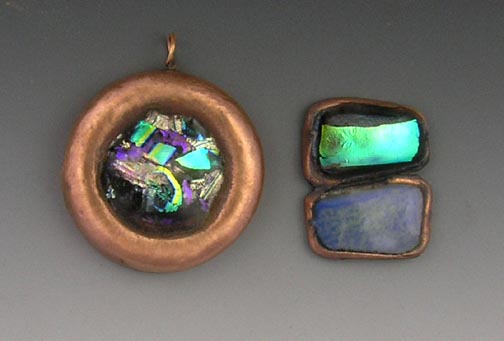
Glass fused in fired copper
It seems to me that this opens up a lot of possibilities. In many pieces of jewelry that combine glass and metal, the role of one of them seems less important. Sometimes the glass is just an accent in an elaborate metal construction, and sometimes the metal is just a frame for a beautiful glass cab. Using this technique of preparing the metal part first may make it possible to create pieces in which the glass and the metal play equal and complementary roles.

June 26th, 2009 at 7:59 pm
hmmm. i wonder if you coated the fired copper clay with boric acid solution, (or other available solutions) like you do when you are embedding copper in glass….if the copper wouldn’t oxydize as much..or would it turn red?
i have never used copper clay YET. guess i’d better try some!
June 26th, 2009 at 9:01 pm
Hi Connie,
It might work. If the copper turns red, it’s really easy to buff it to its natural color. In any case, the oxidation is only on the surface since the firing is not that long. I’d love to see what you do with it!
Hadar
June 26th, 2009 at 9:25 pm
Hadar, this really sparks my interest, because I’ve been thinking lately that all the fused glass stuff I see looks the same — until seeing this. Now, I want to try it, too.
-csc
June 27th, 2009 at 7:07 am
Hadar, thank you so much for this posting! I had just recently posted in Orchid hoping someone would have some experience with the new clays and fused glass. I figured you would have to use a prefired piece but didn’t know what to expect beyond that. I guess I will just have to jump in!
June 29th, 2009 at 11:20 am
This will probably work well for copper clay. How well it works for the bronze clay will depend on the COE of the Bronze–how close is it to the COE of copper?
January 8th, 2010 at 11:50 am
When fusing with silver clay (PMC) use either PMC+ or PMC3 only. If you fuse the glass first, you can then either set the glass INTO the PMC like you would a ring setting or you can cut out a space and set the glass that way. You need to make sure to put a rim around the glass to make sure it is secure. The glass will be slightly liquified when the PMC melts, making the glass even more secure. this technique will probably work the same for bronze and copper.
December 8th, 2010 at 1:57 pm
So, this is basically what I’ve been doing, but I have two problems, and I’m a little desperate at this point, and I wonder if anyone reading here can help solve them. Please forgive the length of this comment!
1)When I use the bronze clay, the open firing seems to leave it with a deposit of copper on the outer layer of the metal, and although it’s mostly removable after an extraordinary amount of vigorous scrubbing with a brass brush, the metal is still left with a rosy look rather than a golden one. It’s not ugly exactly, but if I’d wanted to use copper, I’d have used copper, you know? Any idea how to avoid this, or is it just a feature of open firing the bronze? I’m considering coating the pieces with a boric acid/water solution before trying it again–not so much to avoid the fire scale, which is pickle-able, but to see if it curtails the copper issue. (And to be clear–the copper coating is definitely a problem that’s happening in the firing, NOT in my pickling. There’s no contamination in my pickle.)
2)The second problem is one I’ve had continuously with the glass. I fuse the pieces, and I’m annealing them properly. But at some point, usually a day or two after they’re fired, the glass breaks–a sheer break in half, with the top and bottom halves separating cleanly from one another. The folks at the glass store in Berkeley tell me this isn’t something they recognize–if the pieces weren’t annealed properly, they say they’d be shattering, rather than cleaving in two this way. When I was setting pre-fused pieces into raw silver clay, I thought perhaps the shrinkage around the glass was causing too much pressure on the cab, but now I’m fusing the glass straight into the fully sintered setting–so I don’t think pressure is the issue. If anyone has ideas, I’d be so grateful to hear them.
December 8th, 2010 at 8:28 pm
Amy,
Bronze will always suffer from open air firing, a lot more than copper. Is it possible to bury just the metal in carbon while you are firing, leaving only the glass in the air? As to your other question, I really don’t know much about glass. I hope whoever reads it can help. What store in Berkeley was it?
December 8th, 2010 at 11:00 pm
Hadar, thank you–that’s super helpful advice. I can absolutely bury the bronze and leave the glass exposed.
Also, thank you in general for all your helpful advice here, and for your phenomenal books! I just bought all three, and I recently switched to using your firing schedule for Bronzclay–which pretty much changed my results from close to zero to almost 100 percent. What a difference. (Then I started using the Fastfire Bronzclay I had lying around, but kept to your schedule, and I might as well be firing silver now. Easy perfection!)
And the store is Stained Glass Garden, down on 4th Street. (I live in Davis–I plan to sign up for one of your six-week classes at some point.)
October 6th, 2011 at 1:46 pm
These posts are a little old, so I was wondering if anyone had made any progress in firing fuzed glass cabochons in any of Hadar’s Metal Clays? I know I can do it with silver PMC but I would also like to make some pieces with other metal clays. Any advice?
August 24th, 2012 at 12:37 pm
Hi,
I’m just starting to work with metal clay and planned to use the same kiln I use for glass. A metalsmith I know told this might not be a good idea because the kiln will absord the metal particles and contaminate the glass ( changing it’s color) Has anyone heard of this?