Rethinking the Firing Pan
Recently I have been experimenting with a different firing pan — a simple, cheap, stainless steel mixing bowl, available everywhere, including $1 stores.
The mixing bowl will wear out sooner than the rectangular firing pan, but the bowl has a lot of advantages over the rectangular pan.
1. The cost.
2. The thickness of the walls. Both stainless steel and carbon are poor heat conductors. The walls of the mixing bowl are thinner and allow better penetration of heat into the bowl.
3. The shape. The narrower bottom of the bowl (where the carbon is useless anyway and interferes with the heat flow) holds less carbon.
4. The top of the bowl, where the temperature is the highest, has a larger area than the rectangular firing pan.
5. Availability in different sizes. The mixing bowl that I use for both FireFly and Caldera kilns (and which also fits in front loaders from the Paragon SC series), is 7″ in inner diameter and 2½” tall. In bigger kilns you can use bigger mixing bowls and place the pieces close to all heating elements.
Here is how I place pieces in the mixing bowl:

All these pieces are fairly big: 2″ x 2″. In the rectangular firing pan I would fire them horizontally; if I were to fire vertically, their bottom would be too close to the bottom of the box, where the temperature is lower. Here they are positioned at an angle roughly parallel to the walls of the bowl.
The following drawing may bring my point across.

All the pieces sintered beautifully, including the one in the center.
I used the mixing bowl to fire a thick piece that sometimes would not sinter at first firing in the rectangular box. It is a copper circle, ¾” in diameter, ¼” thick.

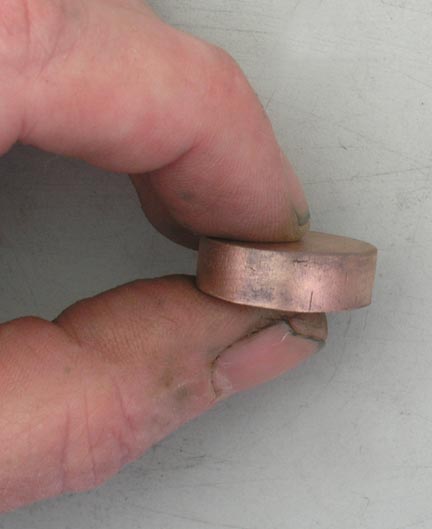
Placed close to the wall of the bowl, it sintered perfectly.
Worth a try!

January 16th, 2010 at 11:44 pm
hadar – do you use a lid?
thank you
connie
January 17th, 2010 at 6:01 am
Hadar – did you cover the pieces with carbon before firing?
January 17th, 2010 at 6:40 am
What a fabulous idea. Of course it makes perfect sense. I have to second Connie’s question, though…do you use any type of lid?
January 17th, 2010 at 10:57 am
Connie,
I use fiber(shelf) paper used for flass fusing. However, I tend to think that a lid is not necessary at all. I will try and post my results.
January 17th, 2010 at 11:02 am
Kathy,
I covered them with about 1″ carbon.
January 23rd, 2010 at 4:58 am
This is really exciting information! I love the way you approach new ideas, Hadar. You keep trying to duplicate the results until you can say that they will work. Very scientific and it makes sense. And I really appreciate that you post every new innovation from your workshops and keep your technical information updated.