Flexible Clay, a Bigger Extruder, and Submissions for a New Book
Flexible Clay
It has come to my attention that people are experiencing some difficulties making flexible clay. The last third of my book, The Handbook of Metal Clay: Textures and Forms (2nd edition) is dedicated to projects for flexible clay. You can also watch the following YouTube video about flexible clay:
I’d like to add some information here that is missing from the book. After letting the flexible layer or wire dry in the air, I refrigerate it for a while, even overnight. When you take it out, you can feel some “knots” in the wire or stiffer areas in the sheet. Wiggle the wire with your fingers over the whole length to release these spots. Wiggle the layer in different spots and different directions to release the stiff areas.

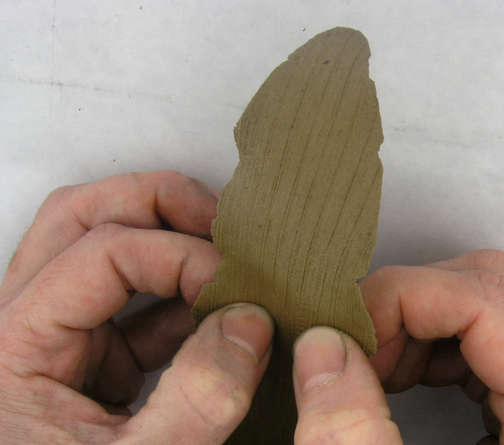
This is hard to capture in stills, but I hope you get the idea. Store extra sheets and wire in the refrigerator, and they will stay as flexible as leather.
Bigger Extruder
Here are some things that I’ve been making with an improvised big extruder.
Large color-patterned beads:

A color-patterned hairband almost as big as a cuff (a cuff bracelet would work as well):

A set of bracelet links extruded all at once (featured in my last book):
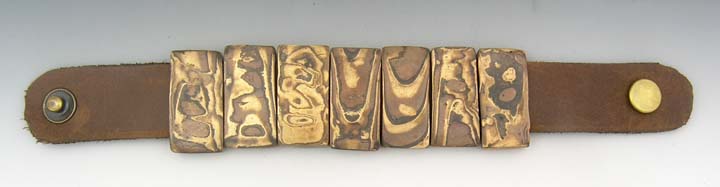
A new design that I call Cat’s Eyes, which can only be done with a bigger extruder:
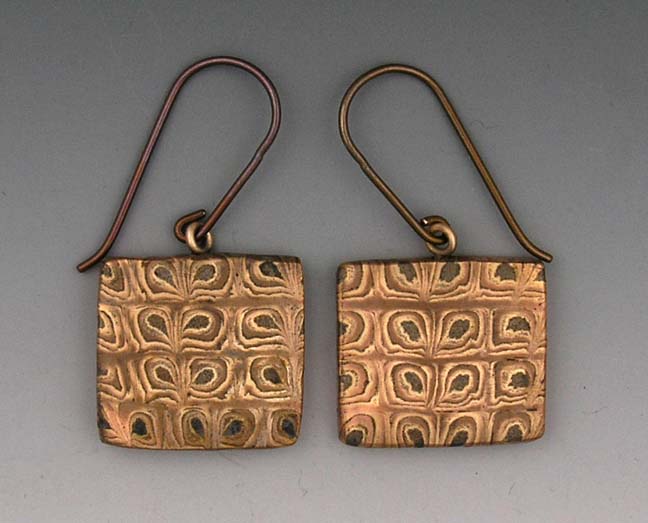
And a new design that I call “Bricks”:


I contacted Makin’s Clay about making this extruder. I have all the specifications, measurements, prototypes of dies, 2 types of bead extruders (tube adapters), and a link extruder that may be able to extrude bracelet links with two side holes. They sounded enthusiastic at Makin’s, but so far have not asked me for these details. This information is free! All I want is for an extruder like this to be commercially available, since building an improvised one is not as simple and cheap.
In any case, I will be happy to share the specs and information with you in upcoming workshops.
New Book – Call for Submissions
I am currently working on my next book. The book will be a kind of an inventory of new color patterns that have been made with metal clay, focusing on rings and mirror-image earrings. Please send me photos of anything beautiful that you have done with color combination (pieces with no combination will be considered as well).

February 12th, 2012 at 4:36 pm
All great news! I think I will work on a new piece after the workshop here, in Montreal….: )
February 12th, 2012 at 4:43 pm
Wonderful!!! Can’t wait for the new book!!!!!!
Maybe you can include instructions on an Architectural piece or put one on your
Blog?? :).
February 12th, 2012 at 5:08 pm
I’m with Kelly M. with instructions in your new book on how to do several Architectural pieces. Keeping my fingers crossed!
February 13th, 2012 at 3:23 am
Hadar
Help! i have tried to make flexible clay with metal clay and it has just become a big heavy lump, it rolls into a ball with no cracks, but when i try and roll it out if just breaks into pieces. i also made some normal silver pearl and white steel just normally kept them in a container as requested and when i come to use them a couple of days later they too where just falling apart and crumbling, DONT KNOW WHAT I AM DOING WRONG BUT IT IS DRIVING ME MADE NOT TO MENTION A LOT OF MONEY, IS THERE ANY WAY THE SILVER CAN BE SAVEDL PLEASE HELP HADAR. SHARON X
February 13th, 2012 at 10:34 am
Hadar, I purchased the large A.C.E. extruder sold by polymerclayexpress.com. The discs they sell waste too much clay, so I’ve made my own with my disc cutter and 22ga brass sheet, but, of course, that only gives me round holes. I extended the plunger by making a plug out of polymer clay so that most of the clay is extruded and not left in the barrel. I’ve made several nice pieces with it. Ron Taylor
February 13th, 2012 at 11:43 am
Sharon, When making the flexible clay, it’s important to follow the instructions as presented in my book and in the video referenced above. There can be several reasons that flexible clay does not stick together properly; It could be the type of glycerin (it should be pure). It takes a few times of rolling until the clay reaches the right consistency. Are you storing your clay in the refrigerator as recommended? Are you finding it has dried and needs to be reconstituted? To reconstitute dried Hadar’s Clay, follow the instructions on page 4 of my User Manual. For more information on reconstituting metal clay, you may wish to Google “reconstitute metal clay.” Good luck! Hadar
February 13th, 2012 at 1:27 pm
I have all of yr books Hadar and look forward to the next (when should it be out?) thanks for taking the time, i wasnt keeping the clay in the fridge. many thanks love all of yr work. sharon
February 15th, 2012 at 9:33 am
Hi Hadar,
I am so excited about a new book!
What is the minimum photo size, resolution needed?
Thank you for your sharing of knowledge and experiments.
Eileen
February 15th, 2012 at 10:04 am
Eileen,
Minimum 300 dpi, 5″ x 5″. Thanks!