What Clay to Use?
I’ve been getting a lot of questions about what clays to use. I admit it’s getting confusing with so many types of clay, but there is an answer to that. I will try to make it as simple as possible.
What Steel to Use and When
Steel on Its Own
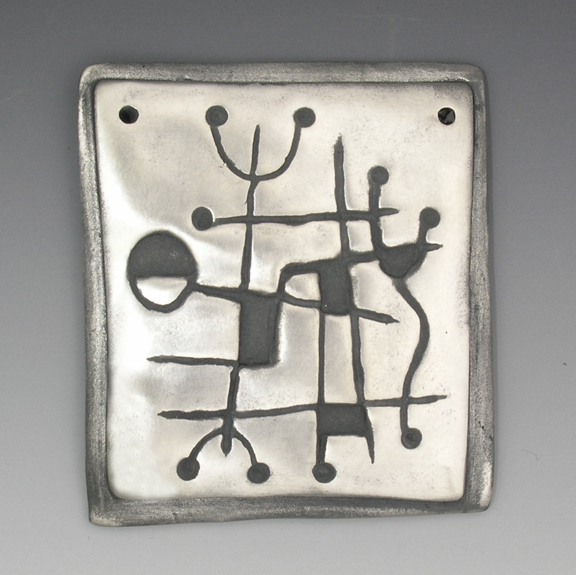
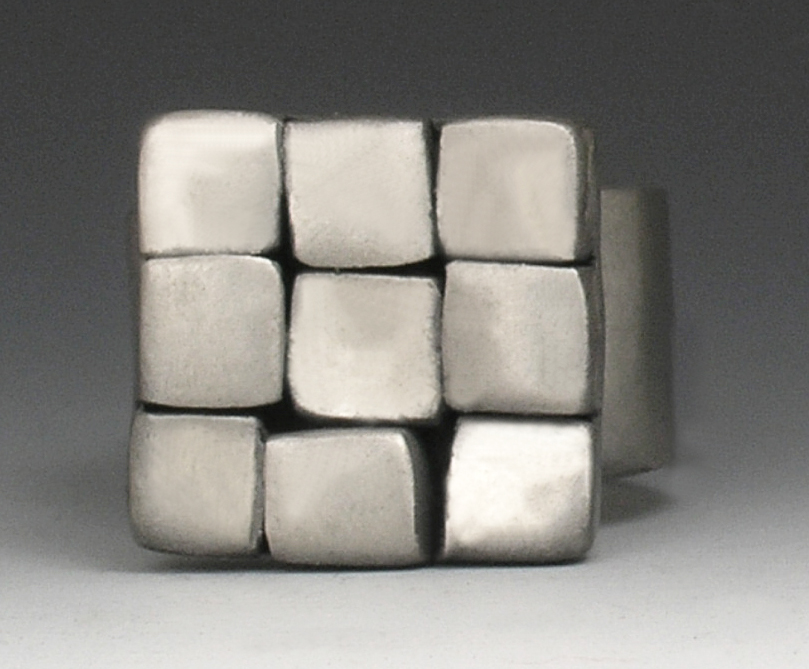
If you are just starting your experience with base metal clay, I would suggest using Low Shrinkage Steel XT. It is friendly and easy to use. Most of the projects that are introduced in my first book: The Handbook of Metal Clay: Textures and Forms (2nd edition), originally written for silver, can be easily done with Low Shrinkage Steel XT.




Steel Combined with Other Metals
1. Mokume Gane Patterns
Any of the steels works well with these patterns if it is used in small amounts.


2. Gradients
All steels work well with gradient surfaces. Only Pearl Grey Steel (not XT) works with gradient from steel to White Bronze!

3. All Other Designs
Low-shrinkage Steel XT is recommended.
If you use it in combination with Quick fire bronze, you will have to fire the steel part first at its high temperature, then add bronze and re-fire at a lower temperature.

If you use it in combination with Quick-fire Bronze XT, you can fire them together once, at high temperature.


What Bronze to Use and When
Bronze on Its Own
I suggest Quick-fire bronze, since it is fired at a lower temperature and therefore shrinks less.


Bronze with Copper
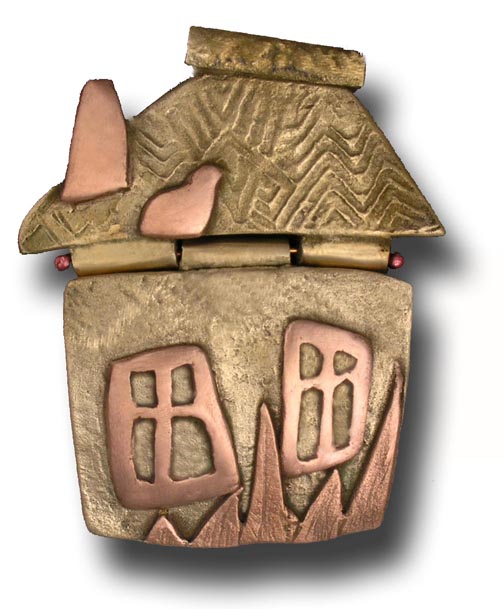
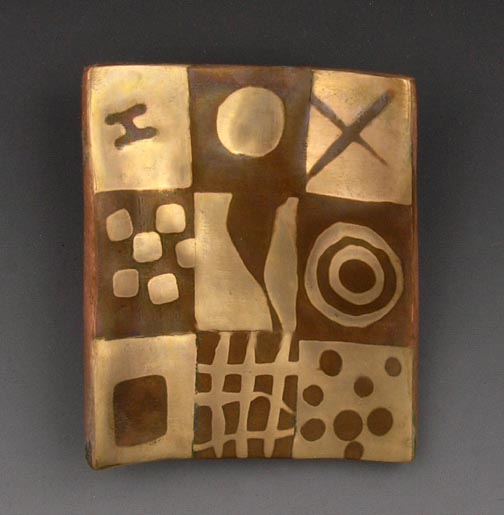
If you are a beginner but want to explore mixed metals, I suggest starting with Quick-fire copper and Quick-fire bronze (not XT). You will find lots of projects in my book: Mixed Metal Jewelry from Metal Clay.. Many of the projects in The Handbook of Metal Clay are “translated” in the second edition to a combination of Quick-fire copper and bronze.


Bronze with Steel or with Copper and Steel
This is the same as “Steel combined with other Metals” above, with one difference:
In mokume gane patterns, if you use Quick-fire bronze and fire at a low temperature, the color of steel will be black (right earring below). If you use Bronze XT and fire at high temperature the color of steel will be blue (left earring below).
 .
.
It’s a matter of choice: if you like sharp contrast, use quick-fire bronze and steel (in small amounts) and fire at a low temperature. If you like subtle contrast, use Bronze XT and steel (you can use big amounts) and fire at a higher temperature.
In about a week, A file called “Introduction to Mixed Metal Clay” will be available is now available on my blog. It will expand on the firing temperatures when combining different metals.

June 12th, 2012 at 2:51 pm
Hadar,
This is great! Very useful. Thank you.
June 12th, 2012 at 3:02 pm
Thanks so much Hadar!!!
June 12th, 2012 at 7:29 pm
HI THERE! I just ordered a new batch of clay from your site. I was looking to see if you have Stainless Steel and didn’t see it there. Am I mistaken or didn’t you have Stainless Steel at one time?
June 13th, 2012 at 7:44 am
Thanks for your reply, and for your latest clarification. I think Ill try a small amount of bronze xt in addition to the low shrinkage steel xt and quick-fire bronze. A couple of experiments should tell me my direction. BTW, Your last earring examples are interesting. I assume the black steel at lower firing temp sinters ok, or you would have mentioned it. Your constant research is inspiring.
June 13th, 2012 at 7:58 am
Jenny, I had stainless steel long ago, but discontinued it.
June 13th, 2012 at 7:59 am
Damienne, The black steel sintered at a low temperature because it was used in a very small amount.
June 13th, 2012 at 8:15 pm
Dear Hadar, Can’t wait to read the mixed metal file. The blog info is very helpful. I especially love the flower with a twist ring.
Cindy
June 18th, 2012 at 1:56 pm
Thanks Hadar sure wish you could get back to the Philadelphia area . Thanks for sharing
June 20th, 2012 at 11:16 pm
I have been troubleshooting White Bronze for a few days, trying to determine why it is YELLOW instead of silver colored. I tried different carbons and different pans etc and finally discovered the key to getting a silver finish rather than yellow. I wanted to share with you what I have discovered:
I started with stove top firing to burn off the binder then went to the kiln for phase 2.
I started at the recommended temp of 1250 degrees in a brick kiln. I have gone up in 10 degree increments and checked the progress of the pieces at 30 minutes, 1 hr, 2 hrs and sometimes 4 hours of firing.
Eventually I got to the range of 1320 for 2 hrs when the first pieces sintered but were yellow and not particularly strong.
I had given up on trying to prevent the yellowing and was looking for the best temp to fire it to make it stronger when I stumbled upon the answer. I kept going up each time I fired test pieces by 5 degrees. When I reached 1335 I noticed that there were patches of white/silver. Next I fired 2 test pieces to 1340 for 2 hrs. One of the pieces came out beautifully white/silver and the other melted.
So I believe that the answer, if the pieces are coming out yellow, is likely going to be to increase the temperature but shorten the firing time so the pieces do not have time to melt.
June 24th, 2012 at 11:29 am
I received my order of low shrinkage steel clay and started working on it right away. Every piece sintered perfectly. I’m thrilled. I sanded them with my dremel with a low grit paper…now can I throw the whole lot in the tumbler? Will they get more shiney and will the pieces get rusty?
June 24th, 2012 at 11:44 am
Sylvia, I am glad you like it. Don’t tumble it or it will rust. You can try tumbling in oil instead of water. But it gets pretty shiny even if you just soak it in oil after finishing.
July 16th, 2012 at 6:40 am
I have been using steel clay for the last few months and I LOVE working with it, but I hate polishing it. I have been polishing by hand with a rotary tool and it just doesn’t look finished. I have a tumbler but I am afraid it will rust, is anyone polishing steel with the tumbler? If so what is the trick to rust prevention? Can you use the rust inhibitor before putting it in the tumbler? Also would I be better off with the white bronze? Does that rust?
July 16th, 2012 at 8:57 am
Tumbling will certainly rust steel (White Bronze doesn’t rust). You can try tumbling it in oil instead of water. However, I don’t think there is a way around heavy sanding with a rotary tool. Finishing is not easy, but it’s certainly worth it. You can find instruction in the first project of both my books: The Handbook of Metal Clay, and Mixed Metal Jewelry from metal Clay.
July 16th, 2012 at 4:38 pm
Hi Hadar…again.
I’m having a hard time with the quick fire copper. I have been firing at the high firing schedule but I’m finding that it isn’t sintering (it’s just falling apart.) What am I doing wrong? I noticed that the copper wasn’t black after the first stage even though it had stopped smoking. Could it be that the binder had not burned off? Or should I fire a bit higher in the second stage? I hate to waste any more time firing as I have a show at the end of the week (and there is a terrible heat wave here, up north, that is making turning on the kiln very difficult.)
July 17th, 2012 at 9:13 am
Sylvia, It sounds to me like the binder isn’t burning out properly. If the smoke stops but the pieces are not black, go to a higher flame and wait another 10 minutes. It is possible that it doesn’t get hot enough. I can’t tell without knowing what equipment you use. Are you at an altitude? In any case, if you want to make sure pieces are sintered don’t try to break them after the second phase. Just re-fire.
August 16th, 2012 at 10:07 pm
I’ve been working with your clays for a couple of months now. On your checklist you state that the carbon and kiln should not stay hot long after firing. Why is that? I have found that I have better results if I leave everything in the kiln overnight after firing to cool. I find, if I take out the pieces immediately after the firing schedule is complete or if I wait until 900 degrees before taking out the pieces, I get more cracks. I am using a paragon kiln, your suggested carbon and a stainless steel bowl (it was a dog dish, now it’s a dollar store mixing bowl.)
August 17th, 2012 at 7:18 am
Sylvia, You are doing everything right. The reason for that question is that if the carbon or kiln stay hot a long time after firing is that at a high temperature the carbon will continue to burn, turn into ash, and eventually expose the pieces to air. It doesn’t mean that you have to open your kiln immediately after firing. Obviously your kiln and carbon cool down at a normal rate.
August 21st, 2012 at 2:56 pm
Hi Hadar –
I have a question which I have wanted to ask you…..
When I fire two clays and I know that I will have to re-fire it after the first firing and wondered if I could just fire them for 4 hours all at once to begin with?
Thanks!
August 21st, 2012 at 3:10 pm
Hi Janet, If the reason for re-firing is that a high-fire clay didn’t sinter the first time, then from my experience 2 firings are more efficient than one continuous longer firing.
December 3rd, 2012 at 6:09 am
I really am getting frustrated firing my steel, it just keeps breaking and I don’t know how to sinter, i got the new fast fire kiln the really small one, and I don’t have a camp stovetop so I was wondering what I could do that my pieces just keep breaking apart like cookies,…very sad been working at this for some time!!!
December 4th, 2012 at 3:08 pm
Hi, Tina. Thanks for your comment. I sympathize with your frustration! My understanding is that Metal Clay Supply, which markets the SpeedFire 1800 series, is now working directly with their customers who are experiencing known sintering issues with these kilns. I have already forwarded your comment to them, and I suggest you contact them directly as well. You can find their contact information on their website, metalclaysupply.com .