Oct
6
2011

Hadar's Clay™ Sampler
The Hadar’s Clay™ Sampler is now available on my online store. The kit includes 25 grams each of Quick-fire copper, Quick-fire bronze, White Bronze, Rose Bronze, and Pearl Grey Steel XT.
The sampler can serve as a low-cost introduction to the wide range of clay. It is recommended to use it to make test pieces to find the correct firing schedule for your individual kiln. The instructions for using the clay, as well as making test pieces, can be found in the instruction manual for Hadar’s Clay on the right-hand pane of this blog.
Here is the range of colors that this kit can produce:

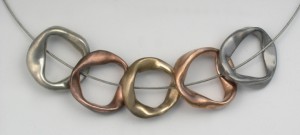
From left to right: White Bronze, copper, bronze, rose bronze, and Pearl Grey Steel. Both Pearl Grey Steels – regular and XT – are the same color. XT is stronger and better for structural purposes.
The powder clay is packed in small screw-top plastic bottles encased in a bubble wrap pocket.

I hope you find it useful.
And a reminder: the deadline for the juried challenge of Metal Clay Today is October 15. The challenge is “Coming Un-hinged”, and one of the prizes is a selection of my clays (500 grams) and one copy of my book Mixed Metal Jewelry from Metal Clay. Please see details here.
5 comments
Oct
4
2011
On page 68 of my book Patterns of Color in Metal Clay you can see a photo of discs that I made for a polymer clay extruder, 1″ in diameter. This extruder is far from meeting our needs, but that’s all I have for now. I think I must have bought every type of cookie press available – both manual and electric – and they don’t seem to work. I also tried to construct my own from plumbing pipes, but it is not as easy as the 3/4″ diameter one. So I’ve been working with the polymer clay extruder, and I’d like to share my results with you. The extruder is big and heavy, but I will bring it to Studio 34 and Metalwerx next week so we can experiment together.

This is not the bracelet from the project on p. 78. Jennifer has that one, and I hope she is still happy with it. This is a new one. All the links were extruded at once through the slot of a 1″ disc.

These are designs that are impossible to make without a bigger extruder and a matching tube adapter. Here is a photo next to a penny, for scale.

How easy it would be to extrude decent size beads and bead cores.
And for those of us who like big, chunky rings:


Speaking of which: it has come to my attention that people think it is possible to smear silver paste on the inside of a ring to avoid allergic reaction with the skin. I strongly recommend against it. If you are familiar with my book Silver and Bronze Clay: Movement and Mechanisms, you probably know how disastrous the reaction between silver and bronze can be. You may end up losing a lot of expensive silver.

This was a copper/bronze mokume-gane ring with silver lining before it was fired. Another ring lost its shank altogether.
Lining rings with silver has to be done in special ways, and I will teach all about it in my Mokume-Gane Rings classes.

7 comments


