Apr 28 2010

The Sintering Bracelet Project

I actually call this bracelet “The Sintering Bracelet” – not only because it has undergone sintering, but also because it graphically depicts the sintering process.

t-Assembled

This posting has three parts: the tiles, the back of the tiles, and assembling the bracelet. This is an improvement on a bracelet project that is featured on my DVD, “Workshop at Textures Studio”. It is made out of White Bronze clay.

The Tiles

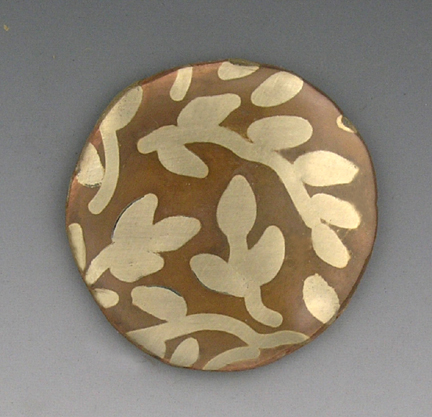
Use any design that appeals to you. Here is a pretty one taken from a rubber stamp.

t-001

Here is my sintering bracelet:

t-08

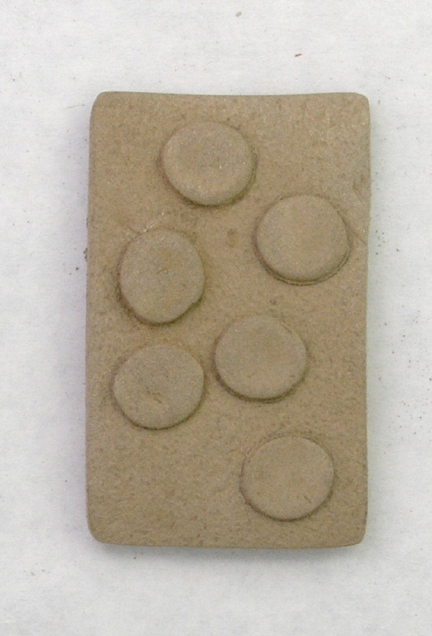
In the first tile from the left, the circles represent the particles of the metal powder in their “green” state. The spaces between them are filled with binder.

t-01

In the second tile from the left, the particles are getting closer to each other.

t-02

In the third tile from the left, the particles lose their spherical shape and fuse into each other.

t-03

In the fourth tile (the middle one), the metal is fully sintered. The particles got as close as they could to each other without reaching the melting point of the metal, and there are spherical pores between them.

t-04

The rest of the tiles show how the spaces between the particles change their shape. Starting from the right side of the bracelet:

The first tile from the right shows the shape of one pore between four spherical particles that hardly touch each other.

t-07

The second tile from the right shows the shape of the pore after the particles have fused a little.

t-06

The third tile from the left shows the spherical shape of the pore when the metal is fully sintered, as in the center tile.

t-05

The Back of the Tiles

1. Turn the tiles over and arrange them side by side. Mark two parallel lines along the whole row of tiles. Start from the smallest tile and adjust the rest accordingly.

t-01

2. Using a round miniature file, file a groove in each line.

t-02

3. Roll a layer of clay 2 cards thick. Pleace a tile on top of it and cut it on both sides to determine its width. Don’t cut the length yet.

t-04

4. Cut Angel Hair spaghetti into small pieces and place them in the grooves. The grooves help to hold them in place.

t-03

5. Wet the back of the tile.

t-05

6. Lay the strip that you cut in step 4 on the back of the tile. Make sure it adheres to the back at every spot. You can do this by rolling a straw over the layer, especially between the spaghetti straws.

t-06

7. Cut away the excess from the strip at the top and bottom of the tile. Dry. When the tiles are half dry, pull the spaghetti straws out by twisting them gently. Continue drying.

t-07

8. Seal all gaps between the two layers. Dry, and sand smooth.

t-08

This is a side view of the tile:

t-09

9. Fire the bracelet.

t-Fied2

Assembling the Bracelet

This bracelet can be assembled using only Stretch Magic. For a different method of assembly please see instructions here.


Apr 18 2010

Firing at High Altitudes – and a Project for White Bronze, Copper, and Bronze Clay

Following the question I asked in my last posting, about firing at high altitudes, here is what I understand. The warming pans and the kilns were not overheating. The temperatures were correct. However, at higher altitudes, for plastic to melt, for water to boil, and for metal clay to sinter, lower temperatures are required.

Because of lower air pressure, the liquids in the clay evaporate faster than at sea level, and the gases trapped in it expand and escape faster.

So the higher the altitude is above sea level, the lower the sintering temperature will be, and the lower the altitude, the higher the sintering temperature.

Thanks to Gail, Kim, Peggy and Mary for their input.

Here is a project combining copper, bronze, and White Bronze clay. This project is hard to do with silver clay because of the reaction between silver and bronze.

t-3-tone rock

This is a hollow form, constructed using the instructions for making a rock (see my first book, p. 69).

1. Choose a rock and cover it with a 2-card layer of bronze clay. Dry.

t-01

2. Cut the bronze layer in half and pull out the rock. Put the two halves back together and dry.

3. Cover the bronze hollow form with a layer of copper clay, 3 cards thick. Don’t dry yet.

t-02

4. Using a tube, cut a hole in the copper layer. Use a knife to cut a strip off the copper layer, continuing all around the rock. Now dry the rock.

t-03

5. Fill the round hole with bronze clay. Just “smoosh” it tight into the hole to make sure it touches the base bronze layer. It’s not important if you fill too much. Dry.

t-04

6. Use a sponge sanding pad to sand off the excess bronze, until the shape of the hole re-appears.

t-05

7. Position the rock the way you want it to hang. Drill a hole through the top third of it.

t-06

8. Fill the rock almost full with carbon. Fire it according to the instructions for your clay.

t-07

9. Clean the strip part using a radial disc or any other buffing/brushing tool. Fill it with White Bronze the same way you filled the hole. Dry.

t-08

10. Sand the excess White Bronze until the shape of the strip re-appears.

11. Fire the rock following the firing schedule for White Bronze.

12. Sand the whole rock smooth and flush.

t-09

13. Paint the rock with Baldwin’s patina to highlight the contrast between the metals. It will react with the copper, but not with the bronze and White Bronze. Wash the rock in warm water.

t-10


Apr 13 2010

What is the Correct Firing Temperature?

This is a question that I am often asked. The answer is that there is no absolute correct temperature. It depends on too many variables.

Some of these variables are: the type of kiln (brick or muffle), the location of the door and the heating elements, the size of the kiln, the age of the kiln, the carbon you use, the amount of carbon you use, the number of times you have used it, the box you fire in (steel, fiber blanket, ceramic, ceramic cloth, lava cloth, fiberglass cloth, etc.), the number of times you have fired in the same box, and finally, the altitude.

There is a simple way to figure out the right firing temperature for your kiln, which is trial and error.

Use bronze clay to make some test pieces, 3, 6, and 16 cards thick. If you have a muffle front loader kiln, fire them at 1550°F/843°C. If you have a brick kiln, fire at 1470°F/799°C. You can refer to my instruction manual for other conditions, such as box, carbon, and length of firing.

Take note of the firing conditions in which you did your test: carbon, box, etc.

After firing check the pieces. If they look curved, blistered, swollen, or somewhat textured, it means that this temperature is too high. Lower the temperature by 20°F (10°C) and repeat the test. Continue testing until you get smooth, strong test pieces.

To check sintering, use slight pressure to try to bend the thinner piece with your fingers. If it breaks, it means the temperature was too low. Raise the temperature by 20°F (10°C) and repeat the test.

A thicker piece may not break easily, even if it is not fully sintered. To check thicker pieces, sand the surface with course sandpaper. If the piece is not sintered, you will immediately see a non-metallic mass under the surface. Again, raise the temperature by 20°F (10°C) and repeat the firing until you get a strong, fully sintered piece.

Once you have found the correct temperature, try as much as possible to stick to the firing conditions you noted prior to your testing.

Next, look at the different schedules for the other clays, and adjust them accordingly. Now you have a customized firing schedule for your kiln.

Conditions may change, of course, so it is a good idea to test sintering after every firing. Buff or sand a hidden spot of the fired piece to see if there is non-metallic matter under the surface. If there is, you haven’t lost the piece. Just re-fire, or repair and re-fire.

I have just come back from teaching a workshop in Grand Junction, Colorado. It’s high desert, 4,700 feet above sea level. Two things happened that I had never encountered before.

First, the same candle warmers that I use in my studio (at sea level) were a lot hotter. They melted plastic, while at sea level I can dry a piece with a straw in it with no problem. Also, some of the kilns were firing too hot.

This seems somehow counter-intuitive, since from what I understand, because of lower air pressure, the higher the altitude, the longer it takes to heat; cooking rice takes longer, and baking bread requires adding dry ingredients.

Since this question may be relevant to metal clay users who live in high altitudes, I would appreciate any input on the subject that I can post on this blog.

The other thing that happened, was that Baldwin’s patina darkened the copper a lot more than I am used to seeing. This may be related to the composition of the air at higher altitudes, so again, if you happen to know the reason, I would love to hear it and let other people know.


Apr 7 2010

Troubleshooting Copper

This posting is in response to a question that I have been asked by many people. There seems to be some misunderstanding about the firing schedule of copper, and I would like to clarify.

The problem that people are having is that although they get fully sintered pieces of bronze, they are often able to break the copper pieces. There is no powder at the cross section, but the pieces are not very strong.

Here is my answer: copper, in order to be as strong as the bronze, needs to be fired at higher temperatures. If you look at my instruction manual for Quick-fire Copper and Bronze, you will see that if you fire copper alone you can go as high as 1800°F/980°C. In fact, I fire copper and steel clay in the same batch.

Therefore, there is no point in testing the strength of copper if it was fired at the sintering temperature of bronze. The binder may be gone, but the metal has not reached its highest density and the copper has not shrunk all the way. It’s exactly the same as when we torch-fire silver clay: you have probably noticed that if you re-fire it for repair, it shrinks more. That’s because it hadn’t reached its highest density the first time around.

So what do we do? When I have just copper to fire, I fire it by itself at 1800°F/980°C. But what if I have mixed pieces?

Luckily for us, mixed pieces are stronger even when they are fired at the sintering temperature of bronze. Even though the copper may be under-fired, the bronze gives the piece its strength.

Under-fired is not necessarily a bad thing. When we add silver to fired copper and torch-fire it, it’s because we want it under-fired. We don’t want it to shrink too much and crack. And the fact that it is under-fired is not important, since it is not a structural part of the piece.

If you want to make mixed pieces even stronger, make sure that the structural part of the piece is made out of bronze. For example, inlay copper in bronze rather than bronze in copper.

I must say, though, that I don’t usually find it necessary to worry about this. Most of the time mixed pieces, if fired properly, are strong enough for normal wear and tear. This is especially true for hollow pieces, since hollow pieces in general are stronger than flat ones.


Mar 31 2010

White Bronze Clay is Now Available

Hadar’s Clay™ – White Bronze is now available on my online store.

You can find the instruction manual on the right-hand pane of this blog and on the White Bronze product page in the store. Please download the instruction manual before you begin firing, since White Bronze behaves somewhat differently from copper and bronze clay. As with all other manuals, the White Bronze manual will be updated on a regular basis. The date of the last update appears at the top of the first page.

Copper clay has a wide range of sintering temperatures, while bronze has a narrower range; White Bronze has a very narrow range. A change of 10°F can determine whether a piece is not sintered or melts. Since kilns are so different from each other, it is important that you find the right firing schedule in your own kiln.

I tested the firing schedule in a top loader and a front loader kiln. The results are reflected in the firing schedule suggested in the manual. Please regard these temperatures as a starting point to determine your own firing schedule. I do not recommend firing actual pieces before firing test pieces. The instruction manual explains how to use test pieces.

White bronze fires when tucked deep in carbon, with slow ramping to a relatively low temperature, and 2:30 hours of hold time.

What can’t you do with White Bronze?

You cannot tell a customer that it’s silver (just kidding, it wouldn’t cross your mind).

You cannot fire it with a torch. The firing temperature is low and the firing time is long (2:30 hours).

You cannot combine it with copper and bronze clay unless the copper and bronze have been fired first.

You cannot bend or hammer it after it’s been fired. Although it’s very hard after firing, it is not flexible at all.

What can you do with White Bronze?

You can make big, chunky pieces that look like silver without feeling guilty.

t-WB rigatoni

t-Next to a penny

t-9-tile pendant

t-Doormat Bracelet

You can combine White Bronze with copper and bronze in the same piece, without having undesirable reactions as between silver and bronze.

t-Oval bead earrings

Unlike silver, you can inlay White Bronze in copper and/or bronze after they have been fired, and they will fuse without separating.

t-Squares

t-Ball earrings

t-Drum earrings

t-Oval bead earrong


Mar 24 2010

Improving Your Torch-firing Results

This is in response to comments by Dragonlady and Jenny on my previous posting.

Whether working in silver or copper, I myself am not a big fan of torch-firing for anything that might have a structural role in a jewelry piece. However, here is another suggestion for improving your results.

When we fire with a torch, we waste most of the heat on heating the air. You can build a “mini kiln” out of a firing surface and kiln posts.

t-01

The posts can be 2-3 inches tall, and, as you can see from the photo, they are arranged in a circular structure, leaving just one opening for the torch.

You can cover this structure with another firing surface, a tile, or a piece of fiber blanket.

t-02

I guess that lining the firing surface with carbon is even better, if you can manage to keep it in place.

Fiber blanket is an excelent heat insulator. Actually, you can replace this whole structure with a cylinder made out of fiber blanket.

t-03

The blanket is stitched with nickel-chromium wire, which resists very high temperatures. In fact, I use it to stitch my fiber blanket boxes, and make eyelets of it to insert into steel clay. Just Google “nichrome” or “nickel-chromium wire.”

Then seal the top of the cylinder with another piece of fiber blanket, and cut a hole for inserting the torch.

t-04

Again, lining the bottom with carbon can’t hurt. I’ll be glad to hear about your results.


Mar 22 2010

Understanding Metal Clay and the Firing Process

When I started my blog, I predicted that within a year many brands of metal clay would be available. This has become true, and it seems to create a lot of confusion. Different sets of instructions have become available, along with different firing schedules, etc. Teachers tend to vary in their choice of brand and may not be fully aware of how to handle other brands.

To help clear up this confusion, I thought it might be best not necessarily to clarify the differences between the brands, but rather to establish what they have in common. My hope is that by gaining an understanding of how metal powder sinters, individual users may find it easier to arrive at their own optimal firing schedule.

I am by no means a scientist. Everything I am about to write is based on a lot of reading, as well as on my personal experience. I have found that reading material about the theory of sintering may not necessarily be helpful, since practice rarely goes hand in hand with theory. However, things that I have read have given me ideas of what may be worth trying, and through trial and error I have arrived at a certain level of understanding. That is all I have to share.

Sintering means the bonding of loose particles together below their melting point. The term sintering applies not only to metal powder but also to ceramics.

Perhaps a good example of sintering is ice cubes. Ice melts at 32°F/0°C. The temperature in the freezer is way below that. What happens if we raise this temperature without reaching the melting point? The ice cubes will start sticking to each other until we are able to pick them up as one solid unit. However, since they don’t touch each other at every point of their surface, there are spaces between them and this whole mass is porous.

The sintering process consists of 2 main phases:

1.Removal of the binder
2.Densification of the particles

The Binder

The role of the binder is to give the metal powder the consistency of clay, so we can shape it or press it into molds. For the clay to turn into pure metal, the binder needs to be removed completely before the sintering process begins. If it is not completely removed, whatever is left of it prevents the metal particles from adhering to each other.

If the binder is completely removed, it does not matter what type it is. The type may affect the working condition of the clay but not the sintering results.

Densification

Once the binder is removed, the particles are allowed to get closer and closer. As far as I know, the particle shape of most metal powder used for the different brands of metal clay is spherical. The spheres get closer and closer, their contact areas grow, but since they don’t reach their melting point and they don’t turn into liquid, they don’t lose their shape completely and there are still spaces between them.

Here is a link to a short video clip that I posted on my blog a while ago. About halfway through the clip you can see a good illustration of it.

http://artinsilver.com/blog/2009/03/08/powder-metallurgy/

So what needs to happen in order for us to have a successful firing?

Precious metals such as pure silver and gold are fired exposed to air. They don’t react with the oxygen in the air, and the oxygen ensures the complete removal of the binder.

Base metal clays such as copper and bronze, when fired exposed to air, react with oxygen to create oxides, which, like the residue of the binder, prevent the particles from bonding. Pure copper can be fired exposed to air for a very short time before it oxidizes internally. However, longer or repeated exposure to heat and air will enhance the oxidation and eventually the copper will disintegrate. This is true not only for copper clay but also to solid copper, such as plumbing pipes and sheets.

Copper alloys, such as bronze, cannot be fired exposed to air. If they do, a large chunk of them will come off, taking with it the texture and details.

So, base metals are fired buried in activated carbon, which reduces the amount of oxygen in the kiln and inhibits this reaction. Gold granulation is done this way since it involves the use of copper. The carbon creates a “reducing atmosphere” by burning; while burning, it consumes the oxygen present in the kiln chamber.

However, most organic binders used in metal clays need oxygen to burn off. If there is not enough oxygen (because it has been reduced by the carbon), the binder will not burn off completely. If the binder is not completely removed, there will be no proper sintering.

So in a way, the activated carbon is both a blessing and a curse. On the one hand it enables sintering; on the other it interferes with the removal of the binder. In industry, vacuum or gasses are used to create a reducing atmosphere.

If we manage to burn the binder before the carbon catches fire, we increase our chances of successful sintering.

From my experience, the binder burns at around 1000°F/538°C in a top loader kiln or 1100°F/593°C in a front loader kiln (I refer to the most popular kilns, that are about 8″x 8″ x 8″). At this temperature the carbon does not burn yet. Some brands of clay have more binder in them than others and may require staying at this temperature for a certain amount of time for the binder to burn off completely.

If you have problems sintering your clay, no matter which brand you use, it is always a good idea to hold at this temperature between 30 to 60 minutes before going on to the goal temperature. Large and thick pieces have a lot of binder to burn, so holding at this temperature will always be helpful. Holding at this temperature will not affect thin or small pieces that may be present in the batch.

Firing Time

The amount of carbon in the box will determine the firing time. The more carbon present, the more time it takes for the binder to burn. Thin and small pieces require very little carbon (1″ below and on top) and can be fired for 1:00 hour once the carbon is removed. In this case, no hold time at 1000°F/538°C or 1100°F/593°C. Thick and large pieces require more carbon and therefore more time, usually 2:00 hours. As I said before, holding at 1000°F/538°C or 1100°F/593°C can only help.

Firing Temperature

Copper clay has a wide range of sintering temperature. If you fire copper alone (preferably in carbon), you can go up to 1800°F/980°C and fire for 1:00 hour.

Bronze will swell and warp if you fire it at over 1470°F/800°C (top loader) or
1550°/843°C (front loader). It is ok to fire copper at this temperature.

White bronze will swell and warp above 1200°F/648°C (top loader) or 1280°F/693°C (front loader).

These temperatures are not absolute numbers. They depend on the size, age, and condition of your kiln, and tests are required before determining your individual firing schedule.

The best test would be to fire bronze or white bronze clay at the suggested temperatures. If the pieces snap at these temperature you need to increase it. If they swell or curl you need to reduce it.

Other Tips

  • The smaller the kiln, the better. Otherwise you are wasting energy on heating air. (Lower temperatures than suggested may be required, though).
  • Use a firing box that is not made out of a poor conductor of heat, such as stainless steel. Stainless steel also oxidizes during firing and contaminates your kiln. I find a fiber blanket box or just a kiln shelf surrounded with kiln posts very effective.
  • Make sure there is some space under and above the box to allow heat flow.
  • Make sure the kiln is vented. The binder, fumes, and contaminants need to escape. If they don’t, they are most likely to inhibit sintering. If you don’t have a venting hole, you can either drill one or fire with the door a crack open.
  • For the same reason, don’t use a lid. The carbon will stay contained in the box and will not contaminate your kiln.
  • Use coconut shell carbon, acid washed, size 12 x 40.
  • After every firing, clean the carbon from the ash that has been generated while it was burning. This way you can re-use it.
  • Unless absolutely necessary, it is best to fire in carbon, starting with a cold kiln and finishing in a cold kiln. Taking pieces out hot may cause oxidation.

This file will be updated as necessary and is downloadable as a PDF file from the right-hand pane of my blog.


Mar 16 2010

Introducing White Bronze – Continued

Here is a report on my further testing of White Bronze clay.

1. I’ve been asked how White Bronze reacts to patina. You can see the result in the photo below.

t-patina

2. How well does it pick up textures? I tried to make my Collage of Textures pendant (first project in the my first book) with White Bronze. It reacts well with liver of sulfur and seems to pick up textures very well.

Before Firing

Before Firing

After Firing

After Firing

3. Smooth/matte/satin finish. Achieving these finishes was no harder than with silver, copper or bronze clay.

t-Earrings2

4. Combining copper with White Bronze.

t-WB in copper

t-Rock

t-2 tone rock

5. Reaction with bronze. I fired both bronze and White Bronze on a copper piece, without sealing the bronze as I would have done with silver. Both sintered, and there was no alloying or change in color.

t-Compatibility with bronze

The following bead has been waiting for this moment for about two years. I fired the copper and the bronze with the intention of adding silver to the bottom part. It was just then that I found out about the reaction of silver and bronze (you can read all about it in my second book), so I stopped working on the bead.

t-3-tone bead

t-3-tone rock

6. Sticking to copper and bronze. Since the firing temperature of copper and bronze is higher than that of White Bronze, copper and bronze need to be fired first. I placed an unfired piece of White Bronze on a fired piece of copper and a fired piece of bronze, and re-fired.

t-Sticking

The results were inconsistent. I repeated it a few times and sometimes they stuck, sometimes they didn’t, regardless of whether it was copper or bronze. My guess is that they will stick if there is a way of creating some pressure between them. The following test supports this hunch. It seems that the pressure of the carbon on the piece was not enough.

7. Inlay.

White bronze in copper

White Bronze in copper

White bronze in bronze

White Bronze in bronze

The following photo shows side by side inlay of White Bronze in copper (R) and inlay of copper in bronze (L).

Color comparison

Color comparison

As you can see, the contrast between bronze and White Bronze doesn’t seem very sharp. Over time it may improve when the bronze yellows some more. White Bronze has not changed in color so far.

The inlay pieces above were only partially successful. In the center of the pieces the metals bonded well with each other. On the peripheries some of the inlay chipped off and required repair and re-firing. It seems that on the peripheries the pressure is lower than in the center.

In the following piece I avoided inlaying the White Bronze on the borders of the piece. The bonding was fine.

t-Inlay


Mar 14 2010

Introducing Hadar’s Clay™ – White Bronze

t-02t-01

The pieces in the photos above (click to enlarge) are not made out of silver or steel. They are made out of a new copper alloy that I call “White Bronze.” This new form of Hadar’s Clay will soon be available for sale on my Web store.

Here is how the pieces looked before firing:

t-02a


I have prepared samples of Quick-fire Copper, Quick-fire Bronze, and White Bronze, textured and non-textured.

t-03

The following photo is taken next to a silver piece that may be familiar to you as a project from my first book.

t-04

Here are some process photos:

t-05b

Textured and folded

t-05a

Dried

t-05c

Fired

t-05

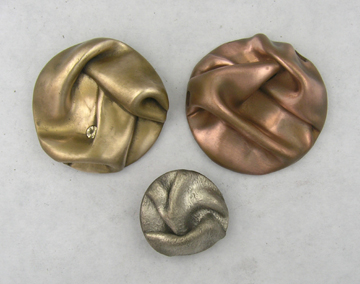
Next, some pieces in copper and bronze. Unlike the copper and bronze pieces, the White Bronze piece was textured before folding. When White Bronze is not textured, it comes out as smooth as copper and bronze.

White Bronze is compatible with both copper and bronze; there is no undesirable reaction between them as there is between silver and bronze.

The firing temperature of White Bronze clay is a lot lower than that of bronze clay, though. So in order to make combination pieces of either copper and White Bronze or bronze and white bronze, the copper and bronze parts have to be fired first.

t-06a

White Bronze was wrapped around fired copper, then fired.

t-06

The result is the piece on the left. On the right you can see the same piece with silver substituted for the White Bronze.

There are still some tests that need to be done. For example, I need to determine the extent to which White Bronze clay sticks to copper and bronze. I will post my results soon.

As you can see from the photos, the shrinkage rate is similar to that of Quick-fire Copper and Bronze. The firing time is about the same and the temperature is lower. The fired pieces are as strong as those of copper and bronze.

Important Note: This is not “nickel silver” (also known as “white copper,” “German silver,” or “alpaca”). This alloy contains no nickel.

White Bronze clay will be available on my store as soon as I complete my testing and write an instruction manual. I hope you like this low-cost addition to the palette of metal clays.


Mar 12 2010

Podcast

A few weeks ago I was interviewed by Alison Lee, host of Craftcast. A conversation with Alison was published in the March Issue of Art Jewlery Magazine, the same issue that has the article about Shibuichi. If you would like to listen to my interview with her, please click below:

Play Podcast

Play Podcast