Sep 27 2013

Hadar’s Molds – A Project for Two Molds

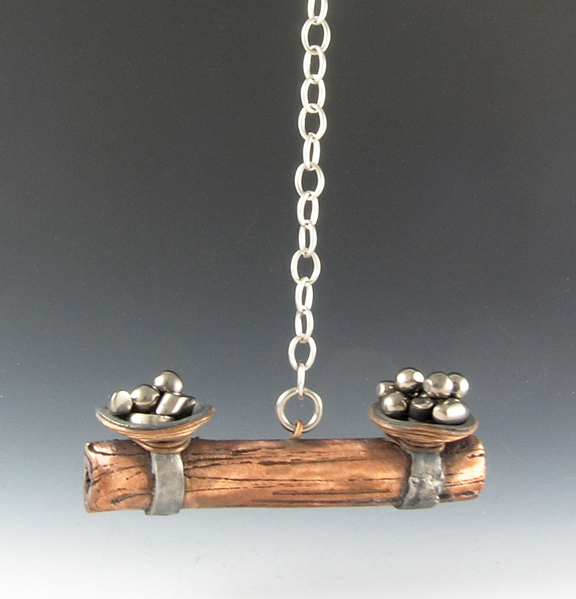
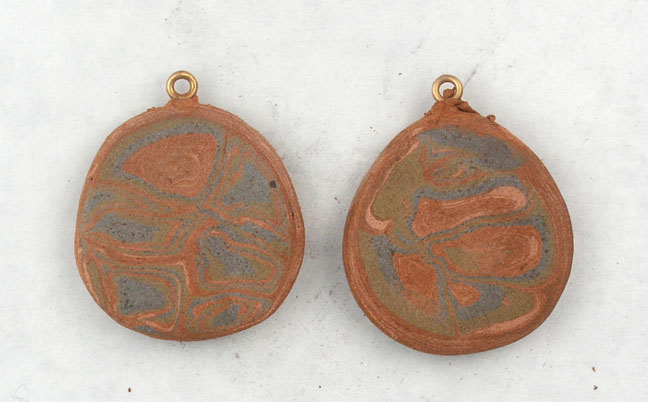
As promised, here is the first of a few projects demonstrating some of what you can do with Hadar’s molds. The piece in the photo below is a concave pendant made with Rose Bronze.

Mokume-Gane 2 and Tree Bark

I used two molds for this piece: Mokume-Gane 2 and Tree Bark.

Mokume-gane 2

Tree bark


You will need a concave area to dry the clay on. You can use a small bowl or a sapping die. I like to use plastic fondant mold. They come in various sizes, and they are cheap and available from Michael’s and JoAnn Fabrics.


Concave

1. Roll a layer of clay 4 cards thick. Pick a circle, more or less the same size as the Mokume-Gane 2 mold, and cut a circle out of the layer. Lay it in the concave area. It is recommended to dry it at least halfway before continuing. You can dry it in the air, in a vegetable dehydrator, or with a hair dryer, but not on a warming pan, because the plastic will melt.

Dry

2. Once the base layer is dry or almost dry, roll a layer of clay, 8 cards thick, and press it well into into the Mokume-Gane 2 mold to get a good impression. As you press it, it will become thinner.

Impression

3. Cut a rectangle out of the center of the mold. Lay it on the backing layer, in the center or off center.

Rectangle

4. Roll a layer textured with the Tree Bark mold. If you like, make it with a different metal. It does not have to be the same thickness as the center piece, but don’t make it thicker, since that would make it hard to reach the center piece for finishing after firing.

5. With a tissue blade, cut a vertical line on the left side of the layer.

Cut a line

As you can see in the photo, I used the mold called Crater, but I changed my mind because it seemed to be competing with the main texture.

6. Wet the backing layer and lay the layer adjacent to the mokume-gane rectangle.

Lay the layer

7. With a knife, cut away the excess clay from the layer; let the dry backing layer lead your knife. The water will make the layer stay put and not move while you are cutting.

Cut away

8. Repeat steps 4-7 with the left side of the rectangle. This time, cut a vertical line on the right side of the layer (step 5) and lay in the left side of the rectangle (step 6).

9. Dry the piece completely. You can remove it from the concave area and place it face down on the heating pan.

10. Fill the gapes between the backing layer and the overlays with clay. Dry again.

11. Make a bail on the back of the pendant. You can find a suggestion for a certain type of bail in my book The Handbook of Metal Clay: Textures and Forms, second edition, p. 36.

12. Fire the piece using the firing schedule appropriate for the clay that you used (see Instruction Manual for Hadar’s Clay from September 26, 2013.

13. Since this piece is textured, finishing is relatively easy. Use radial discs to clean the Tree Bark texture. For a good contrast, you can sand the mokume-gane rectangle, first with 220-grit sandpaper, then with 400 grit. See more information on finishing in the document entitled “Finishing Fired Metal Clay” on my blog.


Sep 22 2013

“Yet Another Quilt” Follow-up – Introducing Hadar’s Molds

Washers

Organic Mechanics

Mokume-Gane 7

Mokume-Gane 8

Cat's Eyes

Mokume-Gane 5

Holey Hexagons

Empty Spaces

Empty Circles

Mokume-Gane 3

Mokume-Gane 4

Quilt

What the textures on the quilt and in the photos above have in common is that they are all hand-crafted and part of the first series of Hadar’s molds, which is are now available on my online store.

Creating texturing and forming molds is something I’ve been wanting to do for a long time. These are molds that I created for my own work. They are not copied from natural or found objects nor computer generated. All masters are hand-made through an elaborate, labor intensive process.

Before getting into this venture I asked myself whether, being a teacher, I should teach how to make these mold rather that make them for sale. Indeed, my books include projects for making a few of these molds. However, they take a long time and much effort to make. Most of them also involve the loss of substantial amounts of clay, and have to be done over and over to reach the desired result.

The first collection includes 33 molds. They are all flexible, made from high-grade silicone putty which picks up fine details. They are all reversed: when you press the clay into the mold you will get the positive, the original pattern that the master displays. There is no need to make a mold from the mold.

In the next few weeks I will be posting projects and suggestion for using these molds, on my blog. Here are some options for using the set of molds called “Holey Rectangles”.

This is a set of three textured rectangles with slightly different size and pattern. They can be made into earrings, bracelets and necklaces.

Earrings

1. Rub the mold with an oiled toothbrush. Press the clay into the mold and pull it out.

Press the clay into the mold

2. Stick a wire eyelet or embeddable at the top of the rectangle.

Add an eyelet

3. Repeat step 1 and 2 for the second earring. Sand, fire and finish.

Brilliant Bronze earrings

Bracelet

1. For a bracelet you may want the links to be 2-sided. In this case, make two pieces for each link.

Make 2 pieces for each link

2. Dry the pieces, and attach them back to back with wet clay.

Attach back to back

3. Dry again, then seal the joint with wet clay.

Seal the joint

4. Dry again, then drill two side holes in each link.

Drill side holes

5. Sand smooth, fire, finish and assemble. The bracelet in the photo bellow was assembled with flexible cord and black pearls as spacers.

Holey Link Bracelet

Suggestion: Make a mixed metal Holey Link Bracelet:

Mixed metal links

Necklace

The process is the same as that of the bracelet. The links don’t need to be two sided, though, and require only one side hole.

Steel Holey Link Necklace

Necklace by Sherry Johannes


Sep 19 2013

Yet Another Quilt

Is this just another quilt? Hint: click on the image to enlarge. What do the different textures have in common?

Local students and friends: please don’t give away the answer.


Jul 20 2013

Another Free Project: a Watchband/Bracelet (and Earrings)

Before getting to the project, I’d like to show a stunning necklace, made by Komala Rohde, who will soon be an accredited teacher for Hadar’s Clay. Komala used a technique based on my latest blog posting, with her own twist and style.

Necklace by Komala Rohde

Mokume-gane watchband

The watchband from my last blog posting consisted of bulls eye cane slices. The links in this watchband have a mokume-gane pattern. How did that happen? This is an “enhanced” version of the “multiple canes” technique described extensively in my book Patterns of Color in Metal Clay, pp. 39-49.

The twist is that instead of the die with a circle hole, I used the tube adapter disc as a die.

1. Make a stack of alternating circles, slightly smaller than 2″ in diameter: 3 copper circles, 6 cards thick; 3 bronze (Quick-fire or Brilliant Bronze) circles, 3 cards thick; and 3 steel (any type), 1 card thick.

The stack

2. Unlike in the previous watchband, load the stack in the ClayMill Extruder with the copper circle on top (close to the die). Insert the tube adapter die in the cap.

The die

3. Extrude the stack. There should be no leftovers in the extruder.

Extruding

4. Bundle the multiple canes.

Multiple canes

5. Roll the canes with your palms into a single cane.

Consolidated canes

6. Twist the new consolidated cane.

Twisting cane

7. Re-roll the twisted cane into an even cylinder shape.

Re-rolling cane

8. Wrap the cane with a 2-card layer of copper clay.

Wrapping cane

9. Place the cane on a warming plate and roll it back and forth until it is half dry. Then place it in a miter box (if you have one). Cut off a slice of each end of the cane.

Slice ends

10. Stick an eyelet at the top of each slice cut from the end of the cane to make a pair of earrings. Dry the earrings.

Eyelets

11. Cut the rest of the cane into slices, leaving enough room for side holes.

Cane slices

12. stick a needle through the side of each slice to mark the place of the side holes.

Side holes

13. Dry the slices. some of them may have small cracks in them.

Cracks

14. Fill the cracks and dry again. Sand both sides of the slices smmoth.

Fill cracks and sand

15. Enlarge the side holes with a drill bit or a round file.

16. Fire the slices and the earrings at mid-fire schedule.

17. Finish the pieces following the instructions in the document entitled “Finishing Fired Metal Clay” on this blog.

Earrings

Will the ClayMill Extruder allow us to move beyond jewelry?

Coasters

Coaster


Jun 23 2013

Log Bracelet with ClayMill Extruder – Free Project

Log bracelet

My latest discovery about the ClayMill Extruder is that it can produce a natural wood grain texture; I mean a tangible texture, not just a color pattern. Here are some examples:

Balance

The seesaw above has steel chairs with a little magnet in them. To balance the seesaw I added shot from the tumbler to each stainless steel seat. The shot stuck to the magnet until full balance was achieved.

Pulley

The bail in the pulley above is also extruded with the ClayMill. By the way, both pieces are projects in the upcoming revised edition of my book Movement and Mechanisms in Metal Clay. Deadline for submissions is July 15.

You may ask: “For these projects I need just one log, but I can’t extrude just one log. What am I going to do with the rest of them?”

I have three answers to this question:

A. You can never extrude too many logs, because there are so many things you can do with them. You can make bails for “quilts,” earrings with thorns or leaves, a necklace with crawling creatures…. How about a wooden bridge? If I ever write a book about architectural jewelry, I would certainly like to include a wooden bridge.

B. In a recent intensive, 9 people each needed one log. Each person contributed just one 6-card circle of copper to build a big stack of circles. We ended up with exactly the number of logs that we needed. So, this is a great idea for a Clay Date or a workshop: each person contributes a small amount and gets exactly what they need.

C. You can use up the stack as in the following project.

This project also shows you how to use the leftover clay.

1. Find a washer, at any hardware store, with a 9-10 mm hole. (This size does not come with the extruder, at least not yet).

Washer

2. Tape the washer to the back of the die with the circular hole.

Tape washer

Some clarification may be required here. Some die sets of the smaller extruder come with a 10 mm hole. So why can’t we use the smaller extruder?

The answer is, that to create a wood grain texture we need to use a tube adapter. In the photo below you see the tube adapter of the smaller extruder behind a 9 mm hole.

Small adapter

The holes of the tube adapter show through the circular hole. That means that instead of extruding a tube, you will end up extruding 4 snakes (the number of holes in the adapter). You can read about it in my book: Patterns of Color in Metal Clay, p. 58, in a project showing how to create a wood grain color pattern.

For a tube to be extruded, the holes of the tube adapter must be invisible. It is impossible to make such a tube adapter for small extruders (trust me, I tried).

To extrude wood grain logs with the big extruder we can adjust the size of the hole by taping different washers behind it. For the seesaw and the pulley I used the original hole of the existing die.

3. Cut circles, slightly smaller than 2″ in diameter, of copper clay and Creative Paper Clay (other paper clays are not recommended because of their consistency). The copper circles should be 6 cards thick; the paper circles, 2 cards thick. Make a stack of alternating copper and paper clay circles.

The stack

Note: To extrude a few tubes you only need half of this amount. For a full bracelet you need at least 6 circles of each. The total weight of this stack, including paper clay and water, was 150 grams. That means that I used about one jar of copper for this bracelet.

4. Mount the tube adapter. Attach a screw mandrel to the center hole. Alternatively, just cover the back of the hole with a penny. What we want is to prevent clay from coming out through this hole.

Extruder loaded

5. Extrude the stack. Cut the extruded 40″ tube into tubes of different or equal lengths.

Extruded logs

6. Play with the logs: bend them, pinch, and twist them. They will look more natural. Then let them dry.

7. While they are drying, unload the extruder. There will be a leftover layer locked between the die and the tube adapter, exactly the width of the O ring. Release this layer carefully, without distorting it. Cut as many circles as possible out of this layer. Cut a small hole in the middle of each circle.

Leftover layer

The photo shows how many circles I cut out of this layer. I was going to use them as spacers but they ended up too big. I sanded and fired them. The photo below shows fired spacers that I collected from several extrusions.

Fired spacers

The photo below shows charming spacers that resulted from one extrusion of a stack consisting of copper, bronze, and steel. Click on the photo to better see the colors.

Other fired spacers

8. Back to the tubes: sand them until the wood grain pattern appears.

Sand logs

9. Drill a side hole in the center of each tube.

Drill hole

10. Fire the logs at high-fire schedule. Copper can be fired 50°F/30°C higher for best strength.

11. To finish the logs, all you need to do is buff them with a coarse mini-fiber wheel (see the document entitled “Personal Toolkit” in the right-hand pane of this blog).

Buff logs

12. Assemble the bracelet.

Assemble

COMING SOON:

Holey Donut

Holey Circle

Holey Circle Steel Earrings

Holey Circle Steel Earrings

Close-up

Close-up

Holey Earrings


Jun 17 2013

Change to The Structure of the Accreditation Program for Hadar’s Clay

This posting is addressed to those of you who have been considering joining the accreditation program for Hadar’s Clay.

In the time since the first round of accreditation started its activities and during the forming of the second group, I have come to realize that for some participants – particularly those of you who live far from California – the requirement of taking a 5-day hands-on class at my studio in Berkeley, CA, creates a considerable financial and logistic burden that potentially exceeds the cost of the entire program.

Based on this valid concern, I have decided to modify the structure of the program. Participation in this workshop is now optional, but is no longer a requirement for accreditation. Replacing the former requirement will be a final project, which can be submitted and evaluated whether or not students choose to participate in a hands-on class.

The second round of accreditation is due to start in late August and end in summer 2014. Please email me if you wish to apply, at hadarjacobson@gmail.com. (As a reminder, my pacbell.net email address is no longer functional.)

Please note: The Cheat Sheet for Hadar’s Clay has been updated to include a Quick Reference Table of Firing Schedules.


May 31 2013

Accreditation Program for Hadar’s Clay™ Teachers – Group of Summer 2014

Applications are now being accepted via email for the second group of Hadar’s Clay™ accredited teachers, which is about to begin its activity in August 2013.

The goal of this program is to establish a team of high-level, professional teachers, who know the ins and outs of base metal clay and who received their training directly from me. They will not be authorized to accredit other teachers. Hopefully, they will form a non-competitive, supporting group that will stay active after the program is over.

Once trained and accredited, Accredited Hadar’s Clay™ Teachers will be listed on the Hadar’s Clay Accredited Teachers’ Registry on my website, along with their contact information and links to their websites. Accredited teachers will receive my ongoing support.

One part of the program is a 5-day hands-on workshop. However, the activity of each group starts online several months before the class, in the form of questions and assignments.

Each round of accreditation will have its own dedicated Facebook group. The first round of accreditation started in March 2013 and will end in January 2014. The second round will start in August 2013 and end in summer 2014.

How do people get into the Accredited Hadar’s Clay Teachers program?

Please contact me via email if you wish to join the second round of accreditation. The requirements are:

1. Having taken a workshop or with me. Workshop or classes taken during the training period (except for the final 5-day workshop) also count. Please follow my travel-teaching schedule.

2. Familiarity with my books, the Instruction Manual for Hadar’s Clay, and related files published on my blog.

3. Experience with Hadar’s Clay.

4. Experience with the firing and finishing process.

5. Willingness to dedicate the time and effort required to complete the program.

Please email me your information with photos of your work with Hadar’s Clay. If your application is approved, you will receive an invitation to join a Facebook Group.


May 27 2013

Drying Low-Shrinkage Steel XT

Low-Shrinkage Steel XT does most of its shrinking while it is drying, not so much during the firing process. This shrinkage can cause the steel to distort significantly while it’s drying. How do we prevent it? People have come up with all kinds of potential solutions, including air-drying, or drying under heavy objects. However, because of friction between the back of the piece and the drying surface, the flat piece may crack while trying to shrink (even if you oil the surface). This can happen even if you dry it very slowly or in the air. Placing a heavy object on top of it is likely to interfere with the shrinkage and cause cracking.

The best way to dry a flat square is to watch it and flip it over once it starts curving upwards. Then flip it again when it starts curving again. By flipping it each time it curves, you allow it to curve back in the opposite direction until it is flat, while also avoiding friction with the drying surface. The process is short and safe.

Here is a short video clip demonstrating the process:


May 15 2013

Instruction Manual and Pre-firing

The Instruction Manual for Hadar’s clay is now updated and marked May 15, 2013.

Besides adding instructions for firing Smart Bronze, changes have been introduced throughout the Instruction Manual. I recommend reading it through when you get a chance, since it may shed some light on your personal experience.

I would like to share with you my experimentation with pre-firing.

First, not all clays require pre-firing. White Bronze, Smart Bronze (up to a certain thickness) and Low-shrinkage Steel XT do not require pre-firing. Steel, decorated with copper and/or Bronze XT, also does not require pre-firing.

Doors

White Bronze

Smart Bronze with Aquamarine

Smart Bronze

Pentagon

Low-Shrinkage Steel XT

LS Steel XT + copper/Bronze XT Overlays

Low-Shrinkage Steel XT with overlays of copper and Bronze XT

Copper and the rest of the bronzes do require pre-firing. Firing longer hours and/or ramping slower has never worked for me. Recently I have done some more experiments with pre-firing in the kiln instead of on the stove-top. Here is what I did:

Brick top-loader kiln

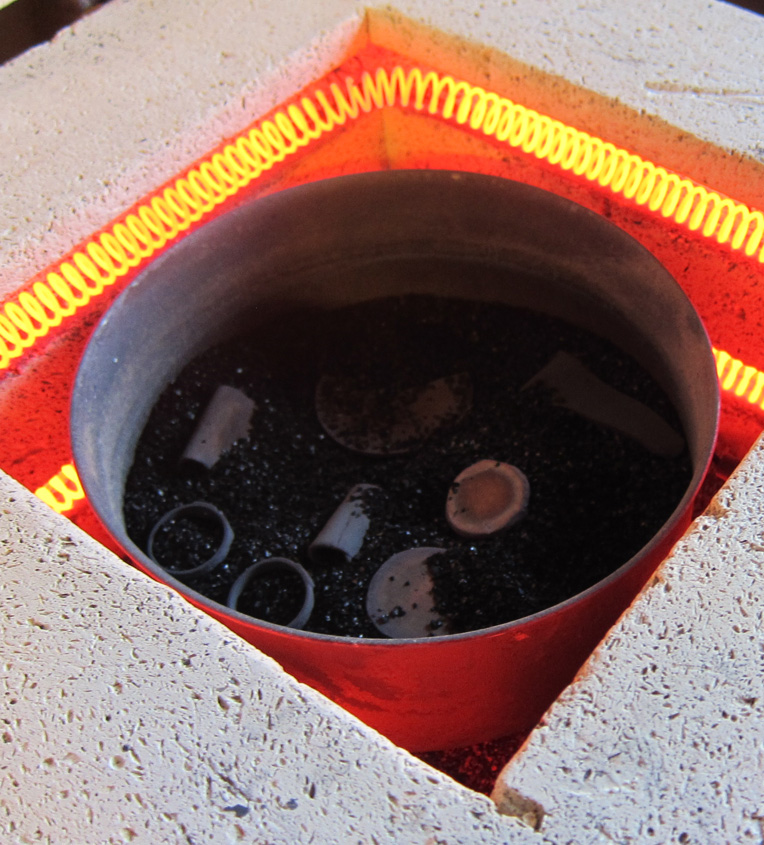
I placed a bowl inside the kiln with copper and bronze pieces resting on top of carbon. Set the kiln to mid-fire schedule.

In the kiln

In the kiln, set to mid-fire schedule

As the kiln reached 500°F I opened the lid to check on the pieces. I kept checking every 100°F. At 800°F pieces started to smoke and turn black.

Smoking

Smoking

Getting black

Getting black

At 1000°F the smoke was gone and the pieces were all black. I carefully turned the pieces over with a spoon to see if they are black on the other side.

Turning over

Turning over with a spoon

The other side still not black

The other side still not black

This one too

This one too

They were not, but they turned black within seconds. I covered them with carbon, closed the door, and let the kiln complete its cycle. Worked great. 2:45 minutes from beginning to end. If the pre-firing is done on a stove-top, this is the time it takes for the second phase alone. So firing this way is shorter and easier than on a stove top.

Covering with carbon

Covering with carbon

If you happen to walk away while the kiln is ramping and come back after it reached 100°F, no problem. Pieces are probably all smoked up and ready for more carbon. Oxidation will not happen if it’s under 1:00 hour, and even if it does, it will be reversed while the pieces are fired inside carbon.

Turning the pieces over is a good idea. Also, it doesn’t matter if the vent hole is open or closed.

Muffle, front-loader kiln

I tried the same thing in a muffle kiln. Surprisingly, the pieces did not show a sign of smoke until the kiln reached 1200°F. At this point the carbon was already on fire. Since it was a front loader, I had to take the bowl out of the kiln to cover the pieces with carbon, which was awkward at this high temperature. And after the second phase, the pieces were not sintered.

I am guessing the reason is the fast ramp of this type of kiln. The chamber got hot, the outside of the pieces got warm, but the inside needed more time. So slowing the ramp may be the answer.

But then I found out something else. I know that firing twice always works, so I tried it again, but with less time. I fired the pieces in carbon at 1510°F for 1:00 hour. It took 1:20 minutes. Took the bowl out of the kiln and cooled the bowl and the kiln under 100°F. Put it back for another hour, and it worked. Another 1:20 hours, plus cooling time. A little longer, but less messy and more successful.

In fact, the easiest way for me to fire in a front loader was to fire 1:00 hour before I went to sleep. In the morning the kiln was cold so it wasn’t necessary to take the bowl out. Didn’t even open the kiln. Just fired one more hour.


May 5 2013

Free Project for Smart Bronze – Solid Ring

New media seem to bring new inspiration. I’ve always leaned toward hollow forms. It never occurred to me that I could work with solid forms, mainly because I was put off by their weight. As it turns out, Smart Bronze is very lightweight after it’s been fired (although not as light as Low-Shrinkage Steel XT), so I decided to give it a try. Once I started, the possibilities seem endless.

Here are instructions for making this ring.

Garnet and Sapphire

The ring weighs 11 grams after firing. The instructions are long, but only because they are very detailed. It’s actually pretty simple.

1. From the ring sizer, pick a ring that is 2½ sizes bigger than your desired size. Trace the inner diameter of the ring with a pencil. (Tip: if you don’t want to separate the ring from the sizer, do it on a corner of a table; this is the only way it’s going to lay flat).

Trace inner diameter

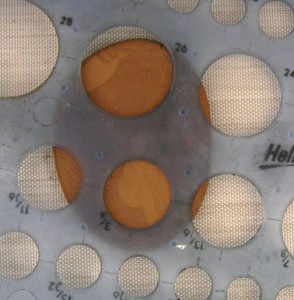
2. Find a tube whose outer diameter is the same as that of your traced circle.

Find a tube

Or: Find a circle template with the same diameter.

Find a circle template

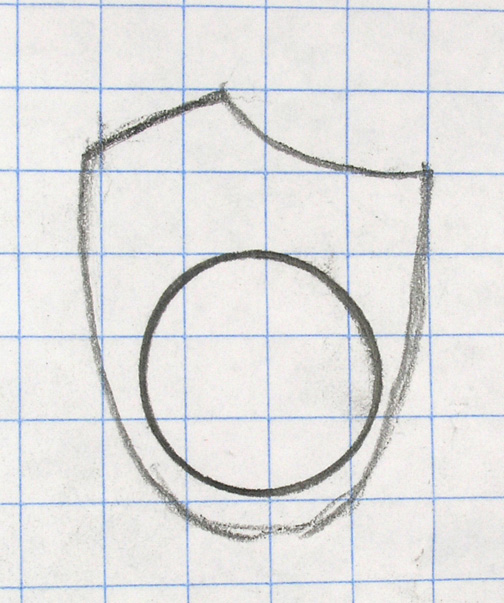
3. Here is the template for the ring:
Template

4. Roll a large layer of Smart Bronze 3 craft sticks thick (18 cards). Cut a circle in it using the tube or the template.
Cut a cricle

Cut a circle

5. Remove the circle. Place the template on top of the layer.

Template on layer

6. To cut the shape of the ring, it’s better to use cutters rather than a knife. Using cutters will help ensure that the cross sections are vertical. Pick a circle or oval cutter that fits the curve on the top right of the ring. Cut this section out.

Cut section out

Cut section out

7. Use a tissue blade to cut the next straight line.

Cut line with tissue blade

8. Use circle cutters to cut away the excess from the layer on the right and left side of the template.

Remove excess with circle cutters

Remove excess with circle cutters

9. Remove the template. If you used a tube to cut the shank, put it back in the hole. This will help prevent the circle from distorting while drying.

Return tube to hole

10. Dry the ring thoroughly, then sand it smooth.

Sand it smooth

11. While the ring is drying, set the stones. You can use any fireable stones. I used an oval natural sapphire and a square natural garnet. For the oval stone, press the stone into a thick patty of clay. Squeeze a drinking straw into an oval shape and cut an oval around the stone. Dry, then sand the bezel to the perfect oval shape.

Set the stones

12. Set the square stone the same way, only use the scraper to cut the bezel around it.

Setting the square stone

13. Attach the bezels to the ring with thick paste. Dry.

Attach bezels to ring

14. Place the ring in carbon, on top of thin fiber paper. Place a piece of fiber paper on top of the shank as well. Cover with carbon, and fire.

Brick kiln: ramp at 1400°F/778°C per hour to 1440°F/782°C. Hold 2 hours.
Muffle kiln: Ramp at 1400°F/778°C per hour to 1490°F/810°C. Hold 2 hours. Make sure the overall ramp time is at least 1:00 hour!

15. After firing, finish the ring following the instructions in the document entitled “Finishing Fired Metal Clay,” available on the right-hand panel of this blog. You can polish it to mirror shine.
Finished ring

Finished ring

Finished ring