Jun 12 2012

What Clay to Use?

I’ve been getting a lot of questions about what clays to use. I admit it’s getting confusing with so many types of clay, but there is an answer to that. I will try to make it as simple as possible.

What Steel to Use and When

Steel on Its Own

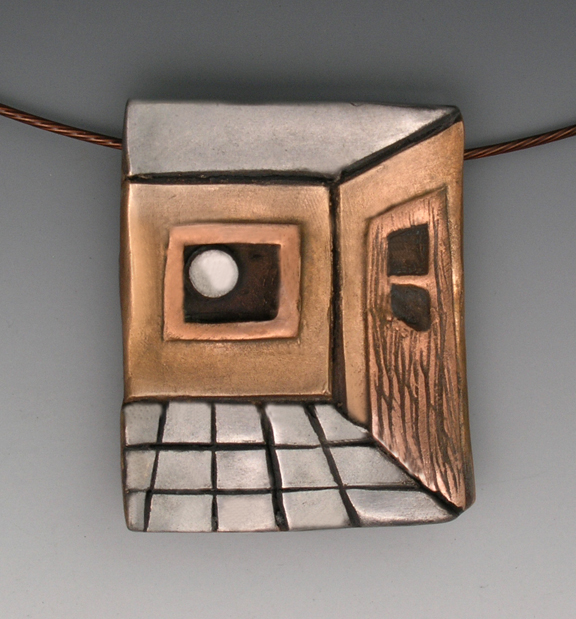
If you are just starting your experience with base metal clay, I would suggest using Low Shrinkage Steel XT. It is friendly and easy to use. Most of the projects that are introduced in my first book: The Handbook of Metal Clay: Textures and Forms (2nd edition), originally written for silver, can be easily done with Low Shrinkage Steel XT.

Room on a View

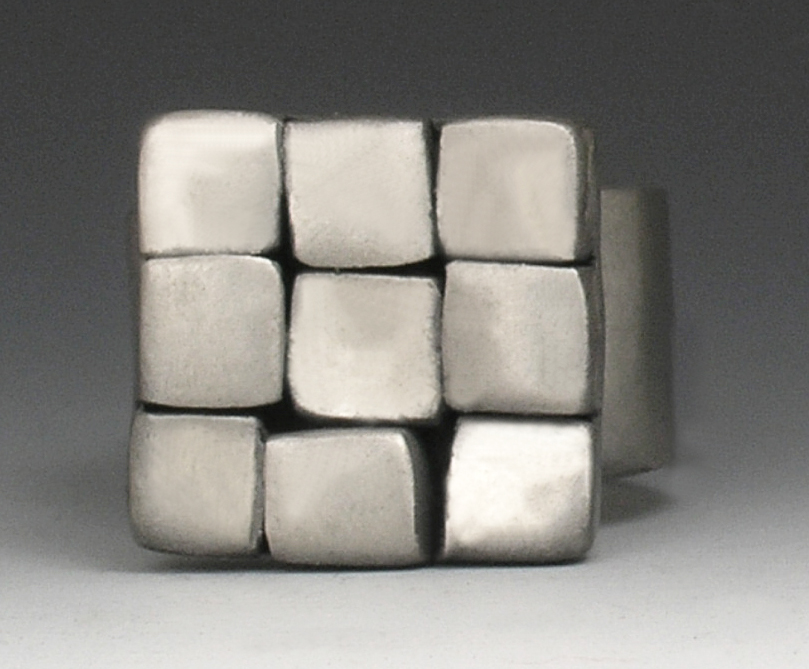
Steel Bricks

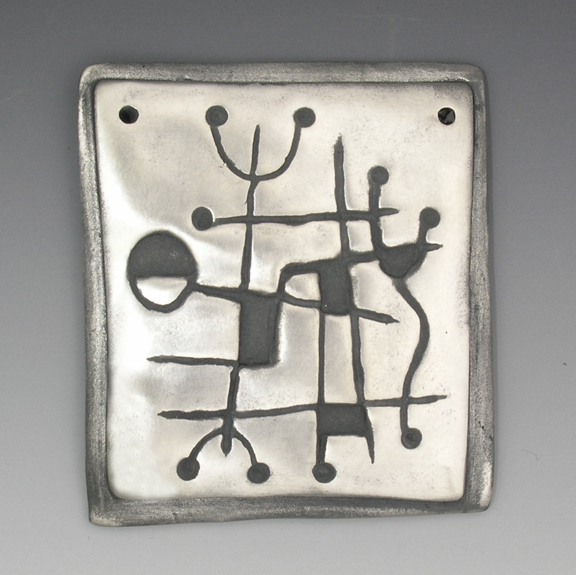
Miro

Circle Pendant

Grout

Steel

Steel Combined with Other Metals

1. Mokume Gane Patterns

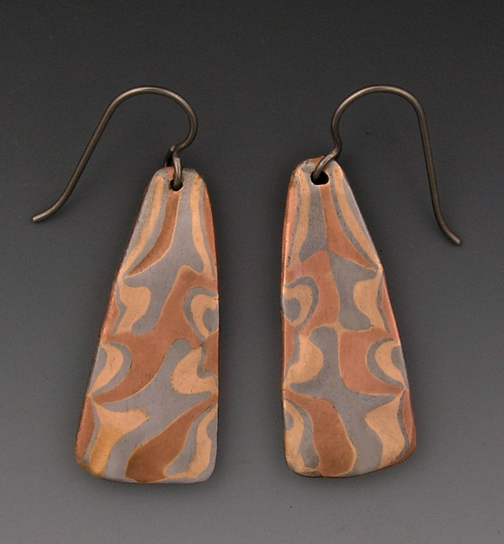
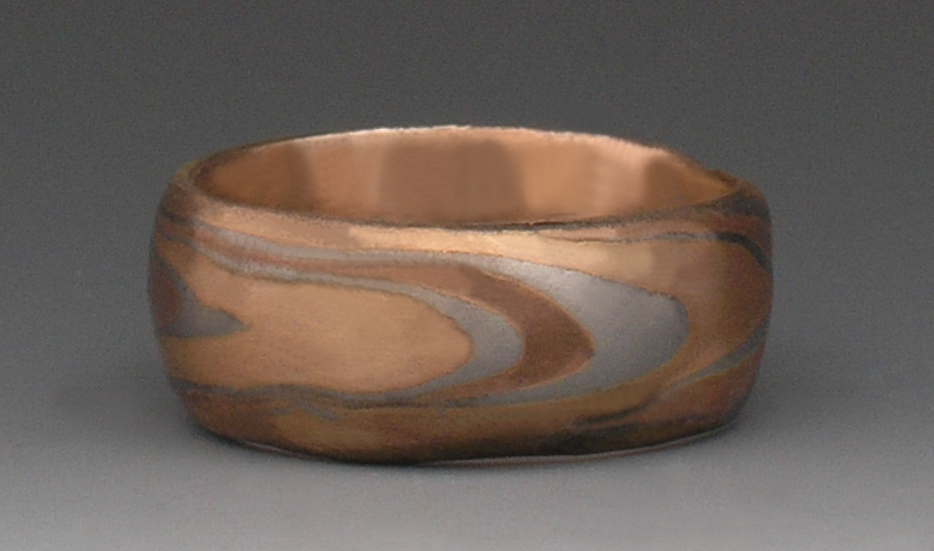
Any of the steels works well with these patterns if it is used in small amounts.

Mokume Gane

Flower with No Twist

Layered

2. Gradients

All steels work well with gradient surfaces. Only Pearl Grey Steel (not XT) works with gradient from steel to White Bronze!

Bird

3. All Other Designs

Low-shrinkage Steel XT is recommended.

If you use it in combination with Quick fire bronze, you will have to fire the steel part first at its high temperature, then add bronze and re-fire at a lower temperature.

Spinner Flared

If you use it in combination with Quick-fire Bronze XT, you can fire them together once, at high temperature.

Skyline

Oval

2 rings

What Bronze to Use and When

Bronze on Its Own

I suggest Quick-fire bronze, since it is fired at a lower temperature and therefore shrinks less.

Bronze CircleHollow Form Earrings

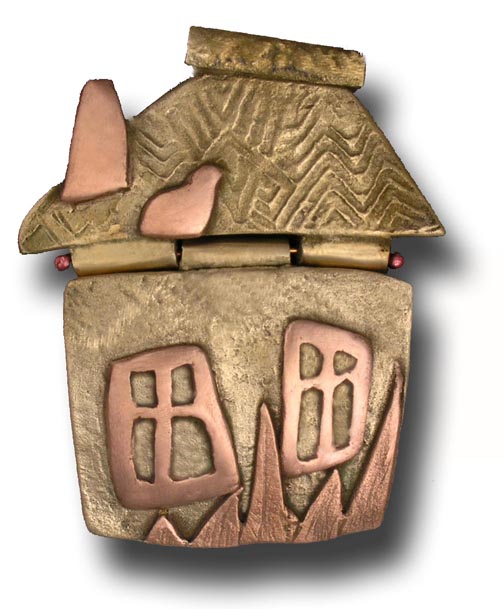
Bronze House

Bronze with Copper

If you are a beginner but want to explore mixed metals, I suggest starting with Quick-fire copper and Quick-fire bronze (not XT). You will find lots of projects in my book: Mixed Metal Jewelry from Metal Clay.. Many of the projects in The Handbook of Metal Clay are “translated” in the second edition to a combination of Quick-fire copper and bronze.

Agates

Collage Mixed Metals

Hinged House

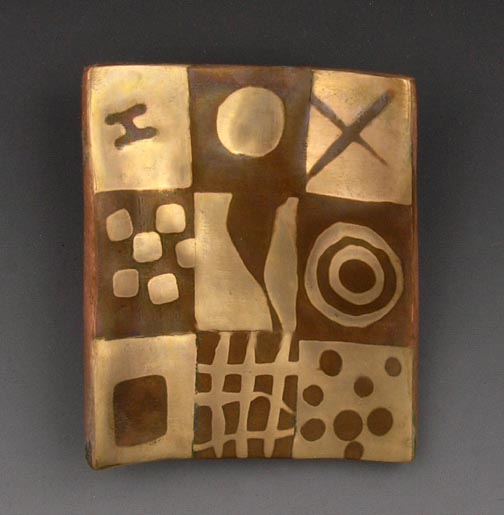
Collage

Bronze with Steel or with Copper and Steel

This is the same as “Steel combined with other Metals” above, with one difference:

In mokume gane patterns, if you use Quick-fire bronze and fire at a low temperature, the color of steel will be black (right earring below). If you use Bronze XT and fire at high temperature the color of steel will be blue (left earring below).

The Pair.

It’s a matter of choice: if you like sharp contrast, use quick-fire bronze and steel (in small amounts) and fire at a low temperature. If you like subtle contrast, use Bronze XT and steel (you can use big amounts) and fire at a higher temperature.

In about a week, A file called “Introduction to Mixed Metal Claywill be available is now available on my blog. It will expand on the firing temperatures when combining different metals.


Jun 11 2012

Low Shrinkage Steel XT Now Available

Low Shrinkage Steel XT

Low Shrinkage Quick-fire Steel XT is now available on my online store.

Low Shrinkage Quick-fire Steel XT shrinks only 10%, like Quick-fire copper. This makes it easy to work with on its own, as well as in combination with other metals. While drying it behaves like copper, with hardly any need to flip it over to avoid warping. Working with multiple layers is easy, since the difference in shrinkage between dry and wet layers is minimal. This is also the case with pieces which require complex construction.

I have always recommended using copper or mixed (scrap) clay as a backing layer when working with more than one clay. This is because their shrinkage rate is lowest. If we use bronze as a backing layer, flat pieces will curve backwards because of the higher shrinkage of bronze. Now Low-shrinkage Steel XT can also be used as a backing layer, whether we use just one clay or more. This expands our possibilities, since copper is not necessarily out aesthetic choice when it comes to designing the major part of a piece.

For example: My choice of copper as a backing layer in the piece below was dictated by its lowest shrinkage.

Houses sun and ocean

Now that I have more freedom of choice, I can use steel instead, as in this locket:

Locket

Back

The locket was made with Low Shrinkage Steel XT as the backing layer, with accents of copper and Bronze XT. It was fired at the high firing schedule of steel.

Both high- and low-shrinkage steel work well in mokume gane patterns.

On another note: My second book: Silver and Bronze Clay: Movement and Mechanisms is now out of print. Being busy with other projects, I have currently no plans for printing a second edition. If you would like a copy of the book, you may still be able to find it at my distributors.

Book 2 cover

And finally, here is a project for a belt ring. If you make it with low shrinkage Quick-fire Steel XT, account for 2 sizes shrinkage (rings don’t shrink like flat pieces).


May 29 2012

Workshops Update

New workshop:

On October 5 – 8, 2012 I will be teaching a workshop in Patterns of Color in Metal Clay and a Master Class in
Mokume-gane Rings, near Hamburg, Germany. Please contact:

http://susand-design.de/
Susan Diana Wilson

+49 41 01 374 502 36 or mobile +49 172 40 28 651
susan@susand-design.com

Very few spots are left in the following workshops:

July 20-22
Krasl Art Center
www.krasl.org
707 Lake Boulevard St. Joseph, MI 49085-1398
(269) 983-0271 • education@krasl.org

Vancouver, Canada
www.artclaycanada.com • carrie@artclaycanada.com
This workshop will take place in July or August. Please contact Carrie at the email above.

September 8 and 9
Martinsville, IN
Contact: Pam Hurst, pamhurst@me.com

October 12-13 (“Introduction to Metal Clay”) and 14-15 (Master Class)
Studio 34 Creative Arts Learning Center
Rochester, NY
www.studio34jewelryartslearningcenter.com • (585) 737-5858

All these workshops will practice projects from my next book (still open to photo submissions).


May 16 2012

Two More Projects for Bronze XT

Overlay and Inlay with Bronze XT

Squares with Bronze XT


May 13 2012

Project for Bronze XT – Onlay

I’d like to thank all the people who offered to help test Bronze XT. Different conditions (kiln, box, carbon, etc.) would have introduced irrelevant variables. We could have never figured out why one tester gets a different result than another tester. As you can see from my last blog posting, even my own kilns showed different results. The clay had to be tested under identical conditions. I do appreciate your willing to help.

To help get you started with Bronze XT, I am in the process of preparing projects for some of the pieces I made during the testing period. One such project has already been published. Here is the second one in a PDF file: “Onlay with Bronze XT“.

Onlay Copper

Onlay Steel


May 10 2012

Three Metals, One Shot: Bronze XT Now Available – Part 3

Bronze XT is now available on my online store in 100-gram and 50-gram jars.

Very Good News:
Since my last posting I have been making the same pieces over and over. As it turned out, the part of my earlier posting that warns about a “bleeding” reaction between copper and Bronze XT at the high-fire schedule was a false alarm. I had observed this behavior in a kiln that turns out to have been over-firing due to wear. My new experiments were repeated in a kiln with a new thermocouple and elements. No bleeding reaction between copper and Bronze XT has occurred ever since then.

Copper next to bronze

Squares

The reaction between copper and Bronze XT at the high-fire schedule is the same as the reaction between copper and regular bronze at the mid-fire schedule; there is some reaction but it is predictable and can be accounted for. You can read all about in in my book Patterns of Color in Metal Clay, pp. 8 and 12.

Please note the following change in the instruction manual and my earlier blog posing, entitled “Bronze XT – Part 1“:

The part that discusses the reaction between copper and Bronze XT (p. 13 in the instruction manual), has now been deleted from the instruction manual. The corresponding part in the “Bronze XT – Part 1″ blog posting has now been stricken out.

So, there is no reason to separate copper from Bronze XT using empty space or steel!

I went back to some of my old pieces and made them again in three metals.

Kandinski

Kalalili

Houses, sun and ocean

This latter piece I had made twice before: once with copper and silver, and once in bronze and silver. In both cases I had to fire the base metal first, then add the silver part using the “hot riveting” and “wraparound” techniques and fire a second time. It’s unbelievable how easy it was to make it this time – like working with a single metal.

You may have noticed that I chose copper for a backing layer in all the pieces that were displayed in the three parts of this article. The reason is that copper is the one which shrinks the least. If Bronze XT or steel were chosen as a backing layer, they would shrink more than the overlay parts, and would either bend backwards or crack. This has always been my choice, even when I used a combination of copper and regular bronze. For now it seems that this is the safe way to go.

I am releasing Bronze XT now with a strong feeling that there is a solid base of resolved issues to lean on. I am going back to working on my book now, to incorporate projects for mixed metals with Bronze XT. I would love to include work of yours that will have been made with this new clay!


May 1 2012

Coming Soon! Bronze XT – Part 2

Quite a few years ago a project of mine was published in Lapidary Journal showing how to make this quilt in silver clay.

Back then only silver clay was available, and things were simpler. The quilt was fired all assembled in one firing. In 2009, when copper and bronze clay became available, I published my third book, Mixed Metal Jewelry from Metal Clay, in which one of the projects (entitled “Quilt”) shows how to make a similar quilt in silver, copper, and bronze. The project involved firing the copper and bronze parts first, then adding the silver parts using a technique which I call “hot riveting,” then firing a second time. There was no way of firing silver and base metal clay all assembled in one firing.

Quilt

Even when steel clay became available, it was still impossible to make this quilt in 3 colors in just one firing, since bronze cannot be fired at the high temperature required for sintering steel clay.

Now that Bronze XT is almost available, it seems that things are starting to become simple again. I repeated the steps from the silver quilt with Quick-fire copper, Steel XT and Bronze XT.

Here are the steps:

1. Roll a layer of copper clay, 3 cards thick (copper should always be the backing layer). Cut it in the general shape of a square, about 2″ x 2″. To make it wavy, fill a plastic bag with carbon or rice, press it with your fingers to create “hills” and “valleys,” and lay the copper layer on top of it. Let it dry.

Copper on bag

2. Roll another layer of copper clay, 6 cards thick. Wet the backing layer only on the sides.

Backing layer wet

3. Lay the new copper layer on top of the backing layer.

New copper layer on backing

4. Cut the top layer to the shape of the backing layer, letting the dry clay lead your knife.

Cut to shape

5. Cut a smaller square inside the bigger one. Remove the smaller square. Since that part of the backing layer is dry, it should be easy to remove. Now you’ve created a frame for the quilt. Dry again.

Frame

6. With a pencil, divide the background layer into 9 more or less equal squares.

Background divided

7. Texture a layer of steel, 6 cards thick. Wet the top left square and lay the textured steel in it.

Top left

Steel in top left

8. Cut the steel into a square, following the pencil lines.

Cut steel

9. Use 2 more different textures for a steel square in the center of the circle and for one in the bottom right.

More squares

10. Fill 3 more squares with Bronze XT, squares all textured differently.

Bronze XT squares

11. Fill the rest of the squares with differently textured copper squares.

Copper squares

12. Dry the piece and sand smooth.

Dry and sand

13. Add a bail. I chose two vertical tubes on the right and left of the back of the piece.

Add bail

13. Pre-fire the piece on a stove top. Move it to the kiln and fire at 1700°F/926°C (brick); 1780°F/971°C muffle).

Quilt


The history of the “Collage Pendant” project

2007: Silver

Collage Pendant

2009: Copper and bronze

Collage, mixed metals

2012: Copper, Bronze XT, and steel

Collage


Apr 28 2012

Coming Soon! Bronze XT – Part 1

Did you ever want to add one or more steel elements to a bronze/copper piece? Whenever I am asked whether it can be done, I have to say: Only if you use it in very small amounts; it has to be fired at a temperature which is too low for a considerable amount of steel to sinter. Bronze needs to be fired at a mid-firing schedule: 1470°F/800°C (brick kiln); 1520°F/827°C (muffle kiln). Steel has to be fired at a high-firing schedule: 1700°F/926°C (brick kiln); 1780°F/971°C (muffle kiln), and will not sinter at a lower temperature unless it is used in very small amounts, as in mokume-gane patterns.

Up until now, if we wanted larger amounts of steel in a piece, we needed to fire the steel first at a high-fire schedule, then add lower-firing clays with some kind of mechanical connection, and re-fire the piece at a lower temperature.

This, of course limits our design options.

Bronze XT changes all that. It looks like regular bronze, but can be fired at a high-fire schedule, at the same temperature as steels, copper and Rose Bronze. That means that it is possible to fire a mix of copper, Bronze XT and steel clays in the same piece without limiting the design and the amount of steel.

The following pieces were all fired just once:

Inlay of steel in bronze as in the photo above is possible only by using Bronze XT.

Wraparound as in the photo above, when regular bronze is used, is only possible with two firings.

And “onlay”, with the majority of the piece being steel. is only possible with Bronze XT.

With architectural pieces the range possibilities is much wider with Bronze XT.

Since Bronze XT is fired at a temperature as high as copper and steel, under-firing is not an issue anymore. If a piece did not sinter, you can be sure now that it is because something went wrong in phase 1 (pre-firing), not because of low temperature in phase 2.

Testing

Fire pieces of Bronze XT at 1700°F/926°C (brick kiln); 1780°F/971°C (muffle kiln). If the pieces blister, swell, or melt, lower the temperature gradually until you reach a good result.

Firing

Firing Bronze XT is the same as with the Quick-fire copper, steels, and Rose Bronze. The Instruction Manual has now been updated to include the Bronze XT firing schedule.

Note: The current version of the Instruction Manual shows all of the changes highlighted in yellow, so those of you who already have the manual can easily see what has changed. The yellow highlights will be removed around the middle of May 2012.

Shrinkage

The shrinkage is the same as that of the steels, 28% by volume. When firing steel, copper, and Bronze XT together, copper will shrink the least. “Onlay” design, with Bronze XT as the major part of the piece, will not work well due to its high shrinkage.

A ring made from Bronze XT shrinks 2½ sizes.

The following section was stricken out on May 10, 2012. For details, please see my posting entitled “Three Metals, One shot: Bronze XT Now Available – Part 3.

Important note:

With both regular bronze and Bronze XT, copper tends to alloy with the tin content of bronze at the contact points between the metals. The alloy is closer to bronze in color, so the fired piece looks like it has less copper then it had before firing. When we fire copper next to regular bronze, at mid-fire temperature – 1470°F/800°C (brick); 1520°F/827°C (muffle) – we can compensate for the alloying by doubling the amount of copper, as described in my book, Patterns of Color in Metal Clay.

This reaction is even stronger at the high firing temperature of Bronze XT. As a result, the bronze may “bleed” onto the copper part.

If the copper is used in small amounts, as in mokume-gane patterns, the distinction between copper and bronze may disappear altogether.

To avoid the bleeding, we can do one of two things:

1. Separate copper from bronze with an empty space:

2. Or, separate copper from bronze with steel:

Separation of the second kind is also needed when you load your extruder to create a mokume-gane pattern. The order of the circles to be extruded should be: copper, steel, bronze, steel, copper, steel, and so on (see my book, Patterns of Color in Metal Clay, pp. 9 and 12.

Since the bronze and copper are now separated, there is no longer any need to double the amount of copper. All three metals can be used in equal or different amounts, depending on the desired design.

A nice surprise is that when Bronze XT is used in a mokume-gane design instead of regular bronze, Baldwin’s Patina does not color the steel black. It darkens the copper only, and the steel looks blue.


Apr 13 2012

Research Underway

I’d like to thank everyone for the beautiful photo submissions you provided for my upcoming book. The book, however, may be delayed due to the development of a new material which may simplify working with mixed metals and expand possibilities. I’m currently testing this material for its behavior around other metals and to discover its full range of capabilities. Upon request, I would be happy to bring samples of the new material to any of my upcoming workshops, in case anyone would like to experiment with it. I am hoping to incorporate projects involving this material in the new book. Hopefully it won’t take too long.


Mar 10 2012

Firing in Layers Can Work

Revisiting my instruction manual, especially the part about arranging pieces in the firing box, I was wondering whether replacing the first phase with stove-top firing makes any difference to how pieces can be arranged in the second phase.

The first thing I tried was to take advantage of the extra space on the bottom of the kiln.

On the Bottom

What you see are small containers made out of stainless steel and silica with one thick piece inside each, 2 in the rectangular one. There is a very thin layer of carbon underneath them, and maybe 1/2″ above. All were pre-fired on a stove-top and then carefully moved to the smaller containers.

A 6″ bowl was placed on top of them. It contained pre-fired pieces arranged in one layer.

Bowl

I fired for 2:30 hours instead of 2, thinking it might take more time for the heat to spread to all the pieces. Every single piece sintered perfectly, including those on the bottom of the kiln, and in the bottom center.

Despite the success of this experiment, I suspected that the pieces on the bottom of the kiln might have sintered because they had a box of their own with very little carbon. So next I tried firing in layers.

I made 21 pieces of Rose Bronze, each 12 cards (4 mm) thick, with a diameter of an average ring – 7 circles, 7 squares, and 7 triangles.

I placed the 7 circles on a very thin layer of carbon on the bottom of my 6″ SS firing box (it’s a pet dish). One piece was in the center. I pre-fired them on a camping stove.

I added a 1″ (maybe less) layer of carbon and arranged the squares the same way. I pre-fired these as well.

I added a third layer of carbon and pre-fired the triangles.

After adding another layer of carbon I went on to phase 2. This time I fired for only two hours. Firing temperature was 1700°F, the appropriate temperature for Rose Bronze.

This morning I sanded each one of these pieces, front and back, with a coarse sanding band, 120 grit. There was not one unsintered spot in any of them!

Sanded 1

Sanded 2

The overall weight of the pieces after firing was 150 grams. That’s one and a half jars of powder. Also, all pieces shrank by 10%.

This all sounds great, but some reservations should be made. As you can see in the photo, my kiln is 6.5″ x 6.5″ x 4.5″. The heat distribution is better than in larger kilns. In larger kilns, the results on the bottom and in the center of the kiln may be different. This requires more experimentation.

It seems to me that most sintering issues are caused by poor binder burnout. When phase 1 of the firing process takes place in the kiln, in layers, pieces in the bottom have hardly any chance of loosing their binder because of lack of oxygen. Stove-top pre-firing takes care of that.

Please note: Torch-firing instead of stove-top firing is not recommended. The reasons are explained in my posting Shortening the Firing Time.

In a previous posting I said that my electric bill was cut by 40% since I started to fire on a stove top (not to mention the time saved). I wonder how much we can save by firing in layers.

I will continue to experiment. It would be helpful if you could tell me about your own experience with larger kilns. When I have more data, I’ll post an updated version of the instruction manual.