Sep 17 2012

Brilliant Bronze Follow-up – How to Finish Fired Metal Clay

Following my previous posting about the launching of Brilliant Bronze, I have been asked to post a photo of regular Quick-fire bronze next to Brilliant Bronze:

BB vs. Bronze

The long rock on the pendant is made from Brilliant Bronze; the rock on the left is made from regular Quick-fire bronze. When I looked at the photo, I noticed that the bronze rock looks a little bit like Rose Bronze. I then took another photo with Rose Bronze and copper:

BB vs. the Rest

From left to right: Copper, Rose Bronze, bronze, and Brilliant Bronze.

I have also been asked how to give Brilliant Bronze a mirror finish. In fact, I am often asked how to retrieve the color of pieces that just came out of the kiln. The first project in almost all my books describes the finishing process, but it seems to be often overlooked. I’ve long been meaning to consolidate all this material into a single article, and have it as a permanent link on my blog. So here it is. This document is linked in the right-hand pane of my blog, as “Finishing Fired Metal Clay.”

Even if you are familiar with the finishing process, I suggest that you read it through to refresh your memory. I have been teaching it ever since I started teaching silver clay in the year 2000, but sometimes we get to the finishing part at the end of the workshop, when people are tired and ready to go home. I also recommend it for anyone who intends to take a workshop with me in the future. It will give you a better idea of what to expect.

The tools required for using this process, and their sources, are listed in the document entitled “Personal Tool Kit,” which is also linked from the right-hand pane of my blog. This file has been updated to include tools required to achieve a mirror finish.


Sep 15 2012

Brilliant Bronze Is Now Available

Hadar’s Clay™ quick-fire Brilliant Bronze (golden color bronze) is now available on my Online Store. Since Brilliant Bronze works pretty much like quick-fire bronze, I have not updated the instruction manual; instead, there is a link to Instructions for Hadar’s Clay™ Brilliant Bronze in the right-hand pane of this blog. It’s only one page, which you can print out and add to your printed instruction manual for Hadar’s Clay. Instructions for Hadar’s Clay™ Brilliant Bronze have now been incorporated in the latest version of the Instruction Manual.

Flat pieces of Brilliant Bronze shrink 23.5%; rings shrink 2½ sizes.

Please be sure to make test pieces. If you see ant blistering on smooth pieces, drop the temperature by 5-10°F (3-6°C). This won’t have any effect on the sintering of other metals that are fired in the same piece.

Brilliant Bronze can be combined with other metals, just like regular bronze. For details, please refer to the documents Introduction to Mixed Metal Clays and Which Clays to Use and When, linked in the right-hand pane of this blog.

All the projects in my upcoming book, Metal Clay Practice, can be made with either regular bronze or Brilliant Bronze.

Here are some more samples:

Cracks with Black

I had to make this one again with black star diopside.

Wedding Ring

Wedding Ring 2

Eggshell Ring

Holey Ring

Holes

Wire Ring

The ring above, which looks like it’s wrapped with wire, is only a texture. Look it up in The Handbook of Metal Clay: Textures and Forms, second edition, p. 48.

Ball Earrings

Solid balls from Brilliant Bronze and low-shrinkage Steel XT, with gold wire balled up at the ends. For instructions on how to make the balled-up wires invisible see my book Mixed Metal Jewelry from Metal Clay, p. 18.

Necklace

Necklace 2

Bead necklace from Brilliant Bronze, White Bronze, and low-shrinkage Steel XT.

Twist and Slice

Mokume-gane style earrings from copper, low-shrinkage Steel XT, and Brilliant Bronze.

Stack

2 Rings

Flared

Flared 2


Sep 13 2012

Which is the Gold Ring? – Brilliant Bronze Follow-Up

Most of you referred to this photo only:

Two rings

The ring on the left is Brilliant Bronze. The other is my gold wedding ring.

Two rings together

In this second photo, the top ring is Brilliant Bronze. The other is my husband’s gold wedding ring.

Here are some more samples:

Cracks

The stone is natural sapphire, fired in place.

Cracks ring

The texture is the “egg shell”. You can find the instructions for this texture in my book: The Handbook of Metal Clay: Textures and Forms, second edition, p. 77.

Holes ring

Both rings are photographed next to my wedding ring, which is 24K gold.

Miro

This one is my Miró piece. You can find the project in the book mentioned above, p. 53.

I photographed it again in daylight next to my ring, since I could not avoid the glare in my light tent. That’s why the background is blue.

Miro and ring

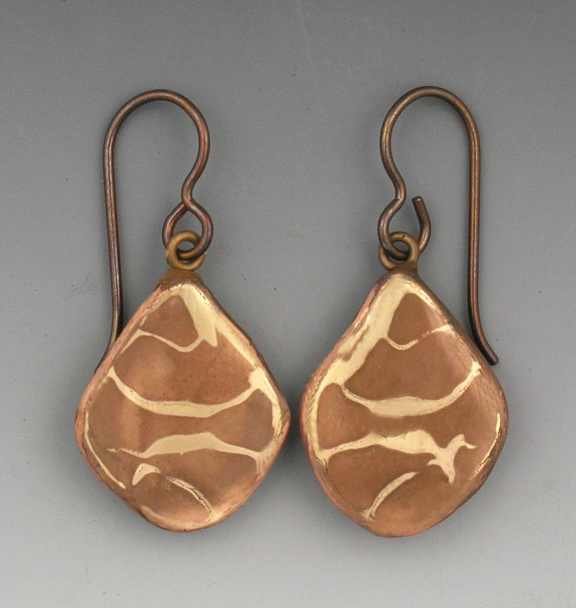
Copper bronze earrings

This is Brilliant Bronze in combination with copper. The contrast between copper and gold color is stunning.

However, there is no contrast more amazing than gold and black. Here is my pièce de résistance: two hollow forms, one steel, one Brilliant Bronze.

Rocks

Brilliant Bronze will be released early next week with instructions. In general, it fires exactly like regular Quick-fire bronze, and can be combined with other metals in the same manner.

Because of the difference between kilns, I suggest that you make a test piece first and fire it at mid-fire schedule. If the piece gets blistered or textured, drop the temperature gradually by 5-10 F. This decrease in temperature will not affect the neither the sintering of copper, nor that of steel, if it is used in small amounts.


Sep 12 2012

Which is the Real Gold Ring?

Brilliant Bronze vs gold 1

Brilliant Bronze vs gold 2

One of the rings in each photo is pure yellow gold; the other is made from my new bronze, which I named “Brilliant Bronze” because of its brilliance.

Hadar’s Clay Quick-fire Brilliant Bronze will be available very soon. More photos and instructions coming soon!

Brilliant Bronze


Sep 8 2012

Second Free Project: Multicolor Lentil II

It’s Friday, 11 p.m. ET and I am stuck at Dayton, Ohio airport because of weather conditions. I’m on my way to Martinsville, Indiana, to teach a workshop at 10 a.m. tomorrow. Thank God for Internet access. What better way to pass the time than posting the second project in the series. Much better then playing with fire after a sleepless night. Which I may have to do anyway. By the time you read this I’ll probably be back home, but who knows, the storm doesn’t seem to be going away.

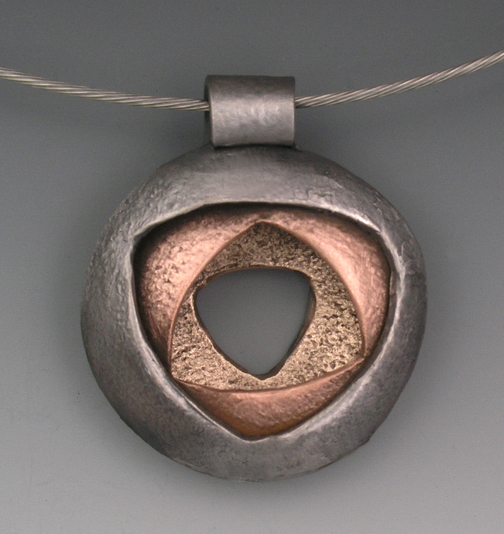
So this lentil is also made with copper, Bronze XT, and low-shrinkage steel XT. They seem to work pretty well together. You will also need a doming mold and a trillion-shaped cutter or template.

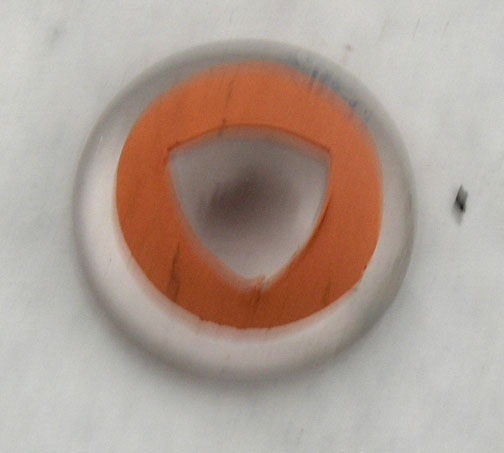
1. Roll a slightly textured layer of steel, 3 cards thick. Cut a circle the size of your choice, and dome it over the doming mold. Using the trillion-shaped cutter or template, cut a trillion shape in the middle.

Trillion

2. Remove the trillion and return it to your storage. Dry the steel dome.

Remove the trillion

3. Roll a slightly textured copper layer, 3 cards thick, and cut a smaller circle.

Smaller circle

4. Dome the copper circle and cut in it a smaller trillion shape.

Smaller trillion

5. Remove the cut-out trillion and return it to your storage.

Remove cut-out trillion

6. Place the dry steel dome on the copper one. Make sure that all of the cut-out area in the copper shows through the cut-out area in the steel dome. If it doesn’t, repeat step 4 with a smaller trillion shape.

Cut-out shows through

7. Repeat step 1. Repeat it again with a bronze XT circle, slightly smaller.

Repeat step 1

8. Place the bronze circle on top of the steel one, with the textured side of both facing down.

Bronze on top of steel

9. Dome both circles on the same mold.

Dome both circles

10. Cut yet a smaller trillion in both circles. Dry.

Smaller trillion

Smaller trillion - dry

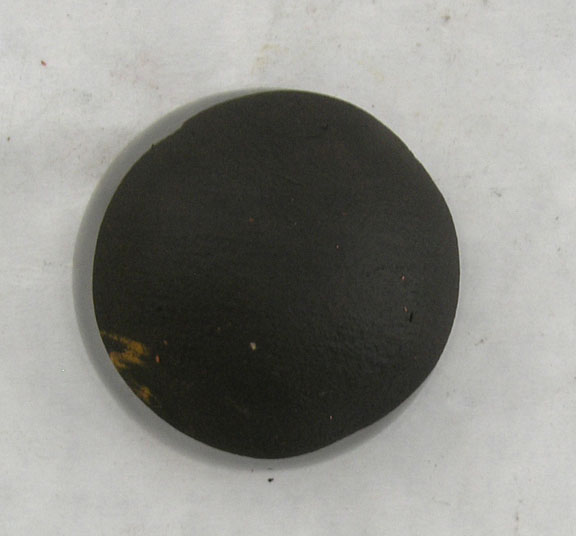
11. The back of the lentil is 2 sided: the outside is steel; the inside is bronze.

Back is 2-sided

12. Rub the two half-lentils on a piece of 150-grit sandpaper, using a figure-8 motion, until their edges are flat and they fit each other perfectly.

Rub on sandpaper

13. Join the two halves with water, and dry.

Join and dry

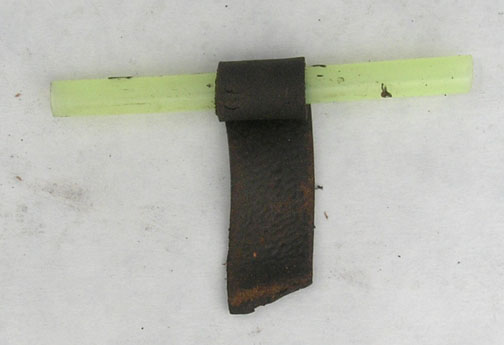
14. Make a bail with a “tail”, over a cocktail straw.

Bail with a tail

15. Attach the bail to the top of the lentil.

Attach bail to lentil

Bail attached, rear view

16. Cut away the excess from the “tail.”

Cut away excess

Bail minus tail

17. Fire the lentil positioned on its narrow side, using high-fire schedule.

Fire the lentil

18. Clean the pendant with radial discs mounted on a screw mandrel.

Finished pendant

2 a.m. now. Storm has gone somewhere else. Time to go. Wish me luck tomorrow.


Sep 4 2012

Free Project: Multi-Color Lentil Earrings

As I promised, here is the first project. But first, a message to our customers in and around the UK: Craftworx is now stocking the full line of Hadar’s Clay and will have the new book as soon as it’s available in early October.

Now on to our regularly scheduled program!

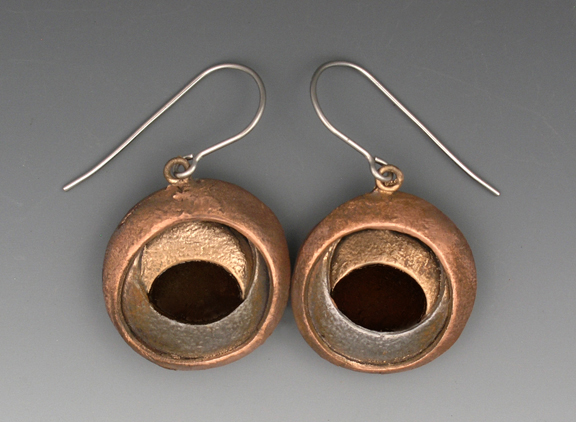
The project is made from Quick-fire copper, Quick-fire Bronze XT, and low-shrinkage Steel XT. Regular bronze (mid-fire) cannot be used in this project, since the earrings are fired at high-fire schedule because of the large amount of steel that is used in them. Steel has to be low-shrinkage so it can shrink at the same rate as the copper and bronze.

You will need 4 dome molds to shape the lentils, and many circle cutters in different sizes, including tubes and straws.

1. Roll a layer of copper, 2 cards thick, over a slightly textured sheet, such as fine sandpaper. (The texture will make it easy to clean up the earrings after firing.)

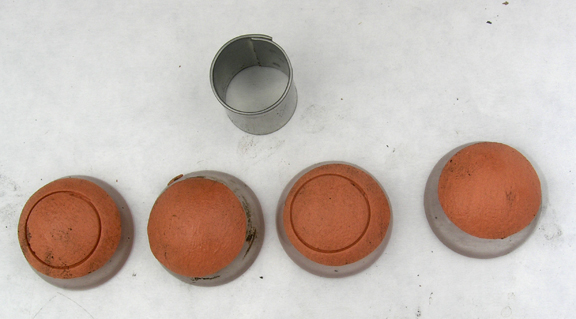
2. Cut 4 circles out of the copper sheet, at the desired size of the earrings, and dome them over the molds.

Circles domed over molds

3. Pick a smaller circle cutter, and cut a circle in two of the copper domes, off-center. Remove the cutout circles. Do not cut the smaller circles before you dome the bigger ones; otherwise, the larger circles will lose their shape once you pick them up! The circles with the cut-outs will be the front parts of the earrings. The other two will be the back parts. Dry them all. If you can’t use a heating pan, dry in the air, with a hair dryer, or in a vegetable dehydrator.

Domed circles with cut-out circles

4. Once the cut-out domes separate from the molds, remove them and continue to dry them on a heating pan.

5. Repeat step 1 with steel clay. Use a smaller circle cutter than in step 3 to cut 2 circles. Lay the circles on the same dome molds as before. It is important that the curve stays the same!

Steel circles on domes

6. Use a smaller cutter than in step 5 to cut a circle, off-center, in each steel dome.

Steel domes cut out

7. Wet the steel domes with a paintbrush. Pick a dry copper dome and lay it on top of the steel one, so the wider part of the steel shows through the hole in the copper dome. Repeat this with the other earring. Then dry again.

Copper on top of steel

8. Repeat step 1 with Bronze XT. Pick a smaller cutter than in step 6 and cut 2 circles. Dome them over the same mold.

Bronze XT domed

9. Pick a smaller cutter than in step 8 and cut a circle, off-center, in each bronze dome. Remove the cut-out circle.

Cut-out bronze

10. Wet the bronze circles. Pick up the copper and steel domes, stacked, and place them over the bronze domes, so the larger area of the bronze shows through the steel hole. Dry.

Stack copper and steel over bronze

11. Rub all 4 domes on a piece of 150-grit sandpaper, using a figure-8 motion, to flatten the edges of the domes. Once you get a perfect fit between each 2 parts, join them together with water.

Join them together

12. Drill a hole at the top of each earring and insert a bronze wire eyelet or embeddable. Seal the hole and dry.

Insert embeddable

13. Fire the earrings positioned on carbon on their narrow end. Use the stove-top method for first phase, then fire in the kiln at high-fire schedule.

14. Finish the earrings by cleaning them with 2 radial discs mounted on a screw mandrel. They will be able to reach all hidden spots.

Finished

Good luck! Please don’t hesitate to contact me if you have questions about this project.


Sep 3 2012

A Few Updates

Travel-Teaching Schedule

My travel-teaching schedule for 2013 has been updated. You can access it at any time from the right-hand pane of the blog. Please note the two workshops a new workshop in Europe the UK next September:

The first: CANCELLED

Ateljé KARL, Sweden
September 6-8
www.ateljekarl.se
Contact: Anneli Raninen Lundberg, anneli@ateljekarl.se, 070-547 43 52

and the second:

Craftworx Studio, UK
September 11-12, 13-15
Contact: Tracey Spurgin, tracey@craftworx.co.uk, 07961 883115

I also added the contact info for the class in Newfoundland and Labrador CANCELLED.

City Of Rings

I recently received an email from Lili Gabbiano about a blog posting of hers. She has done some Photoshop on my “City of Rings” photo, which I thought was cute. Here it is:

Here is the link to her blog.

This is the original photo:

This “Silver City” is about 10 years old. I am still very attached to it, but things have happened in the past 10 years, and now I have a new Ring City, made entirely with base metal clay.

My Website

I have updated the gallery part of my store. A new section has been added called, “Mostly Steel,” which shows work done with steel, copper, and Bronze XT. You can see it here.

New Projects

The holidays are almost upon us, and many of you are probably busy with shows. I am about to release a few projects that did not get into my upcoming book. Hopefully they will make a nice addition to your display. Working on them right now. Please stay tuned.


Aug 21 2012

My New Book

My new book: Metal Clay Practice has just gone to print and is available for pre-order on my Online Store. My printer estimates availability by early October.

Here are photos of the front, back, and inner cover:

The book includes over 55 new projects for mixed metal jewelry, including lots of rings and some projects for a larger extruder. I chose the title Metal Clay Practice because I’ve been teaching many of these projects over the past year and have seen how students practice them and come up with their own beautiful designs and interpretations. Many photos of their work are included in the book. I also believe that making these projects can help both people who practice metal clay for fun and those who practice it for a living.

Please Note: Pre-orders should ship by early October. If you combine any other items with your pre-order of Metal Clay Practice, those items will be shipped along with the book following the book’s publication date. If you need additional items prior to the book’s publication date, please place a separate order.


Jul 4 2012

Architextural Jewelry Intensive

It’s a bit early, but my January intensive is filling fast. It hasn’t been officially announced, but it has been on my online store for quite a while.

It’s a 5-day intensive taking place at my studio in Berkeley, CA, on January 12-16, 2013. The focus will be pictorial and architectural jewelry. We will make at least two pieces, one flat and one 3D. The flat pieces involve using perspective, while the 3D involves constructing hollow forms, including rings.

The pieces are mainly constructed of low shrinkage Steel XT, copper, bronze, and Bronze XT.

The main requirement is experience with metal clay, specifically in base metal clays. No drawing skills are required! Here are some samples.

Castle Quilt

Castle Ring

Open

Skyline Bronze XT

Rose Bronze Ring

Architectural Rings

Room on a View

Rose Bronze House

Hundertwasser

Emerytown

Brick Ring

3 Rings

Sweet Thursday

An interactive piece may be included. These are a few views of the same piece:

01

02

04

06

05

I will be in touch with the participants closer to the workshop regarding toolkit and places to stay.


Jun 25 2012

Two Files Added to My Blog – Instruction Manual Updated

As promised, the presentation I gave at the PMC Conference, entitled “Introduction to Mixed Metal Clay,” is now available on my blog. To access it, click on “Intro to Mixed Metal Clay” in the right-hand pane of my blog, under “Presentations.”

The previous posting: “What Clay to Use?” is also available as a PDF file for easy access. To access it at any time, click on “Posting Reprint: What Clay to Use” in the right-hand pane, under “Other Information.”

By the way, the Instruction Manual for Hadar’s Clay has been updated with a few small changes and additions. The new version features the dateline “June 2012” on the title page, and the new or changed sections are highlighted in yellow. To save paper, you can simply print out the pages that contain yellow highlighted text – you don’t have to print the entire document if you don’t want to.

The Instruction Manual can be accessed by clicking the link above, or from the right-hand pane of this blog.