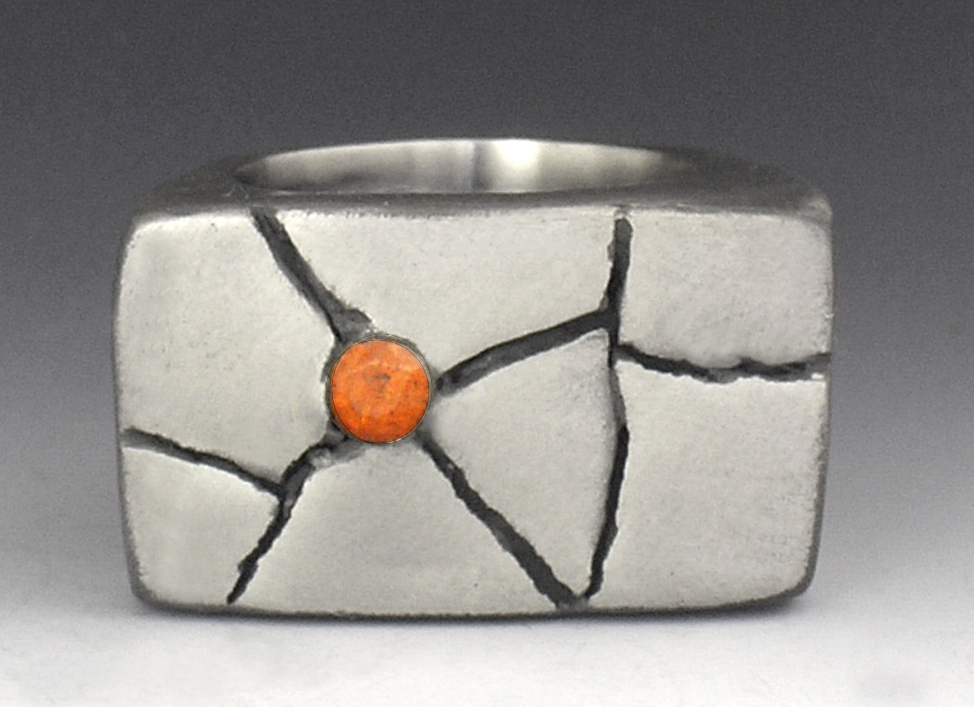
Feb 28 2012

Information About Two Upcoming Workshops

This posting is in regard to two specific upcoming workshops.

The first is the Rings Workshop at the PMC Conference on June 19-20.

I have emailed all the participants with information about this workshop, including the required toolkit. Since it was a bulk email, it may have reached your spam folder. If you have not received my email but are reading this posting and taking this workshop, please contact me immediately at hadar@pacbell.net.

Two of my favorite kilns will be available for sale at the end of this workshop. They are new, and will be tested, programmed, and used at the workshop only. The cost is $490 each. These are offered to any buyer, not exclusively to workshop participants. If you are coming to the conference and interested in one of these kilns, please contact me. It is possible for me to bring more kilns if requested. The last date for them to be picked up is by the evening of June 21.

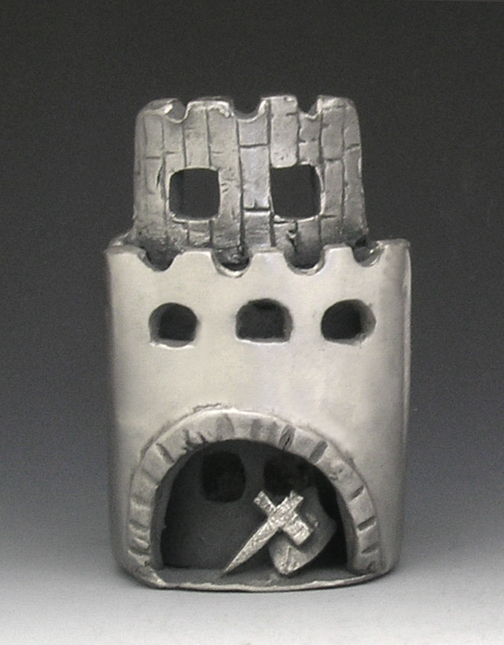
The second workshop is taking place at Krasl Art Center in St. Joseph, Michigan. There have been a lot of requests for another “architectural” workshop since the intensive at my studio in January. Unfortunately I can’t schedule another one at my studio until next January, but that will be the focus of the 3-days workshop at Krasl. This workshop is not until July, 20-22, but the workshop is limited to a small number of students and some spots are already taken. The art center has just released the information. If you are interested, the contact info is:

Krasl Art Center
707 Lake Boulevard
St. Joseph, MI 49085 USA
(269) 983 0271 (updated 3/8/2012)
education@krasl.org (updated 3/8/2012)

Photos from the last workshop can be seen in my posting entitled Report from Architectural Jewelry Workshop.


Feb 22 2012

Old Pearl Grey Steel is Back

Upon request by several customers, Pearl Grey Steel (not XT), which was discontinued at the beginning of the year, is back on the shelves and available on my Online Store.

This type of steel is best used in a mixed metal piece because of its lower shrinkage rate. It is especially recommended for gradient surfaces.

Gradients

Mokume-gane Bird

Ocean View

Gradient

Over the past few days, I tried over and over to make this last piece using the other steel clays, but with no success. I would like to thank Susan Weirather for alerting me to this problem and for her patience and perseverance while trying to solve it.

Projects for this type of gradient surface can be found in my book Patterns of Color in Metal Clay.

Please note that Pearl Grey Steel (I am not referring to XT) is not as strong as Quick-fire Steel XT and Pearl Grey Steel XT when the Pearl Grey Steel is fired on its own.


Feb 12 2012

Flexible Clay, a Bigger Extruder, and Submissions for a New Book

Flexible Clay

It has come to my attention that people are experiencing some difficulties making flexible clay. The last third of my book, The Handbook of Metal Clay: Textures and Forms (2nd edition) is dedicated to projects for flexible clay. You can also watch the following YouTube video about flexible clay:

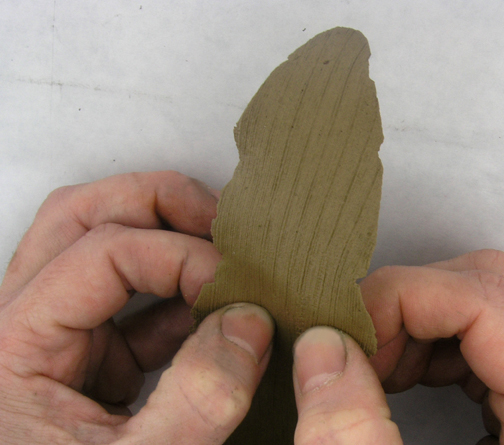
I’d like to add some information here that is missing from the book. After letting the flexible layer or wire dry in the air, I refrigerate it for a while, even overnight. When you take it out, you can feel some “knots” in the wire or stiffer areas in the sheet. Wiggle the wire with your fingers over the whole length to release these spots. Wiggle the layer in different spots and different directions to release the stiff areas.

Wiggle 1

Wiggle 2

This is hard to capture in stills, but I hope you get the idea. Store extra sheets and wire in the refrigerator, and they will stay as flexible as leather.

Bigger Extruder

Here are some things that I’ve been making with an improvised big extruder.

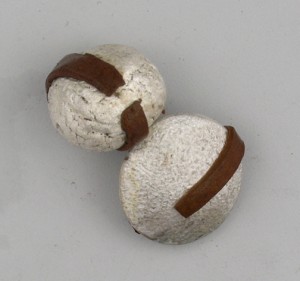
Large color-patterned beads:

Large color-patterned beads

A color-patterned hairband almost as big as a cuff (a cuff bracelet would work as well):

Hairband

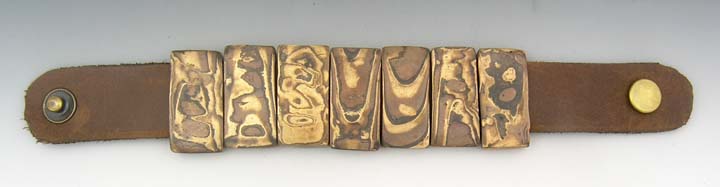
A set of bracelet links extruded all at once (featured in my last book):

Bracket links

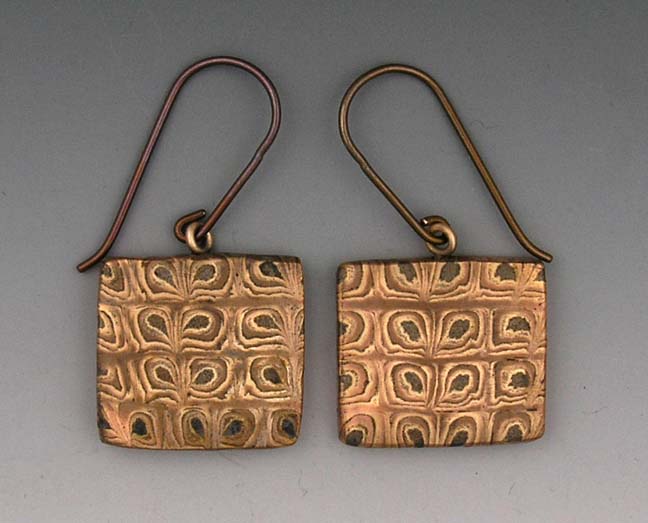
A new design that I call Cat’s Eyes, which can only be done with a bigger extruder:

Cat's Eyes

And a new design that I call “Bricks”:

Bricks

Bricks

Bricks

I contacted Makin’s Clay about making this extruder. I have all the specifications, measurements, prototypes of dies, 2 types of bead extruders (tube adapters), and a link extruder that may be able to extrude bracelet links with two side holes. They sounded enthusiastic at Makin’s, but so far have not asked me for these details. This information is free! All I want is for an extruder like this to be commercially available, since building an improvised one is not as simple and cheap.

In any case, I will be happy to share the specs and information with you in upcoming workshops.

New Book – Call for Submissions

I am currently working on my next book. The book will be a kind of an inventory of new color patterns that have been made with metal clay, focusing on rings and mirror-image earrings. Please send me photos of anything beautiful that you have done with color combination (pieces with no combination will be considered as well).


Jan 13 2012

Report from Architectural Jewelry Workshop

Though I have been making architectural jewelry for many years, this January was the first time I taught it as a workshop, and in base metal clay. It was a very intense five days. Some stayed in the studio to work late into the night, while others started very early in the morning. For all of us time passed very quickly. Time was short, and projects were complicated. I was stunned by the originality of ideas and by the quality of the work that was created during those five days. At the end of the third day I was able to take some photos of pieces that went through preliminary finishing. Everything that was done in the last 2 days was either not finished or not fired yet; I hope to post more photos later. I’ll let the pictures talk. They are presented in the order they were taken and the order of the projects. All are made with copper, bronze, rose bronze, and steel clay.

Room Project

Rhonda Room

Rhonda Wyatt

Cindy Room

Cindy Pope

Nellan Room

Nellan Roberts

Tina Room

Tina Langan

Marie Room

Marie Green

Pamela Room

Pamela Pollock

Pamela Room

Pamela Pollock

Ring Project

Rhonda Ring

Rhonda Wyatt

Nellan Ring

Nellan Roberts

Pamela Trailer

Pamela Pollock

Pamela Ring (Back)

Pamela Pollock (rear view)

Cindy Ring

Cindy Pope

Cindy Ring

Cindy Pope

Marie Ring

Marie Green

Tina Castle

Tina Langan

Trish Ring

Tricia Simmons

Trish Ring

Tricia Simmons

House Project

Pamela House

Pamela Pollock

Nellan House

Nellan Roberts

Skyline Project

Nellan Skyline

Nellan Roberts

Group

Bye, ladies, I miss you already!


Jan 1 2012

New Products and Updated Instruction Manual

The new Hadar’s Clay™ products are now available on my online store. The Instruction Manual has been updated, and the new version is marked “January 2012” on the cover page.

Be sure to always download the Instruction Manual from this blog only, as there appear to be many outdated versions in circulation online!

Since some readers have expressed confusion regarding the new products, here are a few clarifications.

Steel Clays

The old Quick-fire Steel and Pearl Grey Steel have been discontinued. Everything you could do with those products can be done with Quick-fire Steel XT (NEW) and Pearl Grey Steel XT. Both of these products are available in 50 and 25 grams.

Steel XT 50 grams

Steel XT 25 grams

PGS XT 50 grams

PGS XT 25 grams


These clays are improved versions of the discontinued clays.

1. Both can be fired on their own. The result is very strong. Quick-fire Steel XT can be hammered into shape after firing.
2. Both can be fired in combination with other metals under the required conditions, as specified in the instruction manual.

How can you tell one from the other?

The color of Quick-fire Steel XT is black. The color of Pearl Grey Steel XT is gray.

Color of Steels

After firing, Quick-fire Steel XT can be hammered into shape and drilled. Pearl Grey Steel XT is too hard for that. Other differences are yet to be discovered. Their consistency is the same. They are both used and fired in the same way. When fired on their own, they result in a gray, silvery look; when fired in combination with other metals, they will be black if patina is applied.

Torso

Layered

Rectangular Earrings

Both shrink by 28% when fired on their own; rings are very strong and shrink by 3.5 sizes. Since the fired metal is porous, it holds oil very well, which, in turn, helps avoid corrosion. Please refer to the full firing and finishing instructions in the Instruction Manual.

3 Rings

Why choose one over the other?

This is a matter of personal preference. As stated above, their full potential is yet to be discovered.

Because of the high shrinkage of the steel clays, some distortion can happen while firing in carbon. The Instruction Manual shows how to construct a simple cage to fire them in.

What if I still have the discontinued clays?

If you still have the discontinued clays, you can use them up the same way you’ve been using them until now. I believe the discontinued clays may still available from some of our distributors at the old price while supplies last.

Flex Series

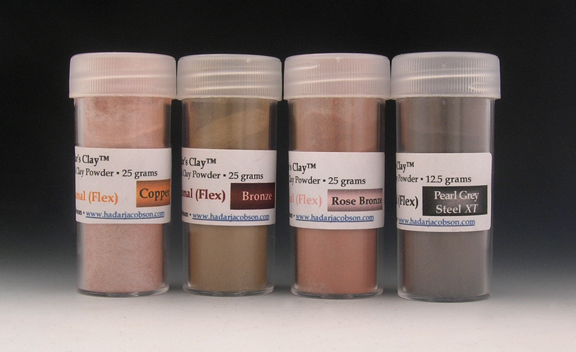
The series of clays that are most suitable for flexible clay (known as Traditional or Flex) has been expanded to include Rose Bronze and Pearl Grey Steel XT as well. There are now 4 Flex clays (copper, bronze, Rose Bronze, and Pearl Grey Steel XT).


The entire series is also available now as a sampler kit containing one small bottle of each.

For more photos of pieces made with the new clays, please see my earlier blog posting.


Dec 20 2011

Project for the Holidays

So Jenny asked how I made the swirl earrings that accompanied my previous posting.

Swirls

If you have some free time over the holidays, here is the project. I have made it twice more, once with a combination of copper and White Bronze, and once with a combination of copper, bronze, and the new Quick-fire Steel XT.

But before I turn you loose with the project, here are a few announcements:

1. A workshop in Sierra Madre, California, was added to my schedule. The dates are June 2-3, 2012. Contact: Ketarah@earthlink.net at MASSC.

2. The “architectural” intensive at my studio is full. Next intensive is in March. Next year’s workshops will combine architectural designs with patterns of color, as shown in the photo below.

Architectural Rings

3. Because of a scheduling conflict, Holly Gage’s teaching engagement at my studio will only include the workshop “Jewelry that Rocks.” The dates are February 13-14.

Green-Red CD Necklace

Now for the project.

Swirls Copper WB

Cu-Br-St

1. Make a disk for your extruder with a square hole, 3×3 mm. You can also use a circular hole of about the same size.

2. Make the stack and extrude it.

021

3. With your fingers taper the end of the cane (the one that came out of the extruder first). Coil the cane around itself. If you used a circular hole, flatten the coil now.

4. Repeat step 2. Coil the cane in the opposite direction. Do not get tempted to extrude one long cane for both earrings!

5. After drying, sand one or both sides of the coil until the pattern shows. If the earring becomes too thin, add a copper backing layer.

6. Sand the earrings into shape and size with a nail polisher.

7. Fire.

Have fun!


Dec 19 2011

Combining the New Sterling Clay with Copper Clay

I have been asked by PMC Connection to test the compatibility of the new sterling clay with copper clay. Here is my report, which includes instructions for applying projects from my book Patterns of Color in Metal Clay to a combination of sterling and copper, as well as some suggestions for avoiding disasters and saving material. Please note that I have not tested the new sterling clay on its own, just the way it works with copper clay.

Firing Temperature

When firing silver clay with copper (and this applies to both fine silver and sterling, and copper clay in general), the firing temperature should be lower then the manufacturer’s suggested temperature. Fire according to the White Bronze schedule (Schedule C in my Instruction Manual, p. 27). I fired sterling and copper at 1320°F/715°C in a brick top loader, which would be equivalent to 1400°F/760°C in a front loader, and my pieces melted. This temperature is way below the recommended one for the new sterling clay.

Melting at 1300°F

The piece on the top right was not fired at this temperature.

Inlay

Inlay Ring

The inlay ring in the photo above was made with copper clay and the new sterling clay. Both clays were fired together at the low temperature for White Bronze. The ring shrank 3 sizes. Because of possible reactions with the skin, I chose to make the shank from sterling. I noticed 2 problems:

1. As you can see in the photo, some copper made its way into the inner shank, probably while I was smoothing the inside with a wet finger. This could not be detected prior to firing.

2. Although I was able to hammer the ring into shape on a mandrel without breaking it, I am not sure how strong it is because it was fired below the recommended temperature. Theoretically, the shank could have been fired first at the high temperature for best strength. In practice, since the shank was not going to shrink again in the second firing, the surrounding layer would probably crack while shrinking around it. The same thing would have happened if the shank was made out of copper.

Wraparound
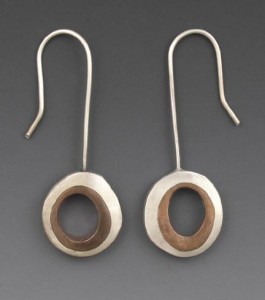
Silver Over Copper Clay

Copper was fired first. Silver was wrapped around and fired with a torch. It worked just fine.

Wraparound 2

Silver was fired first, copper strips were wrapped around it and fired in carbon.
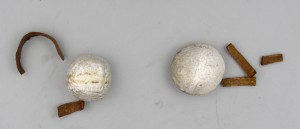
Wraparound 3a

Wraparound 3

The copper strips sintered, but always split and came off. At first I thought it was a shrinkage issue, but eventually I started to suspect that some rejection reaction was taking place. This hunch was supported by the recent experiments that I have been doing with combining the new sterling with copper.

Mokume Gane Patterns

In these patterns silver and copper have to be fired together, without firing one of them first. I have tried it before with home-made sterling clay, and it worked just fine. You can see photos on p. 112 of my above-mentioned book. Here is my first try with the new sterling clay:

Frame Separating

Square Earrings Cracking

I noticed the cracking and separation while I was still burning the binder on a stove top. It took 4 more rounds of patching and firing to bring the earrings to a decent state:

Sterling 2

This has never happened to me before when combining either fine silver or home-made sterling sterling with copper. However, before rushing to conclusions about the new sterling clay, I remembered what happened when wrapping copper around silver, as shown above. As you can see in the photo above, the mokume gane pattern is wrapped with copper. Perhaps it was the rejection reaction that I suspected four years ago.

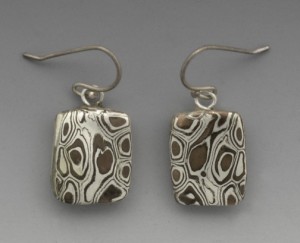
So, I tried pieces without framing them in copper. I watched them on the stove top and no cracking occurred.
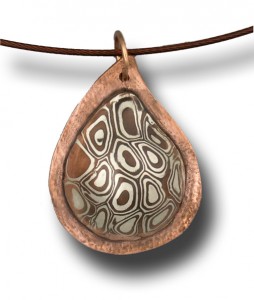
Sterling

Square Earrings

Round Earrings

Because of the high shrinkage rate of the new sterling clay, I fired the above rectangular earrings with my Traditional (Flex) copper clay, which shrinks more than the Quick-fire version. The circular earrings were fired with Quick-fire copper. The shrinkage rate of both pairs of earrings was the same. However, while the surface of both was not flush after firing and required some grinding, the Traditional copper was easier and quicker to grind.

By the way, with home-made sterling clay the shrinkage rate of mixed pieces is very low.

How do we make sure that the outer layer is always silver and not copper?

Most of the mokume gane patterns introduced in my book are created with a clay extruder. The instructions are always to stack the circles with the copper closer to the opening to the extruder. That way the extruded cane always has copper on the outside. When working with copper and silver, make sure the silver circle is closer to the opening, so the extruded cane is silver on the outside.

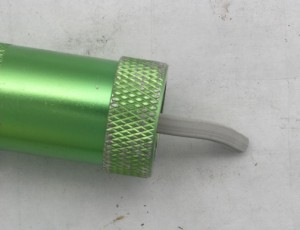
How to Stack

Silver Cane

Making sure that the outside layer is always silver sure helps a lot. However, cracking did occur in all my experiments, not in the first phase but in the second. All pieces required repair and re-firing, although not as may times as when the copper was the outside layer. Cracking did not occur when I used home-made sterling clay.
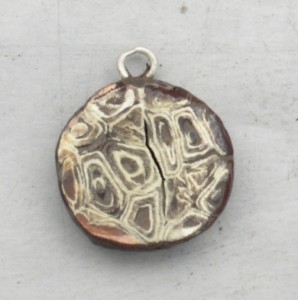
Cracking

How to Save on Silver

Naturally, when sanding and filing pieces from copper and silver before firing, the silver powder gets mixed in with the copper powder. I have been saving the powder, as well as mixed clay that was leftover in the extruder. I have used this clay for making backing layers for the pieces and for patching in hidden spots. The earrings in the following photo were backed with mixed clay:

Swirls

Back of Swirls

The backing layer has a yellow tint. Also notice the pits. I was not able to remove them, even with heavy-duty sanding.

Mixed Clay

The circle on the left is what was left over from the mix after I’d finished the experimentation. It has a pinkish color.

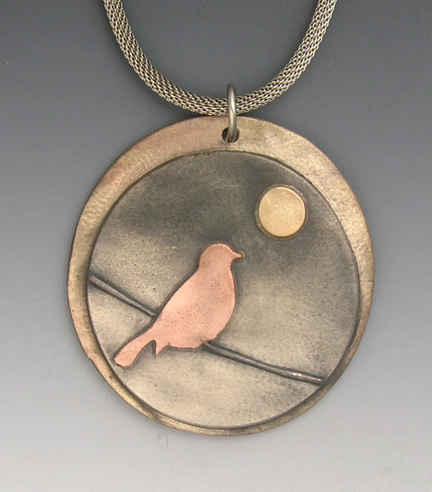
Just as a point of interest, I have noticed that you can mix up to 35% copper in fine silver before any color change is detected in the fired piece.

Dec 1 2011

Updates to My 2012 Class Schedule

Four more workshops have been added to my teaching schedule for 2012:

March 17-22
5-day intensive at my studio in Berkeley, CA
hadar@pacbell.net 510-528-4183.
Sign up here: http://store.artinsilver.com/deforinwo.html

April 2-5
Montreal, Canada
Jocelyne Robertson
Phone: 514 990-0441
http://www.silverclayquebec.com
http://www.metallurgiawebzine.com
http://www.mainshabiles.com

Note: 4 workshops are scheduled in Canada this year: one in Montreal, one in Edmonton, and two in Vancouver.

June 26-April 1
Kvernes, Averøy, Norway
Email: post@glassforum.no
+47 71514100
Website: http://www.glassforum.no

October 12-13 (beginner class) and 14-15 (advanced class)
Studio 34 Creative Arts Learning Center
Rochester, NY
www.studio34jewelryartslearningcenter.com
(585) 737-5858

Please look at the file “Hadar’s Travel-Teaching Schedule” (also available in the right-hand pane of this blog) for the full schedule.


Nov 14 2011

My 2012 Class Schedule

My class schedule for 2012 has been updated. The following workshops have been added:

March 17-22
5-day intensive at my studio in Berkeley, CA
hadar@pacbell.net 510-528-4183.
You can sign up on my website or contact me directly.

March 30-April 1
BeadFX, Toronto, Canada
www.beadfx.com
info@beadfx.com
Details will follow.

July 20-22
Krasl Art Center
http://www.krasl.org/
707 Lake Boulevard St. Joseph, MI 49085-1398
(269) 983-0271
info1@krasl.org
Details will follow.

August 11-14
Alberta, Canada
www.artclaycanada.com
carrie@artclaycanada.com
Details will follow.

August 16-19
Vancouver, Canada
www.artclaycanada.com
carrie@artclaycanada.com
Details will follow.


Nov 8 2011

Changes in Product Line, New Products, and New Distributors

This is a message to all our customers and distributors. In order to align all of our Hadar’s Clay™ products, a few changes will be introduced to our product line (and to Hadar’s Online Store) in January 2012.

1. Traditional (Flex) Pearl Grey Steel XT and Traditional (Flex) Rose Bronze will be added to the product line and will be available in 50 gram jars. These represent the Traditional (not Quick-fire) variety of Hadar’s Clay™ Pearl Grey Steel XT and Hadar’s Clay™ Rose Bronze. It is the most suitable variety for making flexible clay. For a demonstration, please watch the video below. Full instructions can be found in my book The Handbook of Metal Clay: Textures and Forms, 2nd edition.

2. A Sampler Kit containing one jar each of Traditional (Flex) copper and bronze (50 grams each), and Traditional (Flex) Pearl Grey Steel XT and Rose Bronze (25 grams each) will also be added to the product line.

3. Quick-fire Steel XT will be replacing the current Quick-fire Steel and will be available in 50-gram jars. This is an improved product, stronger than the earlier version, and can be fired at a lower temperature. Most important: unlike the earlier version, it can be fired with other metals in the same piece.

4. The functions of Pearl Grey Steel and Pearl Grey Steel XT will be merged, and Pearl Grey Steel will be discontinued. All of the applications of Pearl Grey Steel can be achieved using Pearl Grey Steel XT. Additionally, Pearl Grey Steel XT has the advantage of being suitable for use on its own with no additional metals.

Both Quick-fire Steel XT and Pearl Grey Steel XT shrink 28% by volume. Both are strong on their own and fire nicely with other metals. There are slight differences between them, and choosing which one to work with is a matter of personal preference.

When the product changes go into effect, the Instruction Manual and Hadar’s Online Store will be updated accordingly.

5. We are pleased to announce two new distributors, in Mexico and Canada.

Canada:
Art Clay Canada
artclaycanada.com

Mexico (as of January 1st, 2012):
Art Clay World Mexico (website currently under construction)

and

Mineralia Stores
www.Mineralia.com

A list of all our distributors can be found here.

6. As of January 1, 2012, all Hadar’s Clay™ prices will be increased by 10%.