Dec 6 2009

NEW: Hadar’s Clay™ Quick-fire Bronze

Quick-fire Bronze is now available as well. What bothered me about the Quick-fire Copper is that it could not be fired in combination with bronze. With Quick-fire Bronze it is possible.

Firing bronze clay in open air yields poor results. I have found a firing schedule that works for both Quick-fire copper and Quick-fire bronze. It requires only one phase, takes 1:30 hours, and minimizes the amount of carbon required.

Please read the full Instruction Manual for Hadar’s Clay™ Quick-fire Copper and Quick-fire Bronze by clicking the link in the right-hand pane of my blog.

Here are some highlights:

Quick-fire Copper has three firing options: (a) in a hot kiln, (b) with a torch (small pieces only), and (c) a third option, which may appeal to people who do not want to deal with a hot kiln or ramp their kilns to high temperatures. This third method is used for Quick-fire Bronze as well. In fact, using this third method, copper and bronze can even be fired together, either in separate pieces or mixed in the same piece.

Firing is done in a stainless steel box or mixing bowl only half full of carbon (about 1½” total) . This way the carbon stays in the box and does not spread all over the kiln. The pieces are placed vertically almost all the way down to the bottom of the box and then covered with some more carbon. No lid is used.

Ramp at full speed to 1470°F (800°C) and hold for 1:30 hours. That’s it.

You can take the box out hot or leave it to cool down in the kiln. No need to pickle or even quench in water. Discard the carbon, since it’s almost all ash (no more vacuuming!).

I have fired pieces in the center of the box, and so far, every one of them sintered!

The Quick-fire Clay has a similar consistency to that of my traditional clay. Storage and shelf life are also the same as with traditional clay. There is no need to limit the amount mixed at one time, as is the case with steel clay. One exception, though: when mixing, use a lot less water!

The shrinkage rate for copper and bronze is the same, and is lower than that of my traditional clay. Pieces are very strong.

My traditional clay will continue to be available on my Online Store along with the Quick-fire clay. If you use the traditional clay, please remember to fire it according to the old instructions.


Dec 4 2009

NEW: Hadar’s Clay™ Quick-fire Copper

As I promised when I started this blog, I have been constantly working on improving the firing schedule, especially trying to shorten the firing time and minimize the use of carbon.

After a long series of experiments, I’ve finally been able to come up with copper clay that does not require carbon at all. This product, too, comes in the form of an easy-to-mix powder. Everything, including the consistency, is the same as the traditional Hadar’s Clay™ – Copper, except for the firing schedule. The new Hadar’s Clay™ Quick-fire Copper is fired half an hour on a kiln shelf or a fiber blanket. Small pieces can also be fired with a torch. To see all three firing options please download the firing schedule for Hadar’s Clay Quick-fire Copper by clicking the link in the right-hand pane of this blog.

This is how the copper looks after it has been dipped in water (no pickle necessary). The oxide layer comes off quickly and completely. The shiny parts on the the huge piece on the left are the result of hammering.

The clay powder is now available for sale on my Online Store. The package size and price are the same as for traditional Hadar’s Clay™ – Copper.

In the center piece in photo below, my Quick-fire Copper clay was torched-fired over fired steel clay.

For those who prefer the traditional Hadar’s Clay™ – Copper, it is still available on my Online Store.

I am continuing my quick-fire experiments with other metals as well. I will, of course, post my results as soon as I am sure of them.


Nov 29 2009

Steel Clay is Available

[Edit: The information in this posting is obsolete. A Map of Hadar’s Clay™ Products can be found here. These clays can be viewed and purchased here, on our Online Store. Stainless Steel Clay is no longer manufactured or supported.]


Here are some photos of jewelry made with steel clay.

Steel clay is now available from my Online Store. You can find the Instruction Manual for steel clay in the right-hand pane of my blog, just under the Instruction Manual for copper and bronze clay.

Some things to keep in mind when working with steel clay:

Mixing

The process of mixing the clay is the same as for Hadar’s Clay™, copper and bronze (watch this video).

Rusting

Copper and bronze react with oxygen and moisture to create a copper oxide layer, which protects them from further oxidation. Steel reacts with oxygen and moisture to create an iron oxide layer, but this reaction will go on until the steel eventually disintegrates. In other words, steel rusts and will keep rusting away unless it is protected as described in the Instruction Manual.

Rusting can happen when the clay is still wet. It is therefore recommended to mix only the amount that you intend to use in a day or two. If you have leftover clay, coat it with olive oil, wrap it in plastic food wrap, and store it in a closed box in the refrigerator. It is a good idea to mix the oil into the clay.

Rusting can also happen when pieces are dry and waiting to be fired.

Rusted Clay

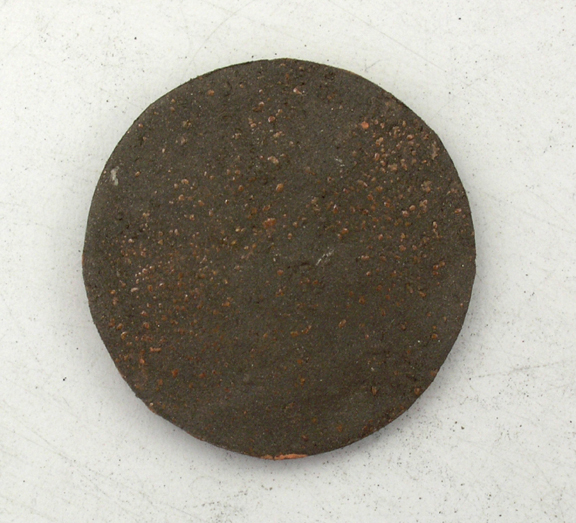
As you can see in the photo, the dry steel clay looks as if it were mixed with copper. Depending on the amount of rust, a rusted piece may sinter, but will have pits at the spots where the rust developed. If you are not about to fire right away, coat dry pieces with olive oil and wrap them in plastic food wrap.

Blue Steel

A blue patina can be achieved by either heating the fired piece and dipping it in cold water, or by applying liquid patina. Please see the Instruction Manual for instructions and sources. Bluing the steel provides some protection from rust.

However, for better protection from rust the piece needs to be oiled and waxed as well. Please see details in the Instruction Manual.

Each jar of steel clay powder comes with a moisture absorber inside the jar.

Firing

The firing process for steel clay is the same as for Hadar’s Clay, copper and bronze, except for the hold temperature in phase II and the type of lid that should be used. The sintering temperature of steel clay has a wide range. The minimum temperature is 1700°F (926°C) in a top-loading brick kiln, and 1780°F (971°C) in a front-loading fiber kiln. It can be brought up to 2000°F (1093°C) or more. If there is no sintering in your kiln at the minimum temperature, raise the hold temperature in the second phase by 50°F (about 25°C) at a time, until sintering is achieved.

Instead of a stainless steel lid use a piece of fiber paper (shelf paper, available in rolls from glass fusing supplies), ⅛” thick. Fiber paper allows gasses and contaminants to escape, which is crucial to the sintering process. It can be used several times.

Stainless Steel Clay

Stainless steel clay does not sinter at less than 2200°F (1204°C). Most of us don’t have kilns that will reach that temperature. However, stainless steel clay will be supplied by special request. Please email me if you wish to order.

Before you do, please keep in mind:

1. Your kiln needs to be able to reach more than 2200°F (1204°C).

2. The price of stainless steel clay is twice as that of copper, bronze, and steel clay.

3. Even stainless steel is not 100% immune to corrosion.

4. Most important: contact of stainless steel and carbon at high temperatures is very likely to compromise the steel’s ability to resist corrosion.

Firing with carbon at a high temperature may cause the carbon to spill onto the kiln floor. As suggested in the Instruction Manual, you can protect your kiln by lining the floor with shelf paper.

Steel clay powder takes up more volume than copper and bronze and needs to be packed in bigger jars. Therefore, the shipping options specified on my store may change.

There is still a lot to be discovered about steel clay and its possibilities. This is a new chapter for us all. As usual, I am here to help and make suggestions, and will be delighted to see photos of your artwork in steel clay.


Nov 27 2009

Workshop in France

My trip to Europe this summer has been extended to include a workshop in France. The dates are July 3 and 4, 2010.

Here is the contact information:

Guilde PMC Francophone, Ploemeur, Morbihan FRANCE
website: http://www.guildepmc.com

e-mail: Guilde.pates.a.metaux@gmail.com
or contact guild president, Angela Crispin,
e-mail: ange.est.la@wanadoo.fr


Nov 18 2009

Steel Clay Updates

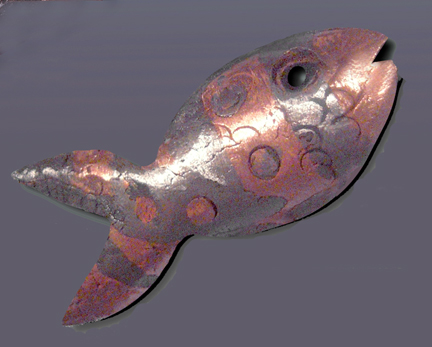
Georgia did it again. You may remember that she was the one who originally discovered the compatibility of copper and bronze clay. As soon as she laid her hands on steel clay, she combined it with copper and fired.

Steel and copper fish

So now we know that steel and copper clay can be fired at the same temperature, without interfering with each other’s sintering.

Although I haven’t yet been able to repeat Georgia’s experiment, I have been able to combine steel and copper clay in a single firing, meaning that both copper and steel clay were fired in green state.

Copper steel

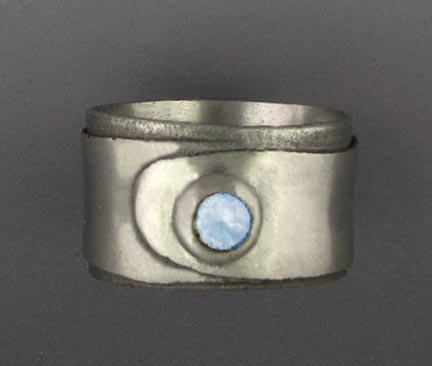
Overlay Wraparound

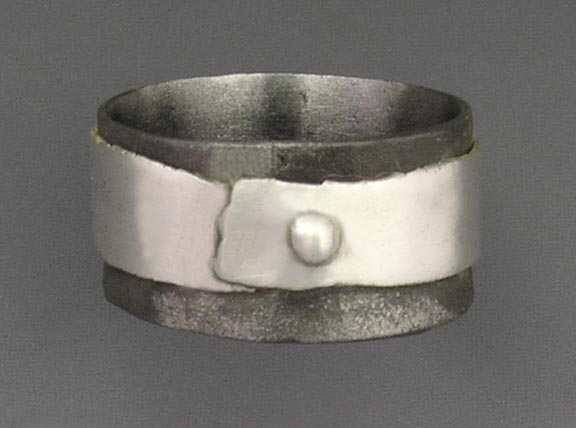
Inlay wraparound


Click on the photos to see the full picture. The one on the left is an overlay of copper clay on steel clay; the one on the right is an inlay of copper in steel clay.

There is a good reason to fire them both in green state: if one of them is fired first, the second shrinks over metal that has already shrunk. Since the firing takes place in a kiln and is not done with a torch, the shrinkage of the second metal is too high and causes it to crack.

Why not bronze and steel? The firing temperature for steel is too high for bronze. However, it is possible to combine them by firing steel clay first:

Bronze steel earrings

Steel and bronze ring

Yes, that last photo is a ring. It’s been a long time since I made any rings. Here are some more. They are incredibly light, and though I’m not sure of the exact shrinkage rate, it seems to be very low.

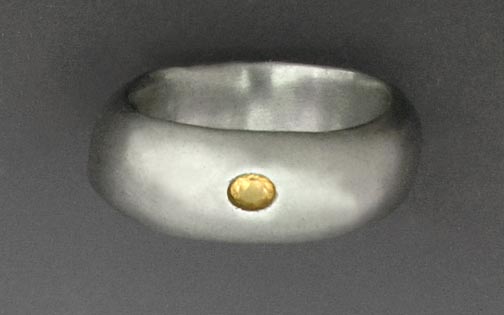
With stone

With silver

Half round

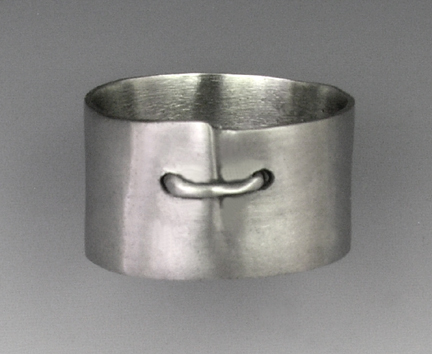
Stitch ring

Here are some pieces that do not involve a single firing. The components were fired separately and then assembled.

3-cube earrings

t-Rod necklace

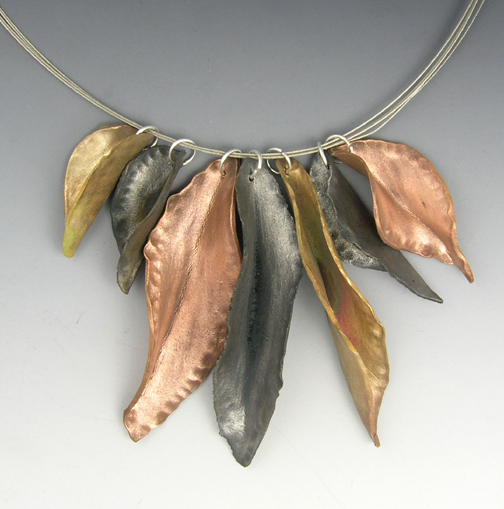
Leaves

This last piece is not the one that is featured in my third book. That piece was made with silver leaves. The piece above is made with steel clay.

So when is steel clay going to be available for shipping? Hopefully around Thanksgiving. I am off this weekend for a 4-day workshop in San Diego, and plan to start stocking as soon as I get back.


Nov 9 2009

Improved Formula for Hadar’s Clay™

I am glad to announce that I’ve been able to improve Hadar’s Clay™ by introducing a few changes to the formula. If you liked the consistency of the clay before, you will like it even better now. Moreover, the improved formula has longer shelf life, the clay is more receptive to oil, and the mixing time is shorter. (No more white spots!) I have a hunch that it has some more advantages yet to be discovered. Here is a video clip (posted on YouTube) that shows how to mix the clay.

As you will see, there are only two changes in the instructions:

1. Less water is required. Do not over-wet the clay. If you do, add more powder.

2. When you stir the clay in the bowl, don’t wait for it to become a single chunk (if it does, it means that it’s over-wet). The clay should stay in the form of crumbs, with none sticking to the bowl. Once the bowl is clean, the crumbs of clay are ready to roll.

The rest of the instructions are the same. At the workshop in San Diego at the end of this month we will already be using the improved formula. From today on, when you order Hadar’s Clay™, bronze, copper, or steel, you’ll receive the improved clay powder.

The Instruction Manual for Hadar’s Clay™ has been updated to include the changes mentioned above as well as the firing schedule for steel clay. A “Firing Schedule” document is available as well. Please download both of these documents directly from the right-hand pane.


Nov 6 2009

Compatibility of Steel Clay with other Metal Clays

Over the past two weeks I’ve been testing whether steel clay can be fired with copper, bronze, and silver clay without reacting with them and causing undesirable effects. As you may remember, when silver and bronze are fired together, they don’t only interfere with each other’s sintering, but also tend to alloy and melt. Copper and silver also tend to alloy and melt if they spend a long time together under high temperature.

Well, the news is all good! No reaction. Here is a spinner bead that I made from steel, bronze, and copper clay.

You can find the instructions for making such a bead in the section called “Spinners”, in my second book: Silver and Bronze Clay: Movement and Mechanisms.

The steel part was fired first, and the copper and bronze were fired second, in a single firing.

Then I used the technique that I call “Hot Riveting,” described in my book: Mixed Metal Jewelry from Metal Clay, to make the following piece:


Then I tried silver inlay in steel. I followed the instructions for inlay of silver and copper from my third book: Mixed Metal Jewelry from Metal Clay. Again, no reaction. The silver part sintered perfectly.

Shrinkage

To test the shrinkage I made a mold from one of my old silver pieces and pressed steel clay into it.
01

The original piece was made out of high-shrinkage clay. The result shows that they have about the same shrinkage:
02

I am still working on the firing schedule for steel clay. By “working” I mean: trying to see at how low a temperature it can be fired. So far it seems that the overall firing time is about the same as my schedule for bronze and copper clay.


Oct 30 2009

Stainless Steel Clay

[Edit: The information in this posting is obsolete. Stainless Steel Clay is no longer manufactured or supported.]

I have arrived at a more or less reliable firing schedule for the steel clay I was discussing in my previous posting. This schedule works for different thicknesses and sizes, and I will post it soon. In answer to your questions, it was not stainless, and yes, it will rust. To those of you who do not like the corrosion effect, there are ways to seal the steel before you sell it, and ways for the customer to protect it further from corrosion. These ways include bluing, tempering, oiling, and waxing, and I will dedicate a separate posting to this topic.

I did make stainless steel clay. This time the clay is shiny silver in color.

Again, I used a mold that I had made before and pressed the clay against it.

I trimmed off the excess clay,

added a bail,

made test pieces, 4, 6, and 8 cards thick, and started to experiment with the firing schedule.

To avoid oxidation, I fired in carbon, using 2 phases. The first phase was the same as for copper and bronze clay. As for the second phase, at 2100°F (1150°C), test pieces 4 and 6 cards thick sintered, but the 8-card test piece and the pieces I demonstrated above did not sinter completely.

I fired the same pieces for 2 more hours and nothing changed. One thing that I have learned from these experimentations is that re-firing unsintered clay, at least steel clay, does not make any difference.

On a different firing, at 2200°F (1205°C), the steel started to swell and lose details (like blistering on bronze). I guess the next step is to go back to firing at 2100°F, but for more than 3 hours.

Before I do that, though, I’d like to pursue the regular steel. There are two main reasons for this: first, the firing temperature for regular steel is lower than that of stainless steel, although still higher than that of copper and bronze clay, and the firing time is the same. Second, steel clay is cheaper than bronze and copper clay, whereas stainless steel is significantly more expensive. The cost and the long firing hours at high temperatures may make stainless steel nearly as expensive as working with silver clay.

In my next posting I will discuss the firing schedule for steel clay, along with some suggestions for protecting the kiln while firing.


Oct 27 2009

Toolkit for my Workshops

For anyone who has signed up for my workshops this year in: San Diego (CA); Phoenix (AZ); Brighton (MI); Los Angeles (CA); Grand Junction (CO); San Antonio (TX); East Yorkshire (UK) and other places,

Please download the file “Personal Toolkit for Mixed Metal Workshops” from the right-hand pane of my blog. It is highly important that you have these tools with you in order to complete the projects planned for the workshop. If you have any questions regarding a specific tool, please feel free to contact me personally at hadar@pacbell.net. For availability of equipment in the classroom, please contact the hosting venue.


Oct 24 2009

What is this blog about?

Click here to find out.

Find Me On Facebook

Find Me On Facebook

City


Subscribe to Hadar’s Blog


Your email address:


For Email Marketing you can trust