Oct 24 2009

Steel Clay

It may be too early to tell, since there is a lot of experimentation to be done yet, but it seems that my first try at steel clay was a success.

Here is what I did: I prepared it more or less the same way I make my copper and bronze clay powder. The clay is shiny black, smooth and creamy. I pressed it against a polymer clay mold that I had made. (You can click on the photo to enlarge).

Then I cut a circle out of the steel clay and dried. Like bronze clay, it shrank about 10% while drying, and I had to flip it over from side to side to keep it from warping.


To keep it simple I drilled a hole at the top.

It was fired in carbon. I am still testing the firing schedule, so I will post my results later. It came out black from the kiln, as if I’d already oxidized it with liver of sulfur. I buffed it with a coarse mini-fiber wheel. The shrinkage was like that of bronze – about 25% for flat pieces.

It is very strong, and surprisingly light.

To test joints I made another piece with a bail on the back. The dry bail easily attached to the dry circle and the joint was very strong after firing.


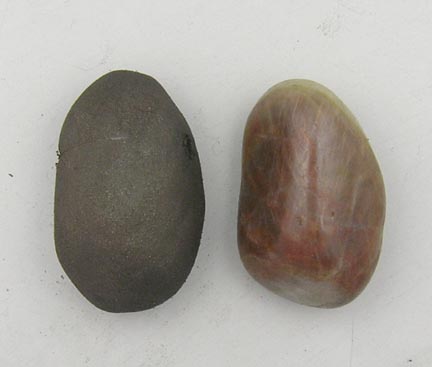
I also made a steel rock, and fired it half full of carbon.


As you can see in the photo, this time the shrinkage rate was much smaller.

After sanding and matting it to a satin finish (which was harder than sanding silver), I took a photo of the steel rock next to a silver rock. The steel rock is somewhat darker.


Oct 19 2009

My Book Has Arrived!

My Third book: Mixed Metal Jewelry from Metal Clay is now available and can be ordered here.

The book includes 41 step-by-step projects for silver, bronze, and copper clay. It is 128 pages, full color, soft cover, spiral bound.

For a full description please read the Introduction to the book.

All pre-orders are currently being shipped. Please contact me if you have not received your pre-order within a week (two weeks for orders outside the U.S.).


Oct 18 2009

Free Project: Tricky Balled-up Ear Wires

t-Finished

This project is for everybody, but is specially dedicated to the brave girls in Sydney who took my two evening classes on balling up a wire at both ends. How fun was that? Here is another thing you can do with this technique, although it’s a little more tricky. You may have to do this a few times until you succeed. I suggest practicing with scrap wire. Seriously, if you manage to do this one, you can consider yourself an expert on balling up wire.

Here are three solid rods from silver, copper, and bronze clay, with a side hole in each. (You can click on the photos to enlarge.)

Step 1

Step 1

Cut a piece of fine silver or Argentium wire, 0.7-0.8mm (22 gauge), 8 cm (3″) long.

Step 2

Step 2

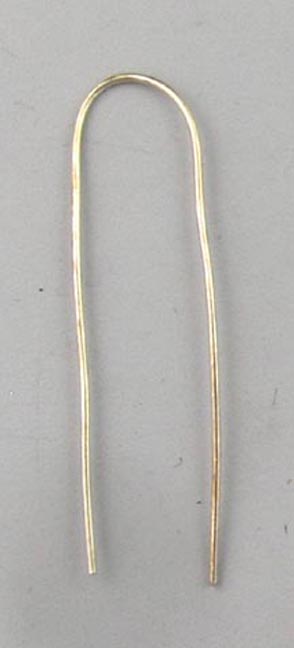
Bend the wire into a U shape.

Step 3

Step 3

Cut another piece of wire of the same thickness and thread it through the side holes. Let it stick out by about 1 cm (0.75″) on each side.

Step 4

Step 4

Overlap the ends of the U-shaped wire with the end of the horizontal piece of wire, as shown in the photo.

Step 5

Step 5

Twist one end of the U-shaped wire with one end of the horizontal wire. Repeat with the other end.

Step 6

Step 6

Cut off the twist to about a 5 mm length on each end.

Step 7

Step 7

Hold the earring with cross-lock tweezers with one twisted end held vertically down.

Step 8

Step 8

Using a propane/oxygen torch, ball up the twisted end. This is the tricky part, since you need to remove the flame on time, as soon as the twist is balled-up, or the wire will melt and the connection will open up.

Step 9

Step 9

Repeat this step with the other twisted end.

Good luck!


Oct 14 2009

Back from Australia

First, a practical note: the first 3-day workshop scheduled for June 25-27 in the UK is full, and reservations are currently being taken for a second back-to-back workshop, starting on June 28. Please contact Tracey, at:

Mobile number 07961 883115
(Outside the UK: +44 7961 883115)
Or email: tracey@craftworx.co.uk

For the past two days I’ve been recovering from jet lag after coming back from teaching in Australia. It was an intense, wonderful two weeks which I will never forget, and I’d like to thank Roz Eberhard-Swan of The Eclectic Studio and the PMC Guild for making it possible. Meeting you and working with you all in Sydney and Melbourne was a pleasurable, enriching experience. I was really sorry to leave and hope to meet with you again some day. Please remember what I’ve already told you: you tend to think that you are behind because you are so far away, but that is not the case. I was amazed by your high level of artistry, craftsmanship, and the courage to jump into new adventures. In terms of physical distance most of us are all far away, even inside the United States; but in fact we are only as far as our own bench and the Internet. Keep up the good work, and please stay in touch!

The workshop in Melbourne was held at Maggie Berman’s studio, but Maggie could not be there so unfortunately I didn’t get to meet her. However, just being there, working in her space, shopping for food where she does, and seeing her beautiful jewelry, made me feel that I knew her a little bit. Thank you, Maggie, for letting us work at your studio!

I’d like to share here some beautiful artwork made by someone prior to the workshop. Susan Brown, who flew in from New Zealand, showed me a piece she had made that was inspired by a project published in one of my books.

Can you blame me for feeling happy and proud?


Sep 22 2009

Workshop in the UK

Another workshop has been added to my travel-teaching schedule, this time in the UK. The dates are June 25-27, 2010. The venue is:

Craftworx Studio
Cold Harbour Farm
Bishop Burton
East Yorkshire

Contact Tracey, at:

Mobile number 07961 883115
(Outside the UK: +44 7961 883115
Or email address: tracey@craftworx.co.uk

For everyone that signs up, Tracey will send detailed travel directions to the studio and lodging information at the time of booking. A booking fee of £25 will be charged to reserve places, with the full balance payable by 31st May 2010.


Sep 16 2009

My New Book

Now accepting pre-orders.

Here is some more information about the book.

Estimated shipment time: late October. To pre-order click here.


Sep 15 2009

This and That Before Leaving for Australia

On Monday, September 28, I will be on my way to teach in Sydney and Melbourne. I will be gone for two weeks, but you can place your orders for books and clay as usual. Everything will be taken care of. For my local students, if you feel that you suffer from withdrawal while I’m away, you can place your orders online and choose the “No shipping” option. You will then be contacted as to when you can pick up your order.

A lot of beautiful work has been done here lately and I’d like to share some of it with you. My book has already gone to press so these pieces did not make their way into it. Some work is currently being done that I know I would have loved to include. So I’ll just keep showing it on my blog.

Janice still has just finished a bracelet she has been working on for six weeks:

This elegant bracelet feels like it hugs your arm. The dimensions of its links are about 3″ x ½” x ¼”, and we prefer not to think about its cost in materials.

Hope Weiner has made an inlay bear and perfect inlay beads from copper, silver, and bronze:

She has also finished this gorgeous dragonfly, which I have to show you in different views:


It is made from bronze and copper, and the little tube on his belly is meant for a pin.

As for myself, I have been experimenting a lot with patinas on bronze and copper. Here are some of the results:


You can click on the earrings photos to enlarge.

I’ve found a good source for patinas: www.artchemichals.com. They sell two sets of sample patina in 2 or 4 oz. The service is quick and the shipment is cheap (no extra charge for hazardous materials). The one I bought is Sculpt Nouveau – Traditional Series Patina Sample Kit. It includes 9 bottles.

Another kind of patina that I had good results with can be found at craft stores like Blick and certain hardware stores like Ace, and on this website. It’s from the “Sophisticated Finishes” series, and the ones I like best are “Patina blue”, “Patina green”, and “Rust”. Remember my corset? Here is her new relic look:

I used rust on the corset and ferric nitrate (from the sample kit) on the body, which yields bright orange and yellow colors.

Since the metal is so porous, I found that the best way to apply it to small objects, like the rocks, is to soak them in the patina for a few hours. When you take them out, you can’t see the patina yet. Put it on your heating pan and see the colors emerge. This is how I got the blue and green colors.

Some of the rocks are orange/red/brown. This was achieved by heating the rocks with a torch until red-hot, then immediately quenching them in cold water. Surprisingly, when I did the same thing with the disk earrings on the right, one side of the disc turned orange and the other one purple.

The patinas need to be coated with several layers of lacquer spray. I used “Working Fixative Spray,” available from art and craft stores.

I don’t know if I’ll keep doing this, but I sure got it out of my system.


Aug 29 2009

The Story of Gourdelia

Gourdelia is a large copper/bronze hollow form that is a collaboration between Toni Ellis (who has been my student for nine years) and me. Gourdelia came into the world as a miniature gourd that I picked up a few years back. By miniature I mean 4″ tall and 2″ in diameter at its widest point. I couldn’t afford to use it as a mold for a hollow form in silver clay, and my base metal clay firings were rarely successful, so the infant Gourdelia slept quietly in my “Box of Odd Shapes,” awaiting her debut.

When there were no more excuses, I realized that Gourdelia’s moment had arrived. I covered the gourd with a layer of bronze clay, in a way similar to the one introduced in the “Rocks” project from my first book. I dried it, then made one vertical cut along the gourd. The clay was pretty flexible after it had dried, so it easily peeled off the gourd without breaking.

I re-joined the cut and covered the clay gourd with layers of copper and bronze clay, to create the look of inlay, or married metals. Still, it looked boring to me and I felt uninspired. This is when I decided to hand it to Toni. If you look here, here, here, here, and here, just for starters, you’ll understand why Toni.

Toni got involved right away. Over a few weeks she gave Gourdelia a complete makeover: a corset, a fancy hat, a scarf and a pair of fancy high-heeled shoes from shoehero.com, and a tail. Toni opened a hole at the bottom so the hollow form could be filled with carbon for firing. Here is the clay gourd, all ready to be fired (you can click on the photos to enlarge):


Gourdelia was fired all by herself, half filled with carbon, lying peacefully on her side under an inch of carbon, at 1000°F for one hour. Then she was cooled down and fired again for 3 hours at 1470°F. Here she is yawning as she emerges from the carbon:

As you can see, some separation occurred between the copper and bronze layers, due to their different shrinkage rates. The gaps were filled with clay and Gourdelia was fired again. I won’t bore you with the details of the long finishing process. Here she is, at last, front and back:

Now Toni and I have joint custody.


Aug 22 2009

A Heartwarming Surprise

During the last days before sending my book to print, I’ve been receiving last-moment photo submissions. This one caught me by surprise. It made my day, and I can’t wait for the book to come out in order to share it with you.

Hadar's Magic Powder Earrings

Hadar's Magic Powder Earrings

Patrik Kusek sent me this photo along with the following description:

Hadar’s Magic Powder Earrings
Size: 3/8″ x 3/4″ each
Materials: Bronze Clay, Copper Clay, freshwater pearl, 14K gold, borosilicate glass vials, polymer clay stoppers, paper, inkjet ink, raw copper clay powder and raw bronze clay powder
Technique: Standard metal clay technique and wire wrapping
Photographer: Patrik Kusek

Of course these earrings are in my posession now, a gift from Patrik. Thanks, Patrik – I still can’t wipe the smile off my face.


Aug 12 2009

Sintering Issues

This is in response to many questions that I’ve been asked about failures in sintering. I’d like to remind you first of the checklist, which is available on my blog and at the end of the instruction manual. It may help you make sure that you have done everything right. I would like to mention a few more variables here:

1. If you still have sintering problems after going over the checklist, I suggest that you try carbon from a different source than you have been using. Not all activated carbons are the same. With some there will be good sintering, with some there will be partial sintering or no sintering at all, and others are only good for a limited number of firings. Unfortunately, this information is not available from suppliers and you will need to ask for samples or purchase small amounts and test them.

This is a major issue. If you have encountered this problem and do not mind sharing your reliable source please do so in the comments to this posting. I am in the process of testing a few sources but it has not been long enough to determine their reliability.

2. Your kiln may not be getting enough power. Make sure that it is connected to a circuit of its own, with no extension cords. Make sure nothing else that requires a lot of power is running at the same time.

If you are a teacher teaching a workshop and need to use a few kilns, don’t use them all at the same time. For example, if you use two kilns, run the first phase on one of them, and when it’s done run the first phase on the other. Then run the second phase with the first kiln, and when it’s over run the the second phase with the second kiln. From my experience this should not take more than 12 hours. Another option is to ask students who live close to the venue to volunteer to fire for some of the other students, as well as for themselves.

3. No shortcuts. Let the pieces cool to room temperature before you go on to the next phase. Even if you cool the box in cold water, the carbon may be still hot. Wait until you can touch it with your fingers.

4. If you use a 4″ tall box, place your pieces horizontally, as high as possible in the box. If you place them vertically, the bottom of the pieces may not sinter. For more about the box, see here.

5. Make sure that there is 1″ space between the top of the box and the top of the kiln chamber. With no space, the top of the chamber is like a tight lid, not allowing fumes and contaminants to escape.

6. For thick pieces make sure to hold one hour in the first phase to give a chance for the binder to burn.

7. Fill hollow forms halfway with carbon. Trapped air in hollow forms may interfere with sintering. Also, avoid firing more than 4 small hollow forms in one firing session.

8. If you are not sure what your full-speed temperature is, make sure that the first phase does not last less than one whole hour. If it is shorter, lower the ramp to 1750°F (972°C). Shorter firing time may cause pieces to break.

I have just fired a big hollow form (5.2 oz.) all by itself. It is safe and sound. Hope to post photos soon.