Jan 31 2010

New Firing Method

Since my last posting I have been working on a firing method that will be cleaner, cheaper, and shorter. I’ve finally found one. This method does not require a stainless steel box, uses a lot less carbon, requires no vacuuming, and leaves the kiln perfectly clean after firing. The kiln can be either cold or hot both before and after firing, overall firing time is shorter, and firing temperature is lower. [Edit on 2/1/2010, 8:10 a.m. PST: I’d like to clarify that as of now, I have only tested this method with my Quick-fire clay. Thanks to readers who asked me to clarify this.] So here goes:

[Edit on 2/3/2010, 4:00 p.m. PST: STOP! These instructions have now been updated, and the latest version can be found here.]

1. Place your ceramic/fiber kiln shelf on posts to position it high in the kiln.

Kiln Shelf

Kiln Shelf

2. Fold a a fiber blanket into a “box.”

Fiber Blanket

Fiber Blanket

The fiber blanket can be re-used. It is quite inexpensive to buy it in rolls from glass fusing suppliers; you can then cut it with scissors to your desired dimensions. The one I bought was 1 inch thick, and I separated it into two layers a half-inch thick.

You can also purchase a rigidizer from the same source (these are normally used to make slumping molds for glass fusing). This will stabilize the shape of your box.

3. Line the inside of the blanket “box” with a ½” layer of carbon.

Carbon Bed

Carbon Bed

4. Arrange your pieces on the carbon bed. As usual, avoid the center.

Pieces Arranged

5. Cover the pieces with another ½” inch layer of carbon.

Pieces Covered

6. Cover the carbon with another piece of blanket, creating a “sandwich.”

Fiber Blanket Sandwich

Fiber Blanket Sandwich

Firing Schedule

You can start the firing in either a cold or a hot kiln.

Top loader brick kiln: ramp at full speed to 1450°F/788°C
Front loader muffle kiln: ramp at full speed to 1530°F/832°C

(You may find that this temperature is too high for bronze. If it is, flat bronze pieces wil warp some. You can either hammer them down after firing or lower the temperature.)

Hold for 1:00 hour.

You can take the pieces out of the kiln while still hot or wait until they cool down. Overnight firing works fine. If you take them out hot, use heat-protective gloves. The sandwiched part is actually on fire!

After firing, most of the carbon turns into ash. Pick up the fiber “box” from both ends and lift it out of the kiln. The kiln will be perfectly clean.

Almost all of the carbon will have turned into ash, including the bottom layer. Just throw it away. To retreive your pieces you can pour it hot through a sieve into a metal container.

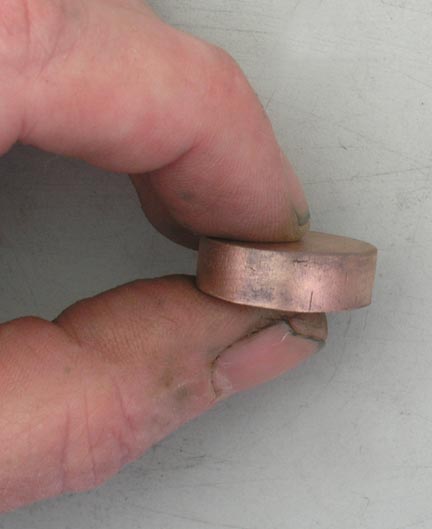
This schedule works best with bronze (even with very thick pieces), with mixed pieces, and with average sized pieces of copper. The bronze circle on the right is ¾” in diameter, ¼” in thickness.

Mixed piece

Mixed piece

[

Thick bronze piece

Thick bronze piece


I am now working on a schedule for thick and/or large pieces of copper, starting with the following options:

  • Hold for 2 hours, or
  • Hold at 1000°F/538°C for 0:30 minutes to 1:00 hour before proceeding to the goal temperature, or
  • Raise the temperature. Copper can be fired as high as 1770°F/965°C (as in the schedule “Hot Firing” in the instruction manual for Quick-fire clay).

As soon as I have reliable results for copper firing, I will post them and make the necessary changes in the instruction manuals.


Jan 20 2010

Workshop In NY

Another workshop has been added to my travel-teaching schedule. This workshop will take place on the weekend of October 2-3, 2010 in Rochester, New York.

Here is the contact information:

Studio 34 Creative Arts Center and Gallery
34 Elton St, Rochester, NY 14607
Phone: (585) 737-5858
Email: studio34artists@aol.com

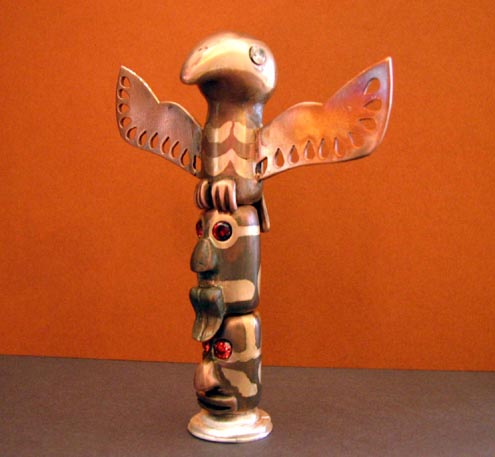
I’d like to take this opportunity to share with you some photos of an amazing piece that was created with Quick-fire copper and bronze by Diane Sepanski from The Metal Heads, Feat of Clay in Phoenix, Arizona, right after the workshop that I taught there. It’s called Pookie and the Chief, Phoenix Tribe.

t-IMG_7749

t-IMG_7744

t-IMG_7745

t-IMG_7746


It’s in 3 pieces and each piece is hollow. The top part was made as 2 separate pieces that are hollow, which were then assembled with the wings. Here’s a picture of how it went into the box.

t-IMG_7752

And here is the finished piece:

t-IMG_7755


Jan 16 2010

Instruction Manual Updated

The instruction manual for Quick-fire copper and bronze has been updated. Please download the new version from the right-hand pane of this blog. The date at the top of the first page shows when it was last updated.

One of the main changes is the hold temperature in front-loader kilns. After firing 18 such kilns at the workshop in Phoenix, I realized that 1550°/843°C is a better temperature for sintering bronze and copper clay in front-loader kilns. Fire at a lower temperature only if you see that bronze pieces blister at this temperature.

Another important change is the addition of a separate firing schedule for thick or large pieces, and pieces that have core material or glycerin in them.

Here is the suggested schedule, still one phase:

Ramp at full speed to:

1000°F/538°C (top loader) or 1100°F/593°C in a front loader
Hold 30 minutes
Ramp at full speed to:
1470°F/800°C (top loader)
1550°/843°C (front loader
Hold for 3:00 hours

The hold time at 1000°F/538°C (top loader) or 1100°F/593°C in a front loader allows all combustibles to burn off. You can increase this hold time if necessary.

If you have sintering problems in general, I suggest trying this schedule.

If you don’t know how to program your kiln for this schedule, please read the file “How to Talk to Your Kiln,” which is also available on the right-hand pane of this blog.

Please note that although various schedules are suggested in the manual, the one I recommend the most for all types of Quick-fire pieces is the one for mixed pieces of copper and bronze.


Jan 16 2010

Rethinking the Firing Pan

Recently I have been experimenting with a different firing pan — a simple, cheap, stainless steel mixing bowl, available everywhere, including $1 stores.

The mixing bowl will wear out sooner than the rectangular firing pan, but the bowl has a lot of advantages over the rectangular pan.

1. The cost.

2. The thickness of the walls. Both stainless steel and carbon are poor heat conductors. The walls of the mixing bowl are thinner and allow better penetration of heat into the bowl.

3. The shape. The narrower bottom of the bowl (where the carbon is useless anyway and interferes with the heat flow) holds less carbon.

4. The top of the bowl, where the temperature is the highest, has a larger area than the rectangular firing pan.

5. Availability in different sizes. The mixing bowl that I use for both FireFly and Caldera kilns (and which also fits in front loaders from the Paragon SC series), is 7″ in inner diameter and 2½” tall. In bigger kilns you can use bigger mixing bowls and place the pieces close to all heating elements.

Here is how I place pieces in the mixing bowl:

All these pieces are fairly big: 2″ x 2″. In the rectangular firing pan I would fire them horizontally; if I were to fire vertically, their bottom would be too close to the bottom of the box, where the temperature is lower. Here they are positioned at an angle roughly parallel to the walls of the bowl.

The following drawing may bring my point across.

Drawing2

All the pieces sintered beautifully, including the one in the center.

I used the mixing bowl to fire a thick piece that sometimes would not sinter at first firing in the rectangular box. It is a copper circle, ¾” in diameter, ¼” thick.

t-04


Placed close to the wall of the bowl, it sintered perfectly.

Worth a try!


Jan 16 2010

Photos and Discoveries from Phoenix Workshop

Last weekend I gave two workshops at The Metal Heads, Feat of Clay in Phoenix, Arizona. You can see photos from this workshop on The Metal Heads website. Here is a direct link to the photos. These photos are posted on a Yahoo! forum, so you may have to subscribe to the forum in order to view them.

I’d like to emphasize that beautiful pieces have been created at every workshop that I’ve taught. If I haven’t posted them in the past or fail to do so in the future, it it either because a camera is not available or the quality of the photo does not do justice to the pieces. So please don’t take it personally.

At every workshop new possibilities open up. Through questions and discussions we raise new ideas, share personal styles, and discover new techniques. I’d like to share some of these with you.

At a previous workshop in San Diego, someone — I think it was Dona Di Carlo — mentioned the cut-off wheel.

At my workshop we were making the Bamboo Slice Earrings project from my last book. This project requires filing a side groove, which is normally a time-consuming process. The cut-off wheel, mounted on a rotary tool, does it in seconds.

t-Cutting wheel1

t-Cutting wheel2.


Cut-off wheels are available from hardware stores and need to be mounted on a screw mandrel.

The cut-off wheel led to a design idea. I used it to score fine lines in dried copper clay.

t-Cutting wheel3

Then I filled the grooves with bronze clay, dried, sanded, and fired.

t-Earrings

This may be a good time to mention that when you do inlay projects, Quick-fire clay requires a lot less sanding. Sanding is easier with Quick-fire than with my traditional clay, and it’s best to stop sanding as soon as the design emerges. If you over-sand, the design may not be crisp enough after firing.

Back to Phoenix. A few things were established:

1. The black powder that you see on the bottom of your kiln after firing copper and bronze does not come from the carbon; it comes from the oxidation of the firing pan. The carbon does not leave the box if you don’t fill it all the way up. Lining the bottom of your kiln with shelf (fiber) paper is a good idea. Wholelottawhimsey sells a firing cloth that can be used for both covering the box and lining the floor of the kiln. Since it’s reusable, I ordered some right away and am going to try it.

2. Hot riveting can be done with slip. Julia Sweeney painted silver clay slip over a textured copper piece that was already fired. She hot-riveted it and the result was a continuous design that is part copper, part silver.

IMG_7729[1]

The photography conditions were not ideal, but I hope you get the idea. If you try this and send me photos, I’d love to post them here.

3. Heating pieces with a torch can add beautiful colors to mixed metal designs. This is what Florence Coleman did in these beautiful pieces on the right and left:

Flossie+Coleman[2]

4. Quick-fire clay is very easy to carve. Here are two amazing hand-carved pieces by Paula Weiss:

IMG_7728[1]

IMG_7727[1]

5. The following was discovered by accident. We were running out of time and one of the boxes needed to be crash-cooled. I filled a sink with water and sank the box in it, hot from the kiln. However, the water splashed into the box. At first it just evaporated, then the carbon started to bubble. When it was cool enough to touch, I dug the pieces out with my hand. What surprising colors! The copper was an orangey color and the bronze looked like gold. Norm, who made the piece, wanted to leave them just like that. Unfortunately I don’t have a photo to show. Later I repeated this on purpose and got the same result. If you do this at home, be sure to wear heat-resistant gloves!

And finally, an idea came up for inlaying silver in copper without riveting. I am currently experimenting, and will let you know as soon as I get consistent results.


Dec 31 2009

Quick-fire Steel Clays

Hadar’s Clay Quick-fire Steel and Quick-fire Stainless Steel are now officially available for sale on my Online Store. This newest version of steel clay fires in one phase only, like Quick-fire Copper and Bronze.

On the right-hand pane of my blog you can see the revised files. You no longer need to refer to the manuals for traditional copper and bronze; there is a separate manual for each of the following:

  • Quick-fire copper and bronze
  • Quick-fire steels
  • “Traditional” (or slow-fire) copper and bronze
  • “Traditional” (or slow-fire) steels

There is also a one-page Quick Reference Table for Hadar’s Clay, which consolidates the firing schedules for all types of clay.

At the beginning of each manual you will see the last date it was updated. Since the manuals are updated regularly, please make sure you always have the latest version.


Dec 29 2009

Instruction Manuals for Hadar’s Clay in French

This posting is especially for French-speaking users of Hadar’s Clay. Thanks to Fleur Hana from France, all of the instruction manuals are now available in French, and will be updated regularly. You can access them by clicking on Hadar’s Clay™ en français (Instructions in French) in the right-hand pane of the blog. You can also access them by clicking on Français in the upper bar of the blog.

I’d also like to mention Sabine Alienor’s tutorial in French for a top-loader kiln. You can see it on her blog, by clicking here.

Merci beaucoup, Fleur and Sabine. I hope to meet you when I come to France this summer!


Dec 28 2009

Updates to Travel-teaching Schedule

A few workshops have been added to my travel-teaching schedule:

On July 6-11 (after the workshop in France), I’ll be teaching a week’s class in Averøy, Norway. The first part of the class focuses on textures and forms; the second part on mixed metal jewelry in metal clay. For full description please see the website:
http://www.mamut.net/glassforum/default.htm. The website is in Norwegian, but you can translate it into English (or other languages) on the fly using Google Translate, by clicking here.

And here is the contact information:
Phone: +47 71514100 E-mail: post@glassforum.no.

In August I will be teaching two 3-day workshops in Washington state:

August 20-22: PMC Guild of Seattle/Tacoma. Please contact Peg:
Peg@wildhairstudio.com.

August 23-25: Snohomish. Please contact Randi:
(360) 568-7709, Randi@ArtatTheRanch.com.

On January 23-29, 2011, I will be teaching a a 5-day workshop in Puerto Vallarta, Mexico. Please visit the website:
http://www.haciendamosaico.com/index.html
Please see the class description here:
http://www.haciendamosaico.com/ws_21.html.

Contact: Sam at info@haciendamosaico.com.

These workshops have been added to the file “Hadar’s Travel-teaching Schedule 2010” on the right pane of my blog.


Dec 13 2009

Torch-firing Hadar’s Clay™ – Quick-fire Copper

Torch-firing quick-fire copper is much like torch-firing low-shrinkage silver clay: the piece will not be as strong as it can be when kiln-fired, but for pieces that don’t undergo wear and tear, or components that are not a structural part of a piece, this may not be all that important.

It takes a little longer, about 6 minutes. I suggest turning on the radio and listening to two songs in a row (or just Hey, Jude) while you are torching. Here is a video clip demonstrating firing a copper piece, 6 cards thick, and an overlay of copper clay fired over steel clay:

Jenny James sent me an email, saying that she wasn’t able to sinter quick-fire copper with a torch, even after 20 minutes. She ended up firing it on the screen on her stove top for 30-40 minutes and succeeded.

If you try that, you can do it outside, using a burner that is used for camping. Place a screen or copper sheet over the burner and place the pieces in a circle, where the flame is.

I answered Jenny that what I think happened, is that her torch did not supply enough flame. Either the flame wasn’t big or hot enough, or the piece was too big for torch-firing. The flame has two roles in base-metal clay firing:

1. To supply heat;
2. To consume the oxygen around the piece in order to prevent oxidation. In fact, that’s what the carbon does by burning. Here is a photo of the carbon burning right after the kiln finished its cycle.

Obviously there was much more flame on the stove to protect the piece from oxygen.

So Jenny went on to her second experiment. Here is what she wrote:

“More heat and less oxygen when torch firing, I tried something new. I laid the piece ON TOP of a little dish of carbon. I then fired for 8 minutes with my small butane torch. It heated up WAY faster to a much brighter glow, and the piece was entirely engulfed in flame. It sintered BEAUTIFULLY in 8 minutes and was super strong! I will keep testing it for shorter periods of time tonight and see just how quick it can really be fired.” Later she wrote: “In 4 minutes the piece sintered perfectly and was super hard – unable to break it with pliers. All of the tests were done with 8 mm thick and 2 cm x 2 cm. By firing it on top of carbon it fires as easily as torch firing silver.”

I’d like to thank Jenny for her input. I would also like to thank Ron Taylor, who sent me a photo of a piece that he created at my workshop in San Diego. Ron came to class with a rendering of a piece that he wanted to make with a combination of copper and silver, and the piece came out exactly as he planned it, including its size!

Ron


Dec 8 2009

Update to the Firing Schedule of Quick-fire Copper and Quick-fire Bronze

I have updated the Instruction Manual for Quick-fire Copper and Bronze. Please download the new manual.

The update is in regard to the firing schedule of mixed pieces of copper and bronze, meaning pieces that are made out of both copper and bronze.

Here is the updated schedule:

Cover the box loosely with either a stainless steel sheet or fiber paper (shelf paper). Ramp at full speed to:

1520°F (825°C) in a top loader kiln;
1600° (870°C) in a front loader kiln.
Hold for 2:00 hours.

This hotter and shorter schedule seems to yield better results.

Also, for all firing schedules, it is not necessary to discard all the carbon. You can save most of it by removing the ash.