Feb 26 2013

Accreditation Program for Hadar’s Clay™ Teachers

I have been asked by many teachers of metal clay to establish an accreditation program, in which I would personally select experienced metal clay teachers who work in Hadar’s Clay™, train them in my own teaching methods, and then accredit them to teach Hadar’s Clay™ techniques and projects in their own local communities. For a long time I rejected the idea, but after deliberate consideration I have decided to go ahead and do it. My goal is to establish a team of high-level, professional teachers, who know the ins and outs of base metal clay and who received their teacher training directly from me. They will not be authorized to accredit other teachers. Hopefully, they will form a non-competitive, supporting group.

In establishing this program, I have tried to address two major objectives:

  • Care should be taken in creating the network of accredited Hadar’s Clay™ teachers, to help ensure that they do not compete with one another within their own communities.
  • Teacher candidates should have proven proficiency in Hadar’s Clay™ and in metal clay teaching.

To help achieve these objectives, I have established the following ground rules for the program:

1. The Accredited Hadar’s Clay™ Teachers program will be by invitation only. I select candidates whom I have come to know in my classes and workshops, who demonstrate proficiency in Hadar’s Clay™ and in connecting productively with other students. In selecting candidates I will do my best to avoid creating unfair concentration of Accredited Hadar’s Clay™ Teachers within the same community.

2. Accredited Hadar’s Clay™ Teachers must be trained and accredited by me personally. Accredited Hadar’s Clay™ Teachers can teach their own Hadar’s Clay™ students (at the level of proficiency to which the teacher has been accredited), but cannot grant Hadar’s Clay™ Accreditation to other teachers.

Starting in January 2014, accreditation classes will begin at my studio, and the first groups of Accredited Hadar’s Clay™ Teachers will be established – one group for teachers outside the U.S., the others for teachers inside the U.S. At the outset, these specific groups will be accredited to teach Hadar’s Clay™ at beginner level. As the program continues, teachers accredited to teach beginners will have the option of continuing to higher accreditation levels if they so desire.

Once trained and accredited, Accredited Hadar’s Clay™ Teachers will be listed on the Hadar’s Clay™ Accredited Teachers Registry on my website, along with their contact information and links to their websites. Accredited teachers will receive my ongoing support.

What does the training consist of?

One part of the program is a 5-day workshop. However, the activity of each group starts several months before the class and does not stop after it’s over. This is an ongoing training, supported by an online group that will be established for each level. Newly accredited teachers will join the existing groups. Prior to the class, the group is given general information and assignments. All of them are required to be familiar with my books, blog, and instruction manual and to have taken classes with me in the past. Thus, participants arrive in class fully experienced and prepared. After the accreditation training, the group continues to communicate collaboratively online with follow-ups, updates, feedback, reports, and trouble-shooting. Apart from the tuition for the Accredited Hadar’s Clay™ Teachers training workshop itself, the program involves no additional cost. Participation in the online group is free of charge, as is all of the support and feedback that I will provide.

How do people get into the Accredited Hadar’s Clay™ Teachers program?

The program is by invitation only. I have contacted and will contact people who meet the criteria explained above – people I get to know over the years through classes and workshops, and whom I know to be practicing artists and teachers. The expectation is that people who enter the accreditation program are highly dedicated to this, and are willing to learn, practice, learn more, and practice more.

This process will require some patience, as all accreditation workshops will be given by me personally, and I can only teach one group at a time. More classes will be scheduled in the future, although the precise scheduling has not yet been determined.

Please do not contact me for registration, but feel free to email me if you have any questions.


Feb 17 2013

Movement and Mechanisms – Call for Submissions and Workshop

It’s time for the second edition of my book: Silver and Bronze Clay: Movement and Mechanisms, which has been out of print for quite some time. Many things have happened since it was published in 2008, so it is going through radical revision and update. It will be called: Movement and Mechanisms in Metal Clay, and will include some of the same projects, altered projects, and new challenge projects, such as scales, seesaws, clockwork, fans, and pulleys. The projects’ level of difficulty varies, so it can appeal to both beginners and advanced users of metal clay.

If you have read the first edition of the book and were inspired to make some of the projects, please send me photos of your work for the new edition. They should be at least 300 dpi, at least 5″ x 5″, and you can send them to me by email if the size of the entire message (including attachments) is less than 2 MB. (You may need to send your photos one at a time or a few at a time to accomplish this.)

When sending photos, please include a title, materials used, and your name as you would like it to appear in the credit line.

The deadline for submissions is the end of June 2013.

In the new edition I intend to use some of the photos that were published in the first edition. If you own one or more photos that were published in the first edition, please let me know if you have any objection to my re-publishing them in the second edition.

Movement and Mechanisms Workshop

A 5-day intensive on Movement and Mechanisms will be held at my studio in Berkeley, CA, on June 7-11. The class will cover spinners, balance scales, hinges, links, dangles, and invisible connections. It will involve using an oxygen propane torch. You can sign up for this intensive here.
Here are some photos of the pieces that are shown in the video above:

Pulley

Watch

Fan


Feb 10 2013

No Pre-firing for White Bronze; One More Update to the Manual

Last week was dedicated to one of my New Year’s resolutions: improving the firing schedule of White Bronze. The result: White Bronze does not require pre-firing. Just fire in carbon at 1250°F/677°C (brick kiln); 1325°F/718°C (muffle kiln). Hold for 2:00 hours. Optional: 1:30 hours for less than 100 grams.
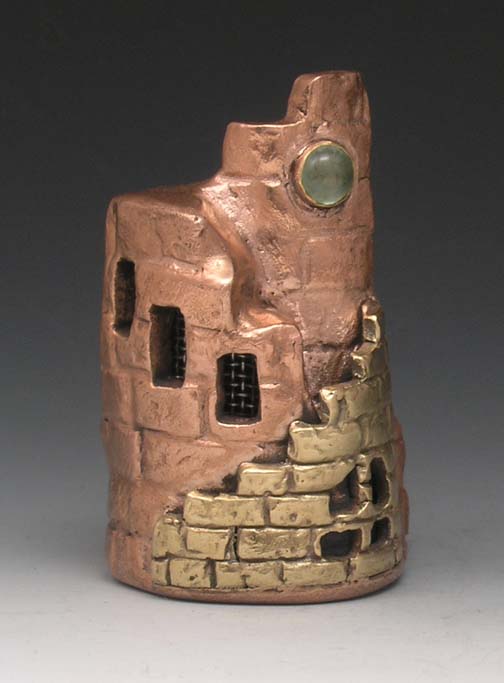
The Instruction Manual has been updated and is marked February 10, 2013. For your convenience, the changes are only on page 14 and 29 (the quick-reference firing schedules)

Very thick pieces fired this way with full sintering, no distortion, and no cracking. They were fired in two different kilns, so it seems that with the one-step firing schedule White Bronze is not so sensitive to slight changes in temperature.

The following pieces are 13 cards thick – 10 cards a piece plus a 3-card bail on the back:

Doors

Slate

To test the brittleness of these piece I made a circle of the same width. Here it is next to a penny:

Circle

I threw it hard (not just dropped) a few times on a concrete ground and it did not break. Don’t get me wrong: this is not a good way to test your pieces! Although people report that they regularly tumble White Bronze without breaking it, White Bronze is still more brittle than the other clays, and cannot be hammered, bent, or drilled. The test is always to sand it with course-grit sandpaper (150 or 220) and see if it becomes all metallic or has pits of powder. You will never be able to perform the finishing process if the piece is not well sintered.

It seems that thick pieces are less brittle than thin ones. However, if you are still worried about strength, here is a way to protect a piece. For the following piece, a frame of copper was fired first at high-fire schedule. This is the structural part of the piece.

Room

1. Cut 3 identical-size shapes. Leave one of them solid (6 cards thick). In the second (2 cards thick) cut another, smaller, identical shape. In the third (4 cards thick) cut a smaller, identical shape.

3 identical shapes

2. Place the second layer on the solid one.

2nd layer on solid layer

3. Place the third layer on the second one. You have now created an undercut, an empty space between the first and the third layer.

3rd layer on 2nd layer

4. Seal the gaps between the layers.

5. Insert fiber paper into the undercuts to keep them open during firing.

Insert fiber paper

6. Fire the piece following high-fire schedule for copper.

7. Clean the undercuts and much as you can. Press White bronze into the undercuts to fill them completely. Dry.

Clean undercuts, press White Bronze

8. Roll a layer of White Bronze, 1 card thick. Lay it on the copper piece.

Lay White Bronze on copper

9. Cut away the excess clay from around the inner frame. Dry.

Trim and dry

10. Make your piece as if the White Bronze were the backing layer.

Make your piece

11. Fire following the new low-firing schedule.

Notes:

  • The moon in the window is made with Brilliant Bronze, which sintered just fine at this low temperature.
  • The frame can be made from any other clay. Here is a piece made with Low-shrinkage Steel XT and White Bronze.

Undercut earrings

Why is the undercut necessary?

First, high-fire metals may not fuse to White Bronze at low-fire schedule. The undercut is a mechanical device that prevents the metals from separating.

Second, the White bronze pressed into the undercuts prevents the inner (White Bronze) part from shrinking away from the frame.

And last, just for color comparison, here are similar pieces side by side, one with White Bronze, the other with Low-Shrinkage Steel XT.

2 slates

Both pieces above were fired with one-phase firing schedule, no pre-firing.

2 rooms

Both pieces required pre-firing, since a large amount of copper is involved.


Feb 5 2013

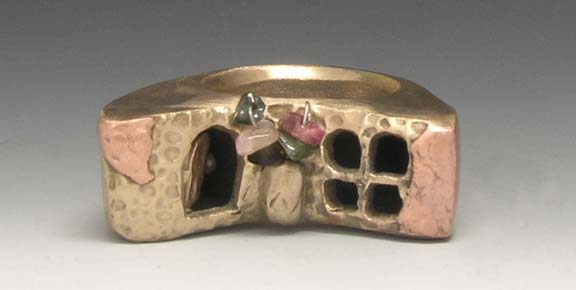
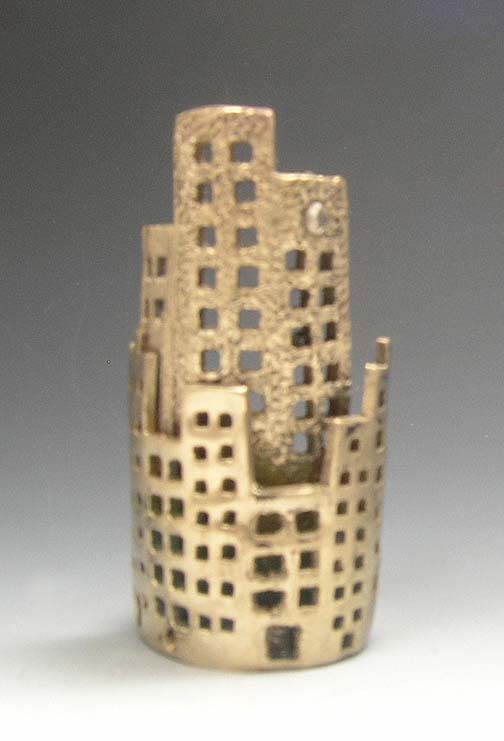
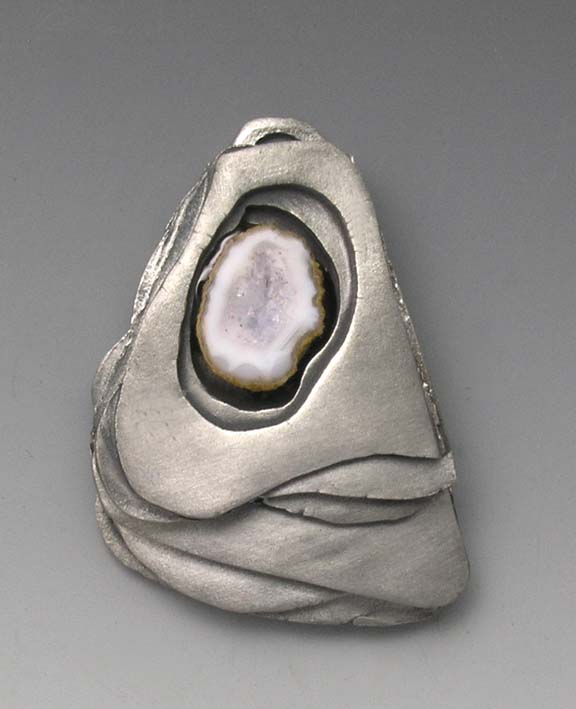
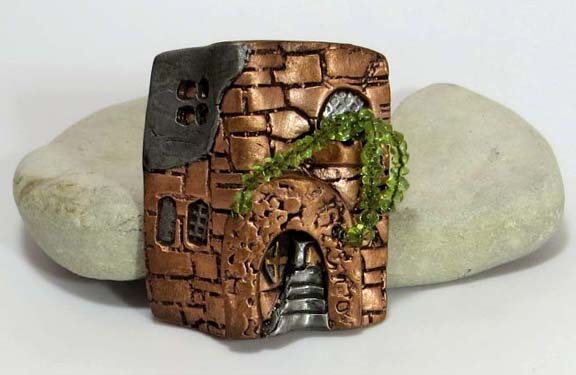
Pictures from ArchiteXtural Intensives 2013

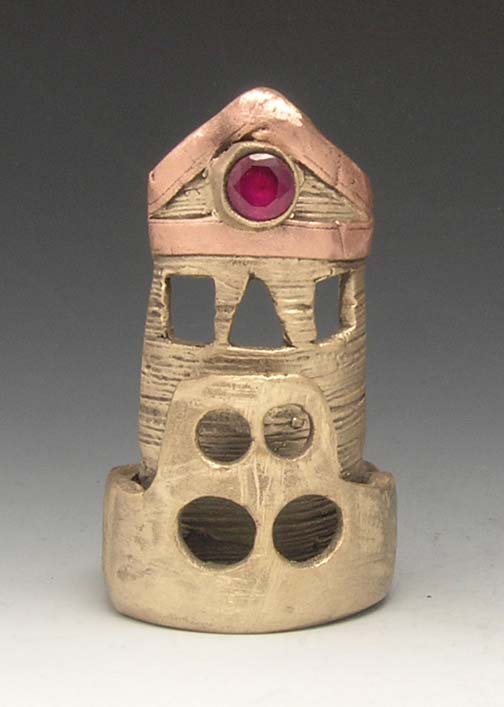
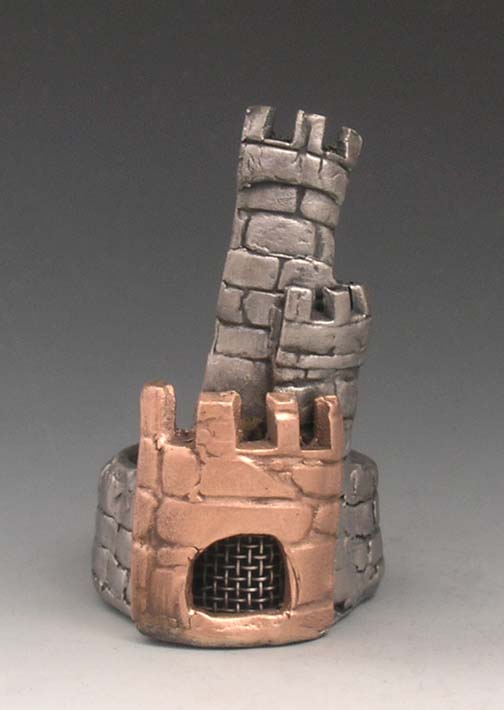
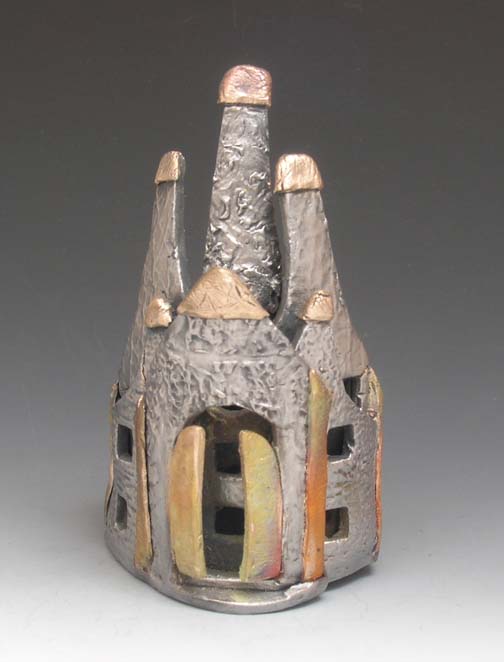
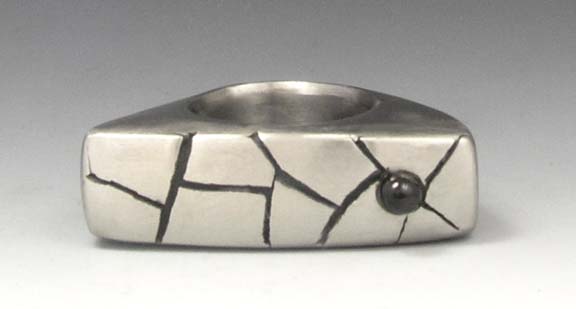
The January 2013 architeXtural intensives are over and I’d like to share with you some photos that I was able to take of the beautiful pieces of art that were created during this period. As usual, no names, just photos. Those of you who have taken the workshops, recognize their work, and would like a high-resolution image, please email me with a link to the relevant photo and I will send you a private link to the large file.

1

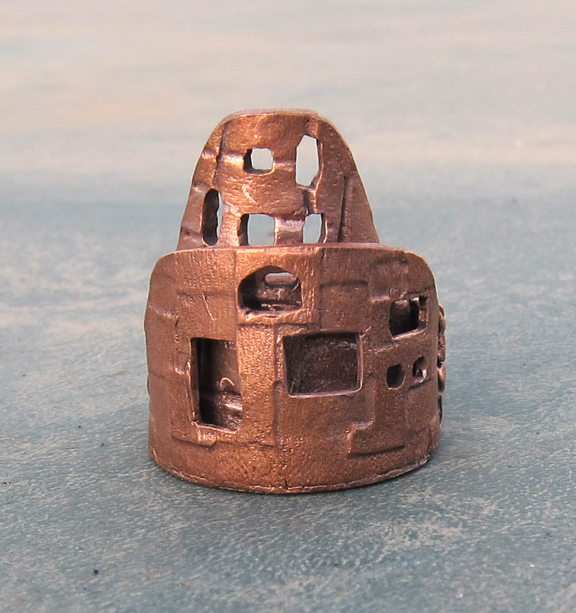
Above: Dragon castle ring.

2

3

4

5

6

7

8

9

10

11

12

The lighthouse above was decorated with the ClayMill Extruder, and so is the bracelet below:

13

14

15

16

17

18

19

20

21

22

23

24

25

26

27

28

29

30

31

32

33

34

35

36

37

38

39

The next architeXtural workshop is scheduled for September 13-15, 2013 at Craftworx in the UK.


Feb 1 2013

Manual Updates and Changes

The Instruction Manual is now updated and is marked February 2013. Also, by popular demand, a file called “Shrinkage Chart for Hadar’s Clay” has been added to the right-hand pane of this blog. It includes shrinkage charts for both flat strips and rings.

Here are some of the changes to the manual:

Changes in Firing Schedules

1. Mid-fire pieces, under 100 grams total, can be fired in phase II for 1 hour only.

Please note: 2 hours and 100 grams are just convenient round numbers. It is important to understand the principle: the bigger the amount of metal fired in a single batch, the longer it takes the heat to reach all of it. Also, the heat will reach the outside area of pieces quicker than their inside area. Therefore, a thick piece, even if it weighs less then 100 grams, may need more than 1 hour to sinter.

2. Low-Shrinkage Steel XT on its own does not require pre-firing, and neither does Low-Shrinkage Steel XT combined with copper and Bronze XT. For these, fire 2 hours at high-fire schedule. Copper alone, Bronze XT alone, and the two combined, do require pre-firing, even at high-fire schedule. Any firing at low-or mid-fire schedule requires pre-firing.

Firing Repair Pieces

If the amount of added clay is small, repair firing does not require pre-firing, regardless of the firing schedule. One hour of firing should be enough.

Pre-firing on a stove-top vs. pre-firing in a kiln

Pre-firing can also be done in a kiln, with the piece resting on carbon but not covered by it. Ramp at full speed to 1000°F/538°C (brick kiln) or 1100°F/593°C (muffle kiln). A few minutes after the kiln has reached the target temperature, check the pieces. When they are all black and the smoke is gone, proceed to phase II. This may be a good solution wherever using gas is not allowed. However, the process is longer; it takes the kiln longer to reach the temperature required for the binder to burn out. Also, since the heat does not come from beneath the firing vessel, as it does on a stove-top, it takes longer for the binder to burn in the bottom parts of pieces (those that touch the carbon).

It is recommended to fire on top of carbon and not on a kiln shelf so pieces do not have to be touched when being transferred to the kiln for the second phase. At this point they are both hot and highly brittle.

The shape of the firing vessel

Round vessels seem to improve the sintering results. When firing in a circular box, there is no need to arrange pieces for optimal exposure to the firing elements. Pieces can be fired in the middle of the kiln, and in a front loader they can be fired in the front (close to the door) as well. The part in the manual that discussed avoiding certain areas in the kiln has therefore been omitted.

The advantage of pre-firing in open air

When pieces are pre-fired in open air, whether on a stove top or a kiln, they do not require a space of ½” between them when going into the kiln for phase II. Pieces can be fired very close to each other, as long as they do not touch. There is also no need to separate big pieces from small pieces. Once the binder is gone, it makes no difference. The part that discusses arranging pieces in the firing vessel has therefore been omitted.

Ramping Speed

In the firing schedules, “Ramp at 1800°F/1000°C” has been changed to “Ramp at full speed.” In most kilns, full speed is 1800°F/1000°C. However, if your controller allows a faster ramp, you can also ramp at 2200°F without causing any damage.

Firing in Cages

The part that discusses firing steel clays in cages has been omitted. Except for rings, there is no need to fire in cages. (As for rings, instead of using a cage, you can just place a piece of fiber paper under and on top of the ring shank). Why has this part been omitted? The cages were meant to prevent distortion when firing high-shrinkage steel clays inside carbon. Since Low-shrinkage Steel XT has been introduced, this distortion no longer happens and the cages are no longer necessary. For structural purposes, Low Shrinkage Steel XT is the only recommended type. The other types of steel clay are best used in combination with other metals.

Furthermore, cages introduce air pockets in the firing vessel. My experiments show that an excessive amount of air pockets inside the carbon results in serious cracking of pieces.

As for the shrinkage chart:

When you look at the shrinkage chart, you may be surprised to see that low-shrinkage steel XT shrinks by 28%. It may seem less confusing if you consider the following:

1. A shrinkage rate of 28% occurs at high-fire schedule. Structural pieces of steel clay cannot be fired at lower schedule, but small amounts embedded in other clays can. At lower schedules, Low-shrinkage Steel XT shrinks less than 28%, but because it is interlocked with other clays, there is no reliable way to measure the exact shrinkage rate.

2. Shrinkage is measured by volume (length x width x depth). If each one of these dimensions were to shrink by 28%, the overall shrinkage rate of the total volume would be much higher. The actual shrinkage of each dimension is a lot smaller than the total shrinkage rate by volume.

To make it simple, let’s consider a 2-dimensional object, like a square.

Squares-shrinkage

The edges of the bigger square measure 20 mm. After reducing the area of the square, the length is 17 mm. That means that while the area of the square shrank by about 28%, each edge shrank by only 15%.

In reality, though, even if we make “flat” pieces, they are still considered three-dimensional, because they have some thickness. Based on experiments that I have made with flat strips, the actual shrinkage of each dimension is 10%-12%.


Jan 27 2013

One More Discovery

In the previous posting I reported that I had been able to sinter small amounts of copper and Bronze XT in combination with Low Shrinkage Steel XT. Pushing the limits just a little bit further, I tried to fire bigger amounts without pre-firing.

Remember the project “Overlay with Bronze XT? I re-made it with Low-Shrinkage Steel XT. Copper backing is 4 cards thick, each overlay is 4 cards thick.

It worked.

Overlay with Low-Shrinkage Steel XT

Two hours firing, no pre-firing, full sintering. Just like the old silver clay.

And it worked again.

Skyline Ring

And again.

Room

And again.

Another Room

At one point I started to add a copper circle and a Bronze XT circle to the batches. While the copper circle sintered some of the time, the Bronze XT circle did not sinter at all. They sintered only when they were combined with Low-Shrinkage Steel XT in a single piece.

The instruction manual is about to be updated. Except for the new discoveries discussed in the last three postings, other issues will be revisited, such as pre-firing on a stove top vs. pre-firing in the kiln, arranging pieces in the firing vessel, and ramping speed.


Jan 22 2013

Breakthrough in Firing Schedule – Further Tests

Firing with core material at high-fire schedule

Following my recent breakthrough in firing schedules, the next thing I tried was to fire Low-Shrinkage Steel XT in combination with core material – specifically, Creative Paper Clay. My suspicion was that (1) the paper clay might not burn off without pre-firing; (2) the paper clay might interfere with the sintering of the steel.

Here are the fired pieces:

Core Material

Core Material

Core Material

All 3 pieces sintered fully after 2 hours at high-fire schedule with no pre-firing. The paper clay behaved exactly the same as with pre-firing; it turned into dust and buffed away.

The third piece is a combination of Low-Shrinkage Steel XT and Bronze XT. Bronze XT was only 1 card thick (see pp. 107-115 in my book Metal Clay Practice). It sintered just fine.

Increasing ramping speed at high-fire schedule

All my tests are done in a brick kiln. Muffle kilns ramp faster, even if they are set to the same speed. It may have been that in my previous experiment, the steel sintered without pre-firing because it had a lot of ramping time. To rule it out I increased the ramp. Total firing time at high-fire schedule was about 3 hours.

The results are surprising:

Tree

Before firing

Before firing

After firing

After firing

1. Low-Shrinkage Steel XT by itself, as well as Low-Shrinkage Steel XT in combination with 2-cards thick copper and bronze XT fully sintered.

2. No cracking occurred as often happens with pre-firing steel clay on a stove top. No repair was necessary.

3. No fireable stones clouded, as they sometimes do, even at lower temperatures.

Firing color-patterned pieces at mid-fire schedule for only one hour

This is something I did not intentionally test, but happened to notice. As you may recall from the previous posting, less than 100 grams of clay can be fired for just one hour after pre-firing. The surface of color-patterned pieces, when fired for only one hour in a batch that weighs less than 100 grams, comes out significantly more flush and smooth than in a 2-hour firing. That makes it much easier to finish.

Color pattern at 1 hour

The Instruction Manual is not updated yet. There are some findings for which I have no explanation just yet, but they seem to imply that further improvements can be done to the firing schedule.


Jan 18 2013

Breakthrough in Firing Schedules

With the encouragement of the participants in my most recent intensive, and with their kind permission to experiment with their pieces, important progress has been achieved in shortening the firing schedule:

Low Shrinkage Steel XT by itself, as well as Low Shrinkage Steel XT combined with small amounts of copper and Bronze XT do not require pre-firing.

Details:

Two big rings that were fired in a brick kiln for 90 minutes at high-fire schedule (1700°F/926°C) with no pre-firing came out completely sintered. The total weight of the two pieces together was less than 100 grams. They are not shown here because I have not done any finishing on them. An attempt to fire a group of pieces weighing more than a total of 100 grams required re-firing.

The batch in the photo below was fired for 2 hours with no pre-firing. The weight was a little over 100 grams. (It looks like a lot more than 100 grams, but keep in mind that steel clay is very lightweight.) All sintered fully.

Batch

Here are photos of the individual pieces:

Concave

Lentil

Lentil

Hollow

Hollow

Hollow Trapezoid

Hollow

Hollow forms did not crack at the seams, as sometimes happens when they are pre-fired.

Pieces made of copper and Bronze XT, fired at the same temperature, did not sinter. However, small amounts of these clays did sinter when added to steel pieces.

Onlay

Onlay

Twisted

Twisted

Mixed

Overlays

The overlays were rolled 2 cards thick before sanding. All sintered perfectly.

The second experiment was done at mid-fire schedule. After pre-firing, 100 grams of copper, bronze, and Brilliant Bronze were fired for only one hour. All sintered. A batch of 10 big rings only sintered partially. My theory is that the bigger the total amount of metal fired, the more time is required for the heat to reach all of it. What supports this theory is that all repairs, fired for 1 hour with no pre-firing, were successful.

To sum up:

1. Low-Shrinkage Steel XT by itself, as well as Low-Shrinkage Steel XT combined with small amounts of Quick-fire copper and Bronze XT, can be fired for 2 hours at high-fire schedule with no pre-firing.

2. Up to 100 grams in total of Quick-fire copper, bronze and Brilliant Bronze can be fired for 1 hour at mid-fire schedule after pre-firing.

3. Repairs for any of the clays can be done with no pre-firing for 1 hour only.

I am not updating the instruction Manual just yet, since I plan to continue experimenting. Hopefully, more results will be posted soon.


Jan 13 2013

Another Project for the ClayMill Extruder – Part III

The ClayMill Extruder comes with 5 dies. What is the serrated (zigzag) slot for?

One technique in traditional Damascus steel and mokume-gane is to emboss the layered sheets of metals (the billet) to about a third of their thickness and then file off the raised parts to reveal the pattern. The die with the serrated slot mimics this technique. There are major differences, though:

1. In traditional Damascus steel and mokume-gane several sheets of different metals are layered one on top of the other. Therefore, when embossing into the same depth at different spots of the billet, the same pattern will be exposed. This can easily be illustrated by stacking layers of polymer clay instead of sheet metal, embossing the stack with a V-shape wood carver, then removing the raised part. The extruder produces a cane, or a stack, that consists of layers of different clays. However, they are not arranged one on top of the other; when embossing into the same depth in different spots of the cane, different patterns of color will be exposed. The pattern will always change along the cane.

2. In traditional Damscus steel and mokume-gane the billet is created first and then the embossing is done. The extruder, in combination with the serrated slot, does both at the same time: it extrudes a cane that is indented to almost a third of its thickness by the sharp edges of the slot. Then the raised parts are removed to reveal a pattern of color.

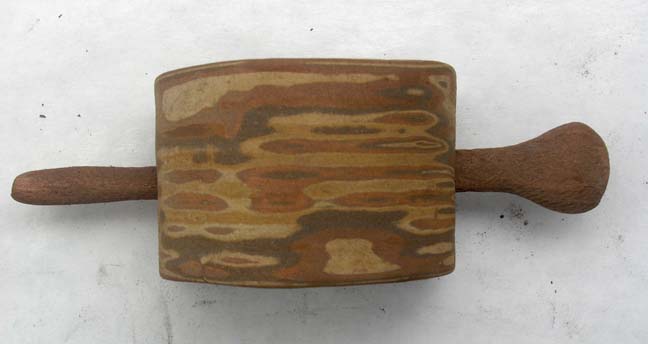
Here is a project, entitled Color-patterned Hair Band, which illustrates this technique.

Hair band

Materials: Quick-fire copper, Quick-fire bronze, Quick-fire steel (any kind).

1. Place the die with the serrated slot in the cap of the extruder.

Serrated die in cap

2. Make a stack of alternating circles: 2 copper (6 cards thick), 2 bronze (3 cards thick), and 2 steel (1 card thick). This stack weighs about 80 grams, including the water. Use a circle cutter about 1¾” in diameter. The diameter should be just slightly bigger than the slot.

Stack of alternating circles

3. Extrude the stack with the copper circle coming out of the slot first.

Stack extruded

4. Using a craft knife or a tissue blade, remove the high parts of the cane. It is not necessary to create a perfectly flat layer since some sanding will be done later.

Remove the high parts

5. Using craft sticks, correct any distortion by shaping the cane into a rectangle.

6. If you wish the rectangle to be longer, roll it down between the two craft sticks.

Rectangle

7. Curve the cane on a cylinder-shaped mold such as a dowel, and dry.

Curve the cane

8. Sand the surface smooth to reveal the color pattern.

Sand smooth

9. Make the stick: roll a thick copper snake. Place the piece on top of it to measure the length, and cut it so that it protrudes past the shape by about ½” on
each side.

Make the stick

10. Press on one end with your finger to flatten it. Dry and sand it to the desired shape.

Flatten

11. Drill a hole on each side of the hair band. Make sure the holes are big enough for the stick to fit through.

Make a hole

Hole

Stick fits through

12. Fire the band at mid-fire schedule. Fire the stick at high-fire schedule. Follow the firing schedules in the Instruction Manual (also available in the right-hand pane of this blog).

13. Finish the piece following the instructions in the document entitled “Finishing Fired Metal Clay” on my blog (also available in the right-hand pane of this blog).


Jan 9 2013

Free Project for the ClayMill Extruder – Part II

As promised at the very bottom of my earlier posting, here is the project for the ClayMill extruder, entitled “Cat’s Eye Ladder.” To view or download the project as a PDF document, click here.