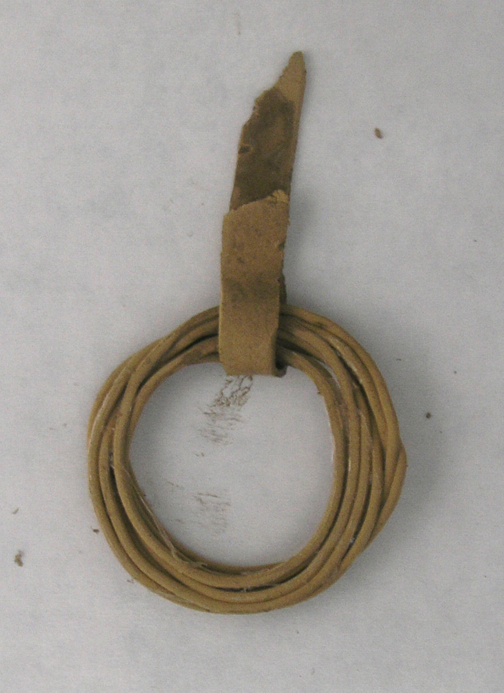
Jan 2 2013

Tips for Using the ClayMill Extruder:
Part I

If you haven’t taken the ClayMill extruder from PMC Connection out of the box yet, or if you have but were afraid to use it, here are a few pointers that may make it easier for you to get started.

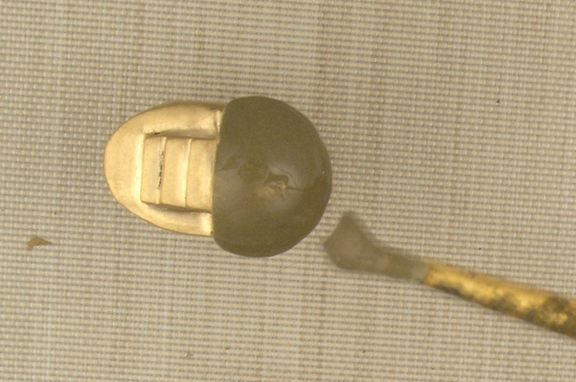
This extruder is quite different from the popular small one. First, It has a black ball at the end of the handle to prevent the handle from sliding off.

Black ball

It’s important to know that this ball screws in reverse (to the right). The reason is, that if it screwed to the left, it would come loose and fall off during the extrusion. So if it seems hard to turn, it is because you are turning it in the wrong direction.

Second, the piston is not attached to the screw. If you scroll the handle all the way to the right, the piston will come out of the barrel.

Barrel

Piston

This makes it easy to clean both the piston and the inside of the barrel.

To put the piston back in the barrel, scroll the handle to the left to make room for it, and place it inside with the circular indentation facing the barrel, and the flat side facing out. Once it’s in, keep scrolling the handle to the left to make room for the clay. Since the piston is not attached to the screw, it will not go in. Simply push it inside with your fingers until it reaches the end of the screw. Repeat this if you need to make more room for clay.

Push

Third, the tube adapter is a disc with 7 holes. It is used with another die, with the thicker rubber washer sandwiched between them (the thinner rubber washer that cones with the kit is a replacement for the washer that is wrapped around the piston). Because of the size of this extruder, it does not necessarily require a pin or a hole corer to create a tube. For example, if you fit the rubber washer between the tube adapter and a disc with a square hole, a square tube with a square hole will be extruded.

Square tube, square hole

Likewise, if you use a disc with a triangular hole, a triangular tube with a triangular hole will be extruded. This is what makes it possible to make the earrings below:

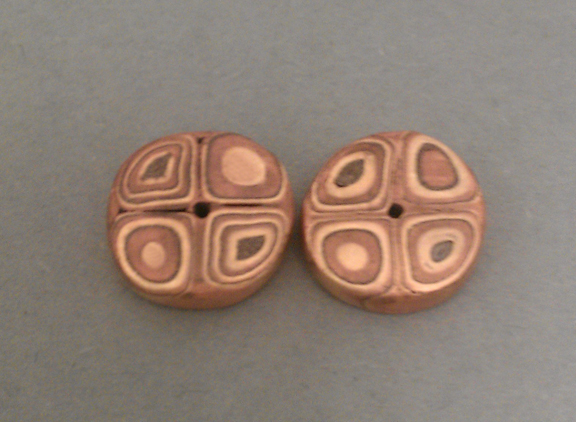
Squares

Triangular tubes

Hopefully, more dies with other shapes will be coming soon.

The center hole allows you to attach different sizes of pins or hole corers. The holes will always be round. The type of corers that can be used are shown on p. 116-117 of my book Metal Clay Practice.

The rubber washer that comes with the kit is less than 2″ in diameter. This may cause clay to be trapped between the washer and the walls of the barrel. You can get a larger 5 mm washer at the hardware store for about 50 cents.

When using the extruder with more than one type of metal clay to achieve a color pattern, the steel circle should always be 1 card thick, or it will not be able to sinter. If the mix involves bronze, it means that the piece has to be fired at mid-fire schedule, lower than what is required for steel. Only minimal amounts of steel will be able to sinter at this lower temperature. I often watch students while they work and notice that their steel circle is too thick. “But I rolled it with one card!” is usually the answer. Then I take the roller and roll the circle again, pressing harder. Here is the result:

Original circle

Original circle

Circle rolled again

Circle rolled again

New circle

New circle

Some of us, including me, don’t have enough strength to turn the handle all the way without leaving some clay inside the barrel. I find it much easier to operate the extruder when it is held in a vise.

Vise

My suggestion is to first practice the different options with a single type of clay. That way you will not be losing any clay. Anything can be retrieved or recycled.

You will notice that when you use the tube adapter, some clay will be trapped inside the rubber washer. The same happens with the smaller extruder, but with the ClayMill the amount is much bigger. When using a single type of clay, this is not a problem; just return it to your storage. When using more than one type of clay, this trapped clay is still usable. One option is described on p. 119 of the book Metal Clay Practice. Another option will be suggested in part II of this posting, which is a project for a Cat’s Eye Ladder.

Cat's Eye Ladder


Dec 31 2012

Updates for the New Year

Happy New Year! Here are some updates for 2013:

1. The document entitled “Personal Toolkit for Mixed Metal Workshops” (also linked in the right-hand pane of the blog) has been updated. It now includes additional tools (including photographs) required for the workshops “Color Patterns in Hollow Forms” and “Architextural Jewelry.”

2. My travel-teaching schedule (also linked in the right-hand pane) has been updated as well. Two 5-day intensive workshops have been added at my Berkeley studio, on February 23-27 and on March 9-13, 2013. This workshop is a boot camp for beginners who need the tools to get started with base metal clay as well as for regular users who would like to practice and resolve issues they encounter along the way. The workshop covers the basics of base metal clay, the firing process, the finishing process, married metals, color patterns, and using the small and large extruder. You can sign up on my website.
3. The Instruction Manual for Hadar’s Clay™ has been updated and is now marked January 2013. (Please remember always to open the manual from my blog, rather than accessing dated versions that may still exist on other sites.)

For your convenience, the changes are highlighted in yellow. Here is the main change:

After experimenting with firing Brilliant Bronze for a while, I dropped the mid-fire temperature by 10°F for all other mid-fire clays. It is not necessary to dedicate a separate firing session to Brilliant Bronze; at this lower temperature, bronze sinters just fine, and so do combinations of bronze, copper, and minimal amounts of steel.

The suggested temperature for the mid-fire schedule is now 1460°F/793°C (for brick kilns); 1510°F/821°C (for muffle kilns).


Nov 28 2012

ClayMill Metal Clay Extruder is Available at Last

The ClayMill Metal Clay Extruder, an extruder with a 2″ barrel, is now available from PMC Connection. Thank you, PMC Connection, for your enterprise and dedication!

ClayMill Metal Clay Extruder

Let me state at the outset that: 1. this is not a product review; 2. I have no financial interest in promoting this product. I have been providing my input during the development of the ClayMill extruder with the sole interest that it should exist in the market and be available for the metal clay community. That’s because I have seen what can be done with it and believe that its full potential has yet to be explored.

This is something I’ve been waiting for for a long time. A bigger extruder allows us to extrude large mixed metal beads, cuffs, hair pins, and bracelet links, all in one extrusion. Apart from its ability to extrude large items, it also allows us to produce multiple pieces – a few pairs of earrings, for example – when we need to stock up for a sale or a show, again, in only one extrusion.

When I say one extrusion, the total amount of clay is either 80 or 120 grams of powder clay after it has been mixed with water. That means one 100-gram jar of powder or less.

However, there is more to it than the size and quantity: in my book Metal Clay Practice, on pp. 116-127, you can find instructions and projects that show what designs this extruder can produce that are impossible to achieve with smaller ones. One example is the the pattern of the rings on the books cover:

2 rings

Here are some more examples:

Big Bead

This is a 3″ patterned bead.

Ladder Pendant

Band Ring

Hair Band

This is a hair pin made with one extrusion.

Spiral

Link Earrings

Bracelet

Both the bead above and the pair of earrings were made with one extrusion. The whole bracelet was also made with one extrusion.

Rectangles

Squares

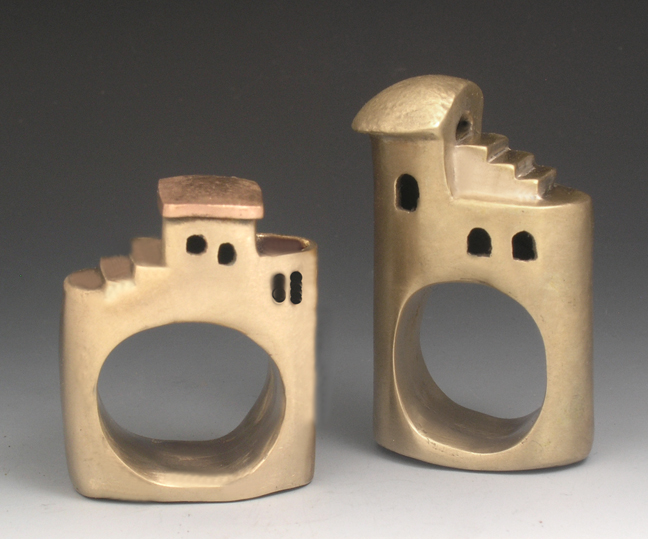
Architectural Rings

I’d like to demonstrate here a more basic project that may help get you started. It includes a lot of photos, but only because I wanted to show every detail. The project is actually very simple. The instructions for feeding the barrel of the ClayMill extruder are somewhat different from the instructions I’ve been giving in my books regarding the smaller extruder. The project explains and demonstrates this.
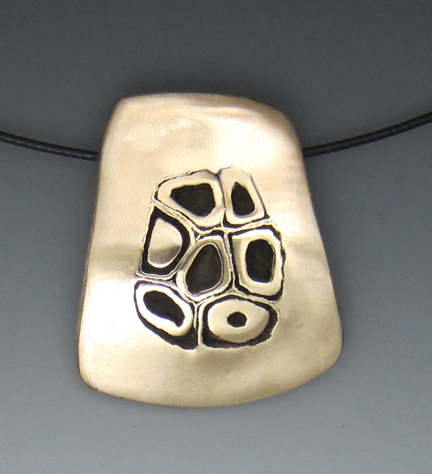
Mirror Image Earrings

For your convenience the project is available as a PDF file so you can print it out and attach it to the book. Here it is.


Nov 18 2012

Holiday Project – Golden Spoon (and Fork)

The holidays are upon us and we are prepared to put on some weight. This project for dysfunctional fork and spoon may inspire you to eat a little less. The project is linked at the very bottom of this posting.

But first I’d like to refer you to a blog posting that I wrote exactly one year ago. I wrote that posting after Sharon Elaine Thompson, in the December issue of Jewelry Artist Magazine (Lapidary Journal) counted my work with metal clay powder among the 10 Most Influential Developments in the past decade “that have had or are soon likely to have the greatest impact on jewelry making today.” I feel just as thankful as I felt then, and would like to repeat what I said at the time, word for word:

“I would also like to thank you all for sticking with me throughout this journey, determined to make it work. I have learned a lot from your questions and from the problems you have encountered, and because of them I feel better equipped to continue my support.”

As for this project: it is a simplified version of a project that was published a few years ago in Lapidary Journal. During the holidays, if you have some time for yourself, or if you need some time for yourself, this non-complicated project may keep you busy and maybe put a smile on your face. Here is is, and here is my daughter Naomi, who made me crop out her beautiful face, wearing them (note the shadow that they cast).

Naomi 1

Naomi 2

Here is the project. Enjoy!


Nov 11 2012

New Use for White Bronze

This is something I should have thought of long ago. In all my instructions for using White Bronze in combination with other metals I said that the other metals have to be fired first, then White Bronze has to be added in a MECHANICAL WAY and then fired again at low-fire schedule.

That is still true, but there is an easier way. You can make the whole piece out of higher firing clays, and then paint White Bronze on parts of it.

I was looking at an old piece of mine that I made when only bronze and copper clay were available. Now that we have so many more options, it looked boring to me.

Piece in bronze and copper

I made some paste from White Bronze, and painted the roofs and the road with it.

Painting in White Bronze

I let it dry, and repeated this three more times, just like we used to do with gold on silver.

I recreated the texture on the road, using a needle tool.

Recreating texture with needle

Then I fired it for one hour, no pre-firing, at low-fire schedule. I sanded the roofs with 220- and 400-grit sandpaper. The White Bronze did not come off.

Finished

I recently made this ring from Brilliant Bronze.

Brilliant Bronze ring

I painted the roof with 4 layers of White Bronze paste.

Painted roof with White Bronze

Fired 1 hour, no pre-firing, at low-fire schedule. The White Bronze picked up the texture of the Brilliant Bronze underneath, so I just buffed it and left it not sanded.

Ring

This works with copper and all types of Quick-fire Bronze. It does not work with steel, since the temperature is not high enough for the two metals to fuse.


Nov 11 2012

Now Available: Traditional (Flex) Brilliant Bronze

Traditional (Flex) BB 100

Traditional (Flex) BB 50

So far, Hadar’s Clay™ Traditional (Flex) clays were available in copper, bronze, steel, and Rose Bronze. Now, Traditional (Flex) Brilliant Bronze (in gold color) is available as well.

For those of you who are new to the blog or to the world of metal clay, Traditional (Flex) clay is clay that stays flexible after it has been dried and allows us to weave, braid, knot, fold, and sometimes even knit and crochet. After the powder clay has been mixed with water, it needs to be mixed with glycerin. Full instructions can be found in my book, The Handbook of Metal Clay: Textures and Forms, 2nd edition. The third part of that book is dedicated to flexible clay, including preparation and projects.

You can also watch a video clip about Traditional (Flex) clay on YouTube.

Rubber bands

The project for the earrings above, made in Traditional (Flex) Brilliant Bronze, is on p. 106 of my book, The Handbook of Metal Clay: Textures and Forms, 2nd edition.

Here is a project for the earrings pictured below. Those of you who are familiar with flexible clay may want to read through, since it contains new tips.

Doodle

  1. Roll a layer of Traditional (Flex) Brilliant Bronze, 4 cards thick. Out of the layer cut 2 strips, about 3 mm wide. Wrap them around a mascara or lipstick container, seal the joints, and dry. These will be the “frames.”

    Important note: Steps 1-3 can be done with Traditional (Flex) Brilliant Bronze without mixing it with glycerin, since no flexibility is required here. However, they cannot be done with (non-flexible) Brilliant Bronze, since its shrinkage rate is lower.

  2. Wrap around container

  3. Remove the frames from the container. Roll another layer of Traditional (Flex) Brilliant Bronze, 4 cards thick, wet it, and lay the frame on top of it with slight pressure.
  4. Lay frame on top

  5. Cut the excess clay around the frames, and dry. Now you have 2 open “boxes.”
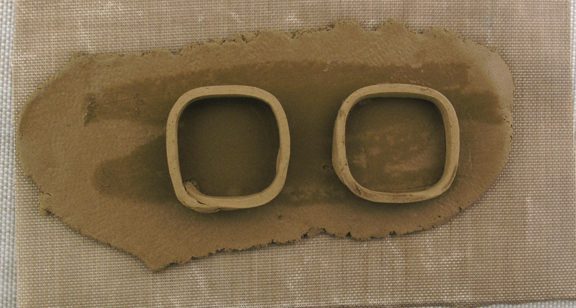
  6. Two open boxes

  7. For this step, use the clay after it has been mixed with glycerin. Roll another 2 strips, 2 cards thick, about 5″ long. Let them dry in the air or in a dehydrator.
  8. 2 more strips

    Tip: After the strips have dried, cool them for 10 minutes in the refrigerator. Before moving on to the next steps, release hard knots from the strips by following this procedure: Hold the end section of the strip between the thumbs and forefingers of both hands (left and right thumb touching, left and right forefinger touching), and wiggle/roll gently to release knots in that section. Then move along the length to the next section and repeat the process. Continue all along the strip.

  9. Attach one end of the strip to the inside of the frame, using paste. When drying, try to keep the rest of the strip away from the heat.
  10. Tip: With flexible clay always use paste, and avoid using water! Water may cause the dry clay to disintegrate.

    Attach end inside frame

  11. Start scrolling the strip inside the box.
  12. Scroll strip inside box

  13. Continue until the entire length of the strip is contained in the box.
  14. Entire length in box

  15. Move the end of the strip towards the center of the box (you can use tweezers). Secure it in place with paste. Dry.
  16. End near center

  17. Roll a layer of Traditional (Flex) Brilliant Bronze (not necessarily mixed with glycerin), 8 cards thick (2 Popsicle sticks). Cut out 2 circles, using a tube or a straw.
  18. Cut out 2 circles

  19. Cut off the bottom third of the circles. Dry them, and attach them to the top of each earrings with paste. Dry.
  20. Attach

  21. Drill holes in the circles for the ear wires.
  22. Drill holes

  23. Fire the earrings 10 degrees below mid-fire schedule. (See firing instructions in my Instruction Manual for Hadar’s Clay™.)

  24. Finish the earrings, following the instructions in the document entitled “Finishing Fired Metal Clay.” If the background is not black coming out of the kiln, use liver of sulfur.

  25. Attach gold-plated ear wires.

Nov 1 2012

2013 Travel-teaching Schedule

My travel-teaching schedule for 2013 has been updated. You can also access it by clicking on “Hadar’s Travel-teaching Schedule 2013” in the right-hand panel of my blog.

Many classes have been added (about 13 in total), including in Canada (Montreal, Ottawa, Edmonton, Vancouver, and Victoria) and in Kansas City, MO.

The focus of all workshops will be “What Clay to Use and When,” and they will include projects for Brilliant Bronze and combinations of high-fire clay (steel, copper, and Bronze XT).

Holey Pendant

Brilliant Bronze

Rock

Brilliant Bronze

Klimt

Bronze, copper, steel

Circle Pendant

Steel, copper, Bronze XT

Advanced workshops will cover architectural rings in metal clay.

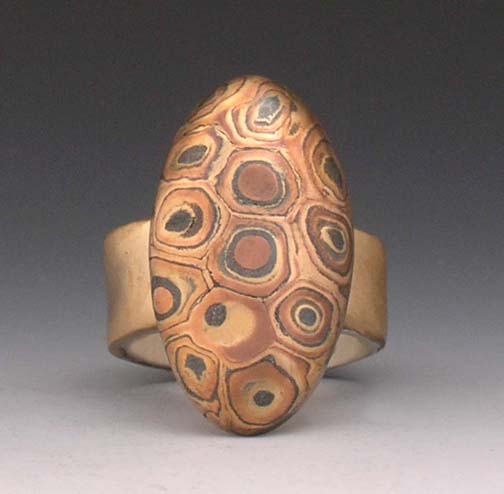
2 BB Rings

Brilliant Bronze, Rose Bronze

2 Steel Rings

Steel, copper, bronze XT

Mission

Brilliant Bronze and Rose Bronze

Lighthouse

Copper and steel

In Steel

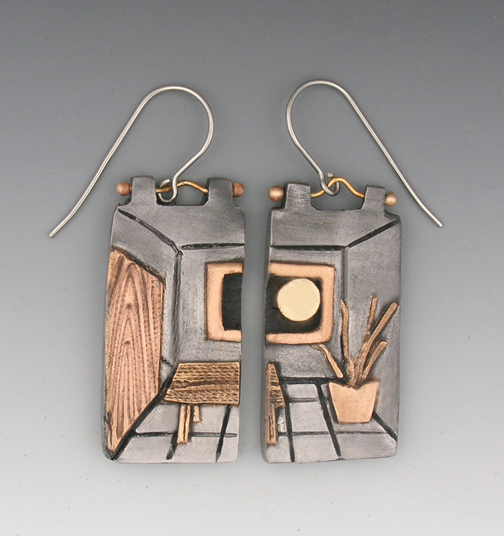
Steel, copper, bronze XT

For the convenience of my local students, next to every workshop are mentioned the dates on which my Berkeley studio will be closed. During my absences the Online Store and Customer Service will continue to function as usual. As always, I will still be available via email for support, although with some possible delays.

Any changes to the schedule will be announced separately. If you have any special wishes, please contact the hosting venue.

Looking forward to meeting you all!


Oct 15 2012

Oyumaru/Instant Mold and Images from a Workshop in Hamburg

Those of you who have read my book Patterns of Color in Metal Clay, and my new book Metal Clay Practice, know that I use resin molds to make color-patterned cabochons. For example:

Oval cab

Table

Resin molds are available in many shapes, but sometimes we want to create our own shape. This can be done by pressing an object into a mold material. Here are some possible objects:

Objects

Rocks, building blocks, glass nuggets, real cabochons, beads, etc….

This mold material is thermo plastic that comes in the form of sticks, which feel like an eraser.

Thermo plastic

Put in in a bowl and immerse in boiling water.

Immerse

After 2-3 minutes the stick will soften and become clay-like. Take it out (Careful! It’s hot!) and form in into a chunk. Push your object into the chunk.

Chunk

It will cool down quickly, but I suggest waiting a few minutes to let the mold harden before pulling out the object. It will be flexible even when hard.

Mold

I used this mold to make this piece from Brilliant Bronze and steel:

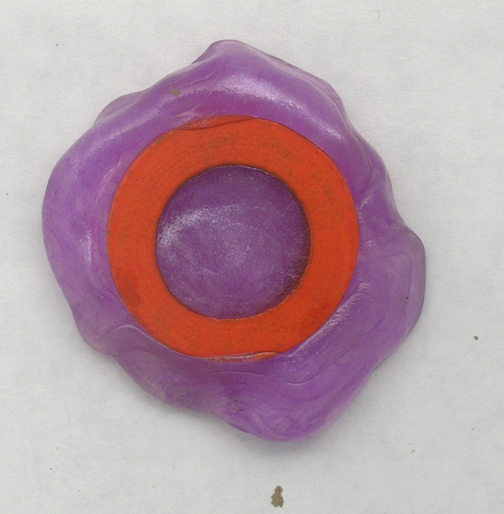
Piece

The advantages of this mold material are the immediacy, the low cost, flexibility, and the fact that it is indefinitely reusable. You can trim away with scissors any excess material around your mold and use it again. Also, if you didn’t get it right the first time, you can start over, unlike other mold materials.

As far as I know, This mold material is available in the US from Art Clay World and Amazon, in Canada from Metal Clay Alchemist, and in Europe from Susan D. Design.

I just came back from a 4-day workshop that Susan hosted at her workshop near Hamburg, Germany. I will soon show photos but first let me tell you how it is related to this mold material.

Some of you may remember that for about 14 years I’ve been looking for a texture of raindrops running down a window pane. I did some crazy things to get it (like standing in the rain with a piece of glass and immediately freezing it), but all in vain. On my last day in Germany, while taking my morning shower, I noticed that the water running down the acrylic doors of the shower is actually a texture. I had half an hour before leaving for the airport. I boiled water and pressed the mold into the shower door.

Shower

It’s a little hard to see because the mold was translucent like the door. Here is happy me having the texture at last:

Happy Me

The workshop was wonderful. People came from Germany, UK, Estonia, Austria, and Holland. Sorry for the poor quality of the photos; all I had was my cellphone.

Group

Piece

Brilliant Bronze

Brilliant Bronze

Piece

Piece

Brilliant Bronze

Brilliant Bronze

Brilliant Bronze

Brilliant Bronze

Piece

Piece

Piece

Piece

Piece

Piece

Brilliant Bronze

Brilliant Bronze

Piece

Piece

Piece

Piece

Piece

Piece

Piece

Brilliant Bronze


Oct 10 2012

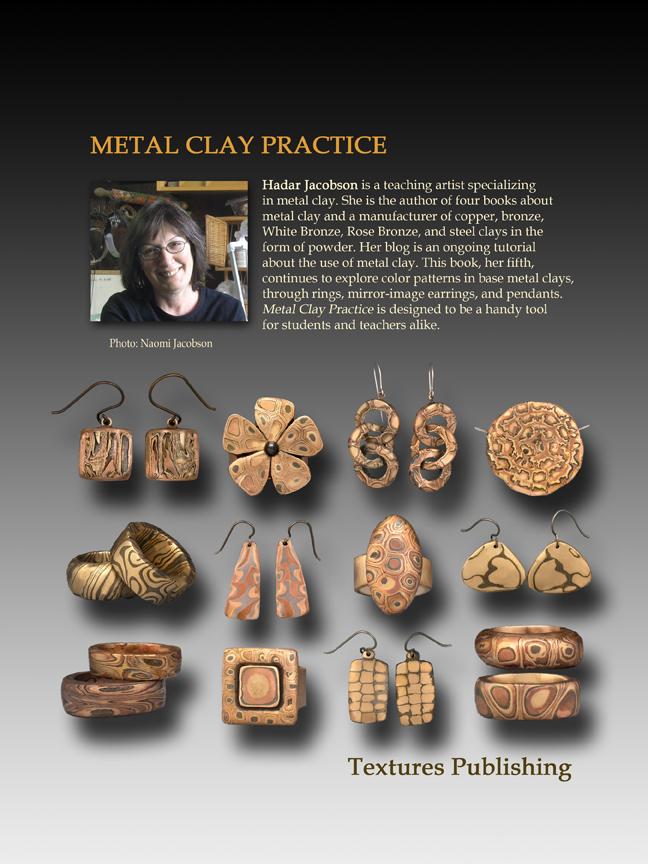
My New Book is Now Available

My fifth book, Metal Clay Practice, has arrived and is now available on my Online Store. All pre-orders have been shipped and should arrive soon, if they haven’t already.

Book 5 Front Cover

Front Cover

Book 5 Back Cover

Back Cover

Inside Title Page

Inside Title Page

Here is a link to the Table of Contents.

A big thank you to all the artists who contributed photos of their work to the book!


Sep 24 2012

Golden Threads – Free Project for Brilliant Bronze

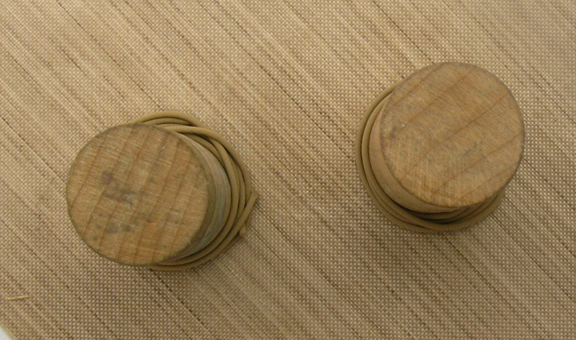
You will need a clay extruder, a disc with the smallest round hole, and a cylinder mold, such as a dowel or a mandrel.

1. Set the cylinder on your work surface. Fill the extruder with a chunk of Brilliant Bronze. Start extruding the wire, using a circular motion, to wrap the the wire around the mold.

Start wrapping

Keep wrapping

2. Continue until you are satisfied with the thickness of the wrap. Be sure that the wire ends at the beginning of the wrap.

Finished wrapping

3. You can remove the mold immediately and let the wrap dry.

Let the wrap dry

or: use a second mold for the second earring, and let the wraps dry around the molds.

Drying on molds

4. Optional: If you don’t want the back of the earrings flattened, once the wire is dry turn it over, insert the mold in the center, and wrap-extrude some more wire on the other side.

5. Cut a narrow strip, 2 cards thick.

Cut a narrow strip

6. Fold the strip around the top of the earrings and join its end.

Fold & join

7. With nail scissors, cut away the excess from the strip. Dry.

Cut away excess

7. Drill a hole in the part of the strip that sticks up.

Hole in strip

8. Fire about 6-8 degrees below mid-fire schedule.

9. To finish, tumble the earrings. Then sand the strip with 220-, 400- and 600-grit sandpaper and polish with rouge. (See finishing instructions in the document entitled “Finishing Fired Metal Clay“, linked on the right-hand panel of this blog.)

Wire earrings

The ear wires are gold filled.