Mar 12 2014

Architectural Ring from White Satin

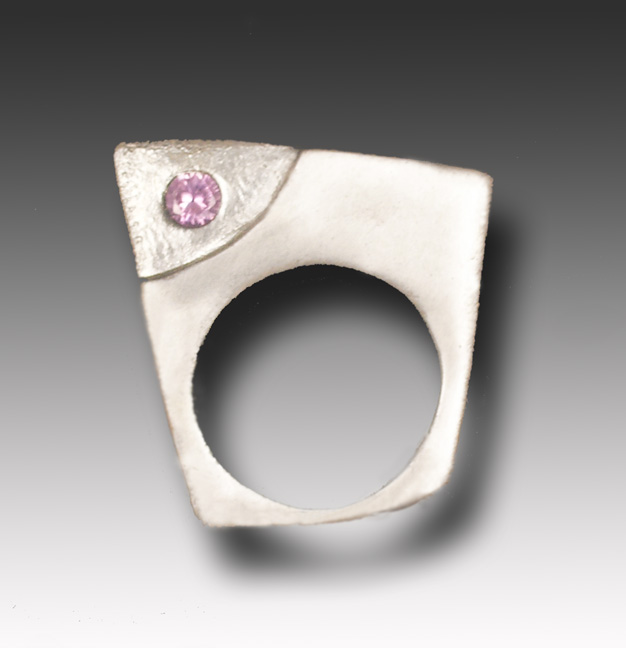
This is the first architectural ring I have made from White Satin. Fired at 1680°F (brick kiln) for 2 hours (no pre-firing), it came out without a crack. No repair whatsoever. The natural sapphire set in it retained its original color.

Here are some photos showing the ring from different angles:

Architectural Ring

Architectural Ring

Architectural Ring

Architectural Ring

In response to the the many questions that we have been getting, here is the MSDS for White Satin.

To see people’s testimonials about White Satin please visit the Hadar’s Clay Support Forum.

Stay tuned: on the weekend we are about to release new products: Dark Champagne Bronze, Friendly Rose Bronze, Friendly Bronze, and the Mokume-gane sampler. All one-fire clays. There will be two separate postings for these clays.


Mar 4 2014

Book Updates

Friendly Bronze and the One-fire Mokume-gane Sampler will be released on March 14. The instruction manual for these products has been uploaded to the blog and can also be accessed from the right-hand pane.

Two of my books are running out of print again: The Handbook of Metal Clay (2nd edition) and Mixed Metal Jewelry from Metal Clay. This has posed a dilemma for me. Do I revise them or just re-print? If I just re-print, they will be outdated. On the other hand, if I revise them, by the time they are published I will probably have to revise them again. The field of metal clays goes through rapid developments, for some of which I have to take some responsibility. Things change faster than the time it takes to revise a book.

So here is what I have decided to do: I am going to re-print the books as they are. At the same time, this blog now has a new section, accessible from the top of the page, called “Book Updates.” Once in a while I will post updates to projects that exist in the printed books. These updates will not necessarily be written or posted in the order in which they were published. The updates will be posted from time to time in the form of short PDF files that you can print out and insert in your books, right next to the specific project(s) they update.

This will help to ensure that your books are up to date with recent metal clay developments, even if you have a version of the book that was published a few years ago. It also saves me the time it normally takes to revise and publish a new printed edition. And, it makes it unnecessary for you to purchase a revised edition of a book you already have. Everybody wins.

If you have questions about certain projects in the current books or if you have photos of pieces inspired by projects, please send them to me. I may be able to answer questions and include (good quality) photos in the updates.

The three first updates, pertaining to The Handbook of Metal Clay (second edition), have now been posted in the “Book Updates” section

With every update, blog subscribers will receive a note. The updates are part of our product support and are free of charge.


Feb 28 2014

Married Metal – Free Project

Before we get to the project, I’d like to invite you to join a new Facebook Group called “Hadar’s Clay Support Forum.” This is an open group, established and administrated by Hadar’s Clay accredited teachers. If you are a user of my clay, this is the place for you to discuss, consult, raise issues and share. You will meet the most knowledgeable and generous people. If you want to sign up for the third accreditation round, please contact me via email.

Second, I’ve cut back on my travels by a lot this year, but I do have 3 workshops scheduled, on the topic of “Constructing a Scene” with the new clays. This workshop is about perspective, low relief, and reverse construction. Please contact Metal Clay Alchemist for workshops in Toronto and Victoria, Canada, and Studio 34 Creative Arts Center & Galleryfor a workshop in Rochester, NY.

Now to married metal.

For those of you who are new to the jewelry profession terminology, “married metals” means one continuous surface of metal composed of different metals, as opposed to a segmented surface, where there is a space separating one metal from another. The pieces in the photos below have a similar pattern, but in the first the metals are are actually touching each other, while in the second they separated from each other by an empty space.

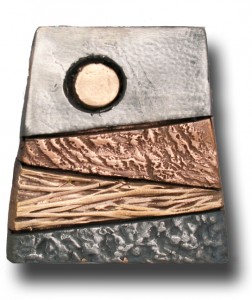
Married metal

Not married metals

Note that the transition from one color to the next is not gradient. It is abrupt, but seamless.

The following is a project – with two variations – for married metal earrings in metal clay.

Tropicana

Married Metals in Friendly Copper and White Satin

Materials: Friendly Copper, White Satin.

1. Roll a layer of Friendly Copper, 8 cards thick.
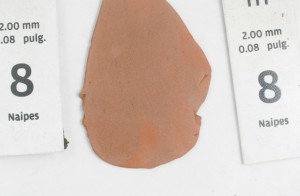
8 cards thick

2. Roll a layer of White Satin, 4 cards thick.

4 cards thick

3. Cut two small circles out of the White Satin layer.
Cut out circles

4. Place the circles on the Friendly Copper layer with a good distance between them.
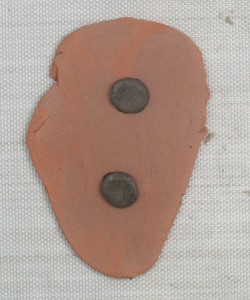
Circles on layer

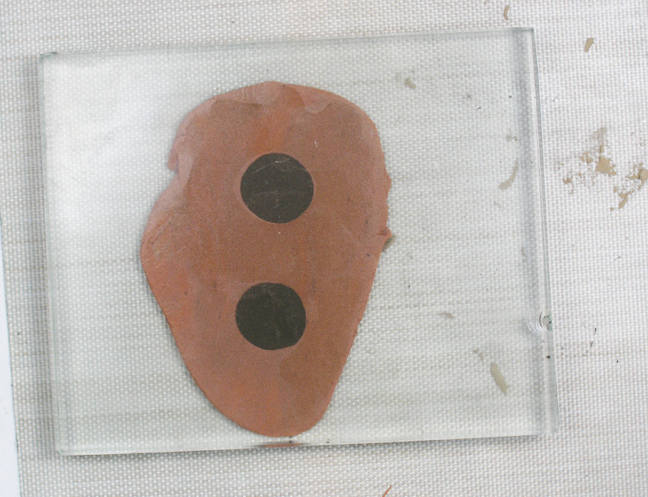
5. Oil a glass or acrylic board, and press down on the circles until they are flush with the copper layer. Remove the board. Don’t do this step by rolling the layers flush with a rolling pin; this will make the circles oval.

Press down

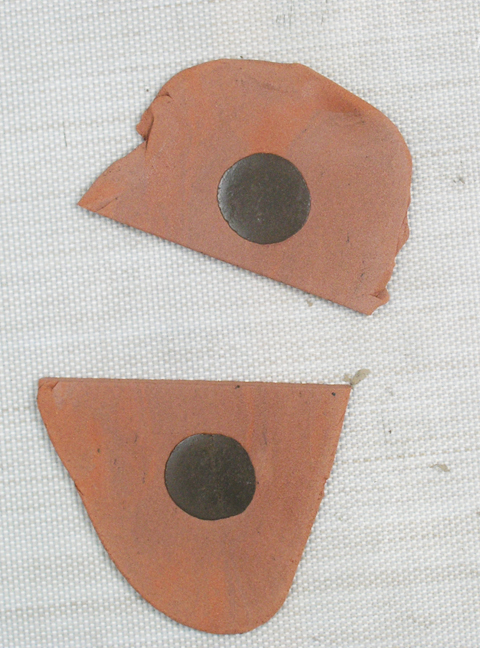
6. Cut the copper layer in half.
Cut layer in half

7. Press each half, face down, into a texturing mold.
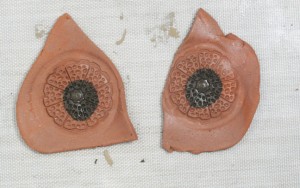
Place in mold

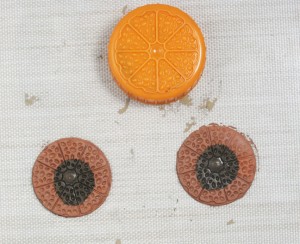
8. Cut a circle out of each layer.

Cut a circle

9. Dry the circles and drill a hole in each one for the ear wire.

10. Fire the earrings for 2 hours at 1730°F-1750°F (brick kiln); 1780°F-1800°F (muffle kiln). Finish the earrings following the instructions in the document entitled “Finishing Fired Metal Clay” (also linked in the right panel of this blog).

Variations

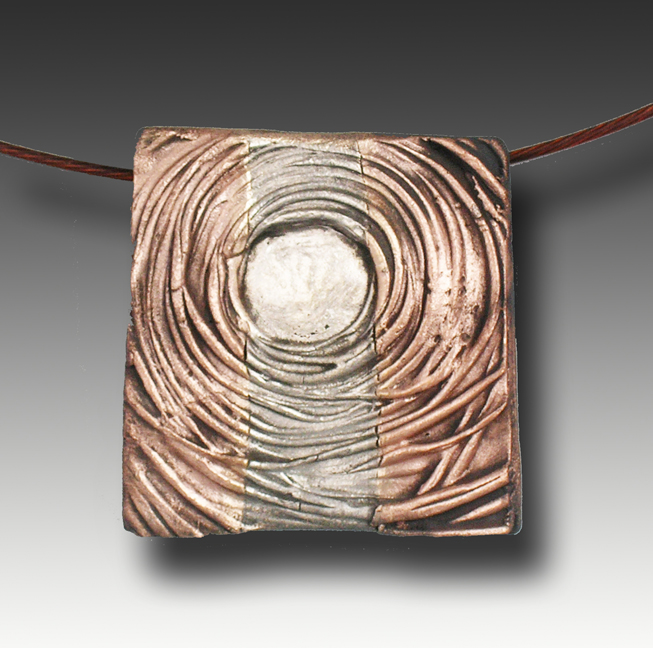
Two-tone Pendant

Friendly Copper and White Satin

Two-tone Pendant

1. Arrange 2 strips of Friendly Copper on each side of a White Satin strip – all 8 cards thick.
Arrange strips

2. Lay them as one layer over a texturing mold. The one I chose is “Wires 4“.

Lay over mold

3. Press the strips against the mold and against each other at the same time. They should stick together.

Press

4. Remove the clay layer and turn it over to examine your results.
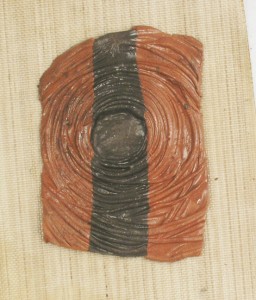
Remove, turn over

5. Cut the layer to the desired shape. Roll a layer of Friendly Copper, 4 cards thick, and lay the cut layer on top of it.

6. Cut the copper backing layer to the shape and size of the top layer.
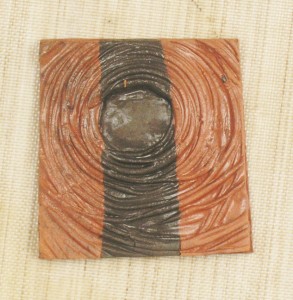
Cut layer

7. Dry. Seal the gaps between the layers with Friendly copper. Dry again, and add a bail on the back of the piece.

8. Fire the earrings for 2 hours at 1730°F-1750°F (brick kiln); 1780°F-1800°F (muffle kiln).
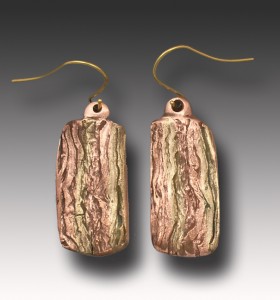
Two-tone earrings

Two-tone earrings

Earrings

These earrings can be made with two combinations: Friendly Copper and Friendly Bronze (not released yet); Friendly Copper and Champagne/Dark Champagne Bronze.

1. Make 2 snakes out of bronze and 2 out of copper. Arrange them in the mold next to each other in an alternating way. The mold used here is Wood Grain 2.
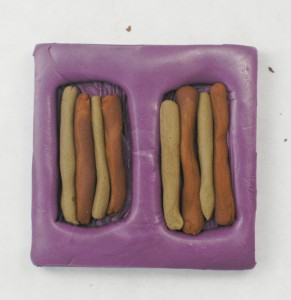
Arrange snakes

2. Press the snakes into the mold and against each other.

Press

3. Release the layer from the mold and turn it over.

Release, turn over

4. Follow the rest of the steps in the first variation.

5. If you used Friendly Bronze, fire 2 hours at 1510°F (brick); 1560°F (muffle). If you used Champagne/Dark Champagne fire at 1750°F (brick); 1800°F(muffle).


Feb 19 2014

White Satin is Now Available and Future Plans

Hadar’s Clay™ White Satin is now available on our online store.

White Satin is high-fire clay which makes a strong, silver-color metal. It is fired in one phase only and is compatible with Champagne Bronze, Dark Champagne Bronze (not available yet), Friendly Copper, and Low-shrinkage Steel XT. All can be fired in one piece. You can find the Instruction Manual for White Satin in the right-hand pane of this blog.

White Satin ring with bronze and copper

White Satin ring with bronze and copper

White Satin ring with bronze and copper

White Satin ring with bronze and copper

White Satin next to steel

White Satin next to steel

In the coming months we will be releasing four more products, all meant to simplify the firing process. They all fire in just one phase and this is why we call them Friendly:

Dark Champagne Bronze is also a “friendly,” high-fire clay. It fires just like Champagne Bronze, but its color is darker and resembles Quick-fire Bronze.

Champagne and Dark Champagne Bronze

Left: Champagne Bronze; right: Dark Champagne Bronze

Friendly Rose Bronze is the same as Quick-fire Rose Bronze but fires in one phase only.

Friendly Bronze is a mid-fire clay, the same as Quick-fire Bronze, but fires in one phase only. The color is similar to that of Dark Champagne Bronze so there are actually 2 one-fire bronze clays. The reason for mid-fire Friendly Bronze is the following item:

One-fire Mokume-Gane Sampler is a sampler containing 50 grams of Friendly Bronze, 50 grams of Friendly Copper, and 25 grams of Pearl Grey Steel XT. For mokume-gane lovers, this combination is mid-fire, fires in one phase, and results in a smooth surface that is easy to clean.

Good results for Mokume-gane are achieved in the mid-fire range only. At high-fire schedule there will be no sharp contrast between the colors.

For your convenience, here is a document which describes our new line of products graphically.


Feb 12 2014

Accredited Teachers for Hadar’s Clay

Twenty-two people have completed the Accreditation Program for Hadar’s Clay Teachers so far. Twenty more are expected to complete it within the next two months and another 20 by summer 2014.

The names and information of the accredited teachers are now on a special webpage on my website. (This page can also be accessed by clicking the “Accredited Teachers” button in the left-hand pane of my website. New names will be added to the webpage as people complete the program.

The accreditation is a year-long program. People who received their accreditation have completed challenging assignments and are not only outstanding artists but also wonderful teachers with investigative minds and extensive knowledge and practice with Hadar’s Clay, as well as with the firing process and the nature of metal clay in general. I encourage you to contact Accredited Teachers in your area for classes and support.

Accredited Teachers stay active on a dedicated online forum and receive ongoing guidance and support regarding new products and techniques.

If you wish to become an Accredited Teacher please contact me personally at my email address.


Feb 6 2014

Coming Soon! White Satin

The mystery guest is Hadar’s Clay™ White Satin. This is a new clay which makes a white metal that is the color of silver. Unlike White Bronze, it is high-fire, easy to sinter, and very strong after firing. This is one of a few clays that we are developing with the purpose of simplifying the firing process and expanding the color palette.

1

The Instruction Manual for White Satin can be accessed from the right panel of this blog.

White Satin is fired in one phase only for 2 hours. On its own, it can be fired at a wide range of temperatures – between 1680°F and 1720°F (915°C and 937°C) for brick kilns. When fired combined with other metals in one piece it can be fired in a brick kiln at 1750°F (954°C).

In muffle kilns it is fired 50°F (28°C) higher.

In the MiniElectric 1800 kiln it fires on setting #8 on its own and at #9 combined with other metals.

White Satin is compatible with other high-fire clays such as the One-Fire Sampler: Champagne Bronze, Friendly Copper, and Low-shrinkage Steel XT.

2

3

4

White Satin is also compatible with gemstones.

5

6

7

8

When? We are hoping to make it available by February 20. We will send a separate announcement.


Feb 3 2014

Mystery Guest – Answers and More

Here are the answers to my recent Mystery Guest posting:

In group 1: The mystery metal is the square on the top left in the first photo; on the far right in the second photo. The rest are silver.

In group 2: The mystery metal is the two trillion-shaped lentils (top two in the first photo). The other two are silver.

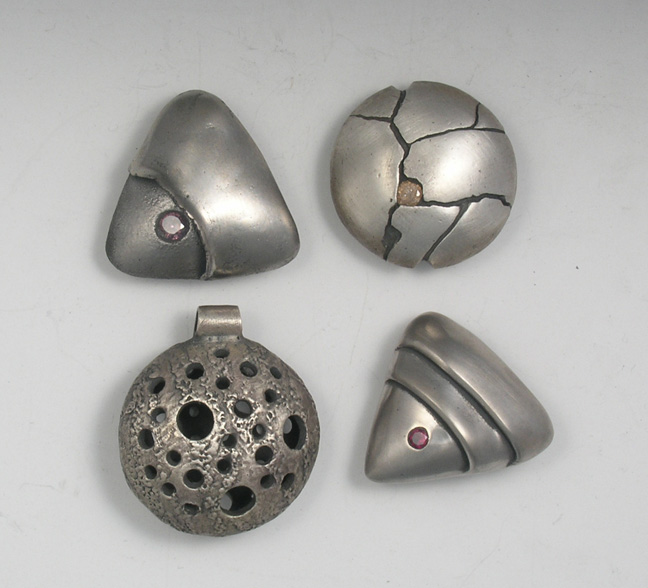
In group 3: The mystery metal is the triangular-shaped hollow form. The rock is White Bronze. The rest are silver.

In group 4: The mystery metal is the one on top in photo 1 and the one on the bottom in photo 2. The piece with the windows is White Bronze. The third piece is silver.

Over the weekend I made molds from two pieces that I made from silver a few years ago. I pressed the mystery metals against the molds and fired them. They shrank about 30%, just like the original PMC.

Here are the pieces, photographed on a gray card, side by side (the bigger one is silver):

1

2

3

4

Then I photographed a mystery metal piece next to a steel piece:

5

6


Feb 1 2014

Who is the Mystery Guest?

The following questions have been presented to people at my studio live, not in the form of photos. These are unedited photos of some pieces, taken on a photographic gray card, under the same lighting conditions. Some of the pieces are silver and some are not. For each group of pieces several photos were taken. In each photo the pieces are arranged differently, to rule out the lighting factor. I hope you play along. Those of you who already know the answer, please don’t give it away.

1. One piece in each of these photos is not silver or White Bronze. Which one is it?

Picture 1

Picture 2

2. In this group, two hollow forms are made of silver and two are neither silver nor White Bronze. Which ones are silver and which are not?

Picture 3

Picture 4

Picture 5

Picture 6

3. In this group of hollow forms, two pieces are made with silver, one is made of White Bronze, and one is neither silver nor White Bronze. Which ones are silver, which one is White Bronze, and which one is not?

Picture 7

Picture 8

4. In this group, one of the pieces is silver, one is White Bronze, and one is neither. Which one is which?

Picture 9

Picture 10


Jan 20 2014

Champagne Bronze and Steel

One thing that was impossible to do before the One-fire Trio is to fire bronze and steel together to get the amazing contrast between black and gold colors. Here is a project for this combination, which is now easy thanks to the One-fire Trio. The clays I used are Champagne Bronze and Low-shrinkage Steel XT.

Pendant

And here are a few photos of other pieces I have made with this combination.

Circles

Windows

Bird and sun

Fold

Starry Night

Wrapped

Four-piece Necklace

Wird

Earrings 1

Earrings 2

Earrings 3


Jan 14 2014

One-fire Trio Follow-up

In the past weeks I’ve been going through my books, making old projects with the new Trio. Everything is so easy and fast now – one short firing, no compatibility issues. I hope you’ve had a chance to play with the One-fire Trio, starting with the beginners projects I posted last week. If you are out of ideas and would like to experiment some more, here are a few suggestions:

Changing Places

Changing Places

Changing Places

The instructions for making pieces like this (a technique I call “Changing Places”) can be found in the book: The Handbook of Metal Clay: Textures and Forms (2nd edition), pp. 21-26.

Keep in mind: it’s best to make backing layers out of steel, 6-8 cards thick. It will hardly add any weight to the pieces, since steel is so light. This does not apply to pieces where the steel is used in just small amounts:

Bird

The bird in the photo above is colored with Super Blue Patina.

The Trio doesn’t work so well for mokume-gane, or wherever a high contrast is required. The reason is that steel does not react with Baldwin’s Patina when fired at the high temperature required for the Trio. Super Blue Patina will darken all metals, not only steel.

Hollow Form

Hollow Form

The core of the two hollow forms above is made with Champagne Bronze, since it has the highest shrinkage rate.

Skyline

I am making now pieces made out just of Steel and Champagne Bronze. Next posting will include a project and some photos.

Bird