Nov 3 2011

New Video – Shortening the Firing Time

I recently taught a 4-day class in Waltham, MA. There were 12 people in the class and one of them was kind enough to bring in a double-burner camping stove. We did all our pre-firing (first phase – binder burnout) on the stove. The second phase was done in three front-loading kilns. If you have ever taken one of my workshops, you know how many pieces can be created in the course of 4 days. However, while at my previous classes people had typically waited for their pieces to be fired, this time the kilns were waiting for them. We fired twice a day, sometimes three times. We ended up firing almost all the pieces before the class was over.

This photo was taken by Nicki Piaget:

And these beautiful pieces are the creations of Maggie Bokor:

As I wrote in an earlier posting and follow-up, firing the first phase over a stove top can save hours of firing time! Here is a video showing the whole quick process from beginning to end. Enjoy!


Oct 6 2011

Hadar’s Clay™ Sampler

Hadar's Clay™Sampler

Hadar's Clay™ Sampler

The Hadar’s Clay™ Sampler is now available on my online store. The kit includes 25 grams each of Quick-fire copper, Quick-fire bronze, White Bronze, Rose Bronze, and Pearl Grey Steel XT.

The sampler can serve as a low-cost introduction to the wide range of clay. It is recommended to use it to make test pieces to find the correct firing schedule for your individual kiln. The instructions for using the clay, as well as making test pieces, can be found in the instruction manual for Hadar’s Clay on the right-hand pane of this blog.

Here is the range of colors that this kit can produce:

Rocks

Rings

From left to right: White Bronze, copper, bronze, rose bronze, and Pearl Grey Steel. Both Pearl Grey Steels – regular and XT – are the same color. XT is stronger and better for structural purposes.

The powder clay is packed in small screw-top plastic bottles encased in a bubble wrap pocket.

Sampler (Green)

I hope you find it useful.

And a reminder: the deadline for the juried challenge of Metal Clay Today is October 15. The challenge is “Coming Un-hinged”, and one of the prizes is a selection of my clays (500 grams) and one copy of my book Mixed Metal Jewelry from Metal Clay. Please see details here.


Oct 4 2011

What a Bigger Extruder Can Do

On page 68 of my book Patterns of Color in Metal Clay you can see a photo of discs that I made for a polymer clay extruder, 1″ in diameter. This extruder is far from meeting our needs, but that’s all I have for now. I think I must have bought every type of cookie press available – both manual and electric – and they don’t seem to work. I also tried to construct my own from plumbing pipes, but it is not as easy as the 3/4″ diameter one. So I’ve been working with the polymer clay extruder, and I’d like to share my results with you. The extruder is big and heavy, but I will bring it to Studio 34 and Metalwerx next week so we can experiment together.

This is not the bracelet from the project on p. 78. Jennifer has that one, and I hope she is still happy with it. This is a new one. All the links were extruded at once through the slot of a 1″ disc.

These are designs that are impossible to make without a bigger extruder and a matching tube adapter. Here is a photo next to a penny, for scale.

How easy it would be to extrude decent size beads and bead cores.

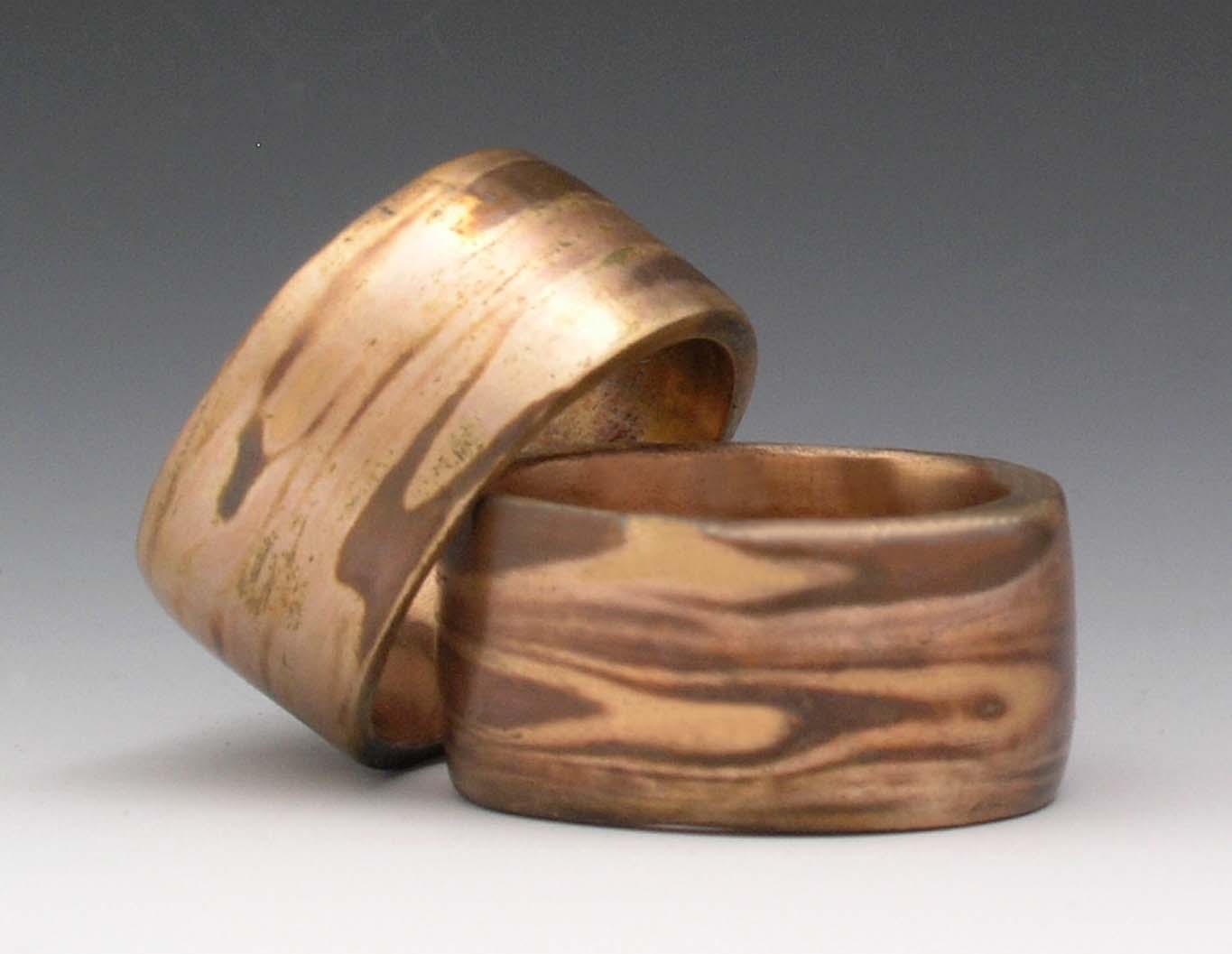
And for those of us who like big, chunky rings:

Speaking of which: it has come to my attention that people think it is possible to smear silver paste on the inside of a ring to avoid allergic reaction with the skin. I strongly recommend against it. If you are familiar with my book Silver and Bronze Clay: Movement and Mechanisms, you probably know how disastrous the reaction between silver and bronze can be. You may end up losing a lot of expensive silver.

This was a copper/bronze mokume-gane ring with silver lining before it was fired. Another ring lost its shank altogether.

Lining rings with silver has to be done in special ways, and I will teach all about it in my Mokume-Gane Rings classes.


Sep 21 2011

Shortening the Firing Time – Follow-Up

There have been a lot of responses and questions about my last posting about shortening the firing time and I’d like to address them here.

First, I must say that I’ve never gone back to firing the first phase in the kiln. Firing on a camping stove, kitchen stove, or the SpeedFire® Cone System™ for Metal Clay seems to work 100% of the time. The advantages:

1. It saves a lot of time. The firing time is practically the same as firing silver clay.
2. You don’t need to worry whether you held long enough at the first phase. When the smoke is gone and the pieces darken, you can be sure that the binder has burned off completely.
3. No need to cool down between phases.
4. In a workshop situation, a lot more pieces can be fired.

Again, this way of firing replaces the first phase only. Once the binder has burned off, the pieces need to be covered with carbon and the box should be moved to a kiln for the second phase.

It’s been reported that an electric kitchen stove works just as well. It makes sense: when the pieces are not covered in carbon, the binder will burn at 400-500F, which is within the capacity of an both electric and gas stoves.

As a lid you can use just a fiber board or fiber blanket with a hole These photos were missing from my last posting.

Top view

Fiber blanket

Watch for the smoke coming out of the hole. If you are not sure (sometimes thin pieces don’t generate a lot of smoke), it is ok to remove the lid with a glove or tweezers to look for the smoke and the color of the pieces.

I have successfully fired big and hollow pieces, including rings. My advice: with complex pieces use low heat; it’s best for the binder to burn out slowly. Still, the firing time rarely exceeds 10 minutes. (Rings need to be positioned in a special way. I will talk about it in my upcoming workshops).

And finally – this works with all base metal clays: bronze, Rose Bronze, White Bronze, copper, and steels.


Sep 14 2011

Pre-Conference Class on Mokume-Gane Band Rings

At the PMC Guild conference in July 2012 I will be teaching a class and giving a presentation.

The Class

On June 19-20 I will be teaching a 2-day workshop on making mokume-gane band rings from metal clay as part of the PMC Guild pre-conference classes. We will practice a few mokume-gane designs. Some of the designs are covered in my latest book, Patterns of Color in Metal Clay, but require some modification when applied to rings. Other designs are new developments. In the workshop we will also cover the firing process for base metal clay in depth, as well as sizing rings and finding solutions to possible reactions between the metal and the skin.

You can sign up for the class on my website. Please have a look at the toolkit required for the class, and email me if you have any questions. Please order clay prior to the class and bring it with you. You can order the clay, a finishing kit, and books on my online store. Since I will be flying in, I will not be able to bring books for sale.

Here are some class samples.

Woodgrain

Woodgrain 2

Veins

Veins 2

Storm

Steel and Silver Lining

Table

Eyes

Condensing

Carving

Cabs

The Presentation

In the conference I will also give a presentation on ways of combining different metal clays. The presentation will cover the nature of metal clay jewelry as opposed to cast and fabricated ones, the sintering process, and ways of combining different metal clays together to create mixed metal pieces of jewelry. I will discuss and illustrate which metals clays can be fired with others and under what conditions. If you are interested, please sign up through the PMC Guild.


Sep 13 2011

Shortening the Firing Time

While experimenting with firing in more efficient ways I discovered something that can shorten the firing time significantly. It seems that the first phase – in which the binder is expended – does not have to be done in a kiln and can be completed in as little as 10 minutes, with no cooling time between phases.

This can be done with the SpeedFire Cone system, on a camping stove, or on the kitchen stove.

Here is how it works:

Pour a 1″ layer of carbon into a small stainless steel bowl. Place your pieces on top of it without covering them in carbon.

Put the bowl on the burner.

Cover the bowl. You can use the cone from the cone system, or the circular fiber box that is actually a firing box, or a fiber board, or a piece of fiber blanket. If you use the cone, cover it with a fiber board or a fiber blanket.

In each of these lids drill a pencil-size hole. To do this in a fiber board or the fiber box you can use a screwdriver. Just twist it in; the fiber is very soft. With the fiber blanket just stick in a pencil to make the hole.

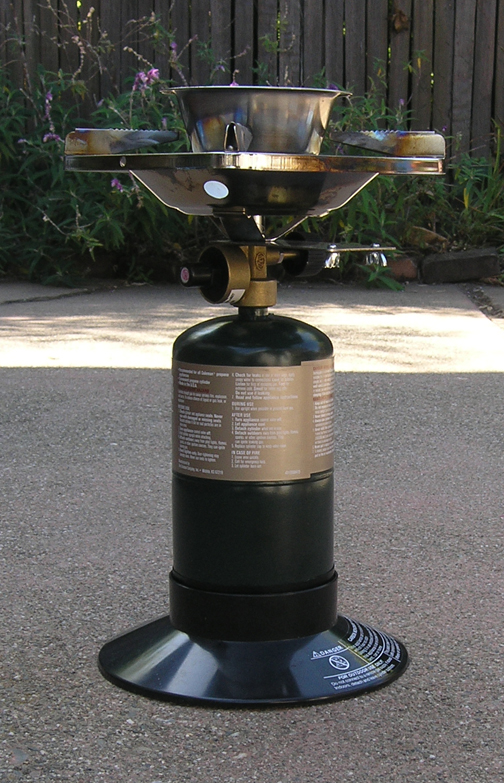
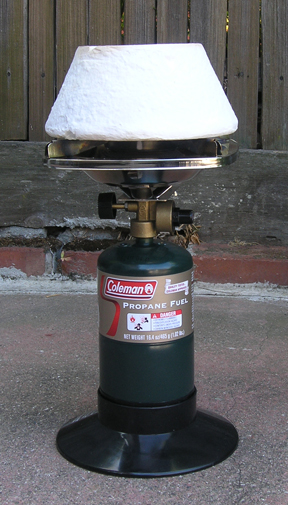
Here are some photos of the set-up:

Fiber board with hole on top

This photo was taken inside my studio, but this should be done outdoors.

Set-up

On the left is the fiber box; on the right is the fiber cone. The pans are flat, but I mostly use simple bowls.

Kitchen

If you do this in the kitchen, the fiber blanket is not recommended. You can protect your stove with aluminum foil.

Turn the flame on to full capacity. After a few minutes you will smell and see the smoke coming out of the holes in the lids. This is the binder burning. I tried to photograph it, but it turns out that smoke and fire are hard to shoot.

After about 10 minutes the smoke will stop. Remove the lid with a glove and peek inside. The pieces should look black.

Before

After

Pour more carbon into the bowl to cover the pieces and put them in the kiln for the second phase of firing. The whole process takes about 2:30 from beginning to end.

I have just fired a batch of thick pieces. If I had done the first phase in the kiln, I would have had to hold for at least 2 hours. Given that the ramping takes about 30 minutes and the cooling time at least on hour, I saved myself 3:30 hours.

Why not burn the binder with a torch?

I have tried this many times. The pieces were positioned the same way, in a bowl with a 1″ layer of carbon. This works only sometimes. In most cases pieces crack from the direct heat, and the cracks do not necessarily show until after the second phase is over.

Why not do the same thing in a kiln?

I have tried this as well. A kiln takes a long time to ramp. This exposes pieces to oxygen for an extended length of time and most probably causes internal oxidation. That means that when they come out of the kiln after the second phase, they may crumble, but not necessarily because they are not sintered: it’s because they are oxidized.

Why is the fiber cone or box necessary?

Without them, it would take a long time for the pieces to heat up and they might oxidize, just as in a kiln. The fiber cone and box create a hotter chamber, partially shielded from oxygen.

A word about internal oxidation: before the advent of base metal clay, I used copper pipes, rods, and wire (solid, or bare, copper, from plumbing supply stores). I used to wrap them with silver clay (low shrinkage) and fire. Cracks would occur because of the shrinkage of the silver, and I had to repair and re-fire. Nothing in the way that the copper looked showed any sign of oxidation. However, after a few repairs, the copper would crumble in my hands.

This is one of the reasons that I avoid firing copper in open air. Even if it looks fine after firing, you never know what is going on inside. Furthermore, sometimes the copper needs to be re-fired, as in repair, enameling, soldering, or adding silver clay. With each firing the copper oxidizes further and weakens, just like what happened with the solid copper.


Sep 8 2011

Notes About Upcoming Classes

I just wanted to post a few notes about my upcoming classes:

1. A spot has opened up at my workshop in Tuscon, AZ on January 28-30 and there are 2 spots left for January 30. Please contact:

Lyle Rayfield
Art Jewelry & Instruction
Tucson, AZ
520-682-8325

bdangled@dakotacom.net

Here is Lyle’s website.

2. The pictorial/architectural intensive at my studio in January 7-11 is filling up. Please contact me if you would like to participate. You can see the class description here.

3. The next travel-teaching class after Tucson will be on April 20-22 at PMC Connection in Dallas. You can sign up as soon as it is posted on their website.


Aug 21 2011

Upcoming Special Workshops in January-February 2012

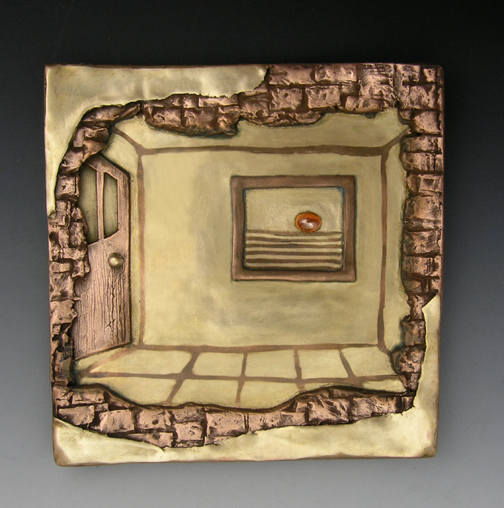
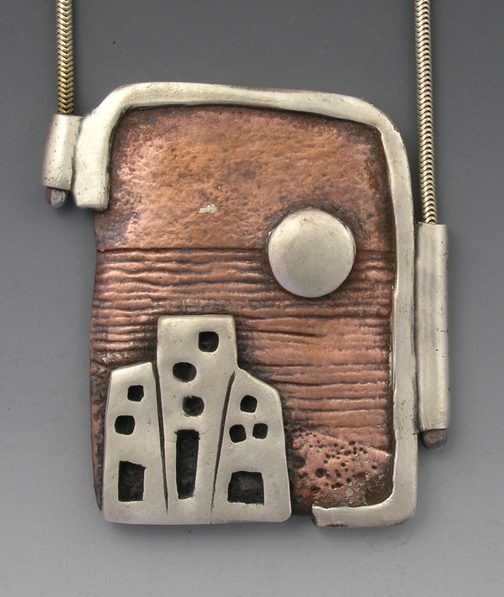
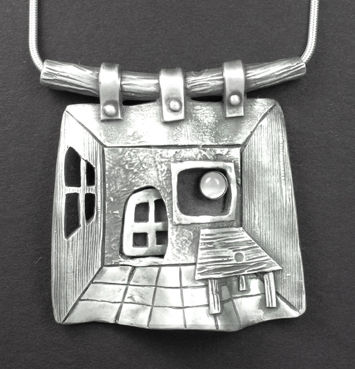
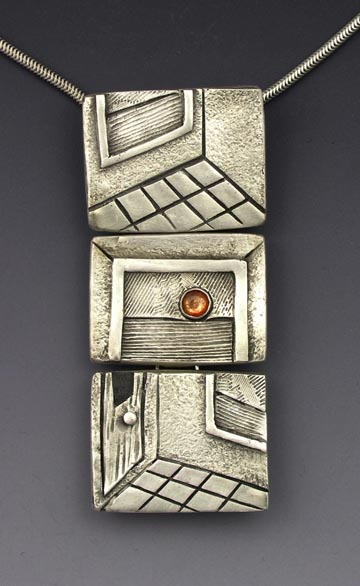
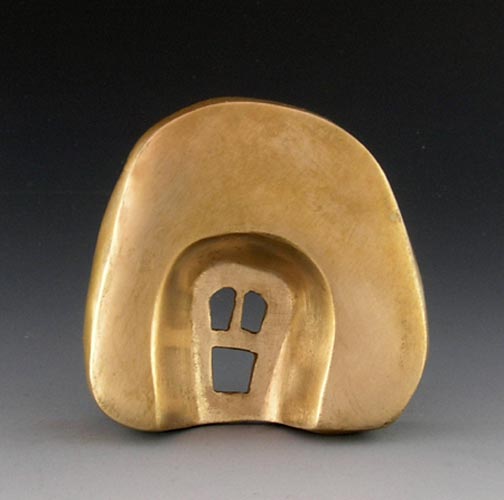
The first 5-day intensive I will be teaching next year at my studio will be on January 7-11. By popular demand, the focus will be pictorial and architectural jewelry, but mokume-gane may be covered as well. We will make at least two pieces, one flat and one 3D. The flat pieces involve using perspective, while the 3D involves constructing hollow forms, including rings. Here are some samples (more available here). To sign up for my January Intensive Workshop click here.

Pictorial (flat)
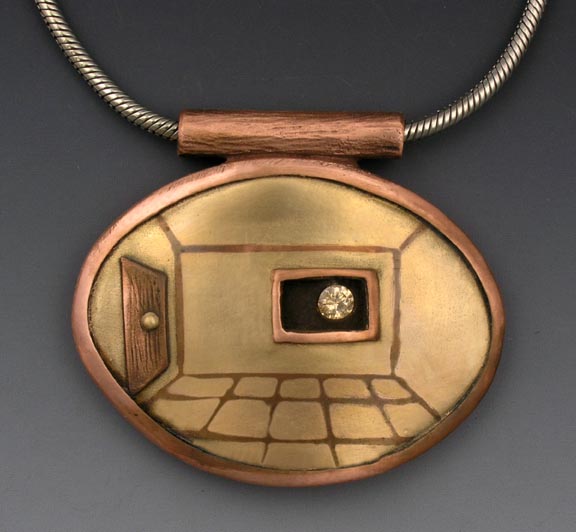
Room

Tile

Finished

Is there anybody out there?

Person looking out

Room

Architectural (3D)

View

Room and view

Houses with sea

City

Moon and door

Rings

Bronze house

Holly Gage will be coming to teach two workshops at my studio in February.

First workshop: Ever-Changing World: Kinetic Jewelry
February 11-12, 2012, 9:00 a.m. – 5:00 p.m.

Personal memorabilia and the theme of moving on in an “ever-changing world” will become the inspiration for the elements in your kinetic necklace. The technical portion of this project is inspired by constantly changing designs in wind kinetics and wind sculpture. We will push it to the limits as we explore free moving parts, riveted connections, and the mesmerizing sub-patterning created through this process to make a beautiful piece of jewelry that makes a statement.

Bring a piece of personal memorabilia that has meaning to you. Anything can be used as inspiration, such as a pattern on a piece of cloth, a trinket, or a picture. This item is meant to stimulate your creativity, so no anxiety necessary.

$30.00 Kit supplied by teacher: stencil paper, tracing paper, pencil, sandpaper, 3M polishing papers, polishing cloth, sterling wire 14g.

Class includes all basic tools needed for class. The only things students need to buy are: PMC3 25g, fire in place gems (optional). Also optional: Your own personal tools, magnifying lens, Ott light, etc.

A gourmet lunch will also be offered for purchase.

Kinetic movement web

Kinetic movement web

Kinetic movement web

You can sign up for Holly Gage’s Kinetic Jewelry Workshop by clicking here.

Second workshop: Jewelry that Rocks!
February 13-14, 2011, 9:00 a.m. – 5:00 p.m.

Exploring Art, Design and Line through Music
2-day workshop – All levels of ability

Music is a powerful trigger to our senses. Music can have energy and movement and emotion. For this lesson we will let different musicial selections guide the way as we explore design and line and transform the musical melody into an inspired pair of earrings or pendant.

The jewelry will be made with a Music CD set in a frame of fine silver. The techniques learned include cutting the CD, riveting, polymer plate making with an emphasis on how line is used to create motion, tension, drama, and direction in your surface embellishments.

$30 Kit supplied by teacher: photopolymer plate acetate, 20 g sterling wire, sandpaper, 3M paper, polishing cloth

Class includes all basic tools needed for class. The only things students need to buy/bring are: PMC+ 28g, recycled gaming or music CD (also available for purchase). Optional: your own personal tools, magnifying lens, Ott light, etc.

A gourmet lunch will also be offered for purchase.

Green-red CD necklace

CD Pendant

Gray CD earrings

You can sign up for Holly Gage’s Jewelry That Rocks Workshop by clicking here.

Holly Gage of Gage Designs creates contemporary jewelry and teaches her unique techniques both with a gentle blend of art and soul. Through traveling classes and master workshops that are available in the U.S. and abroad, Holly brings her innovation and creativity, as well as her gift of helping others find their artistic voice. She is a full-time Contemporary Jewelry Artist, Certified Metal Clay Instructor, and Jewelry and Metal Clay Conference Speaker. In addition, Holly holds a BS degree in Fine Art and Education. Her jewelry and articles on techniques and design can be found in over 45 regional and national publications including the Best of America Jewelry Artists, PMC Guild Annual Volumes 1-4, Metal Clay Artist, and Jewelry Artist, among others. You can find more information about Holly’s jewelry, classes, awards, shows, and numerous free tutorials on her website.


Aug 16 2011

SpeedFire Cone System

I’ve been getting lots of emails asking me if my clay can be fired with the SpeedFire Cone system. My answer was always “Unfortunately not,” because the SpeedFire system has no digital controller, and there is no way of knowing how much gas is left in the tank. “Unfortunately,” because not everyone can afford a digital kiln.

I’ve just come back from teaching a 4-day workshop at The Greater Philadelphia Metal Clay Guild, hosted by Holly Gage. Holly had the SpeedFire Cone system and thought it might work for firing base metal clay. It was totally her idea. I thought: what is there to lose? And we tried. Before I go on, please bear in mind that I am not recommending anything, at least not yet; I am just telling what happened.

While I was teaching, Holly was reading the instructions and setting up the system. I prepared 3 test pieces. Two of them I made according to the suggestion for test-firing in my Instruction Manual, and the third was a cane-slices piece, about 10 cards thick.

We did not use the cone system as instructed. We removed the screens, and fired inside the cone rather than on top of it, with the bowl sitting directly on the burner. We used a little stainless steel bowl (typically used for cat food), filled with carbon. The pieces were positioned vertically in the bowl.

Bowl on burner, front view

Bowl on burner, top view

We put the cone on top of the bowl and turned the system on.

Cone on bowl

We tried to set the temperature for the first phase. After the pyrometer reached 1000°F/538°C it suddenly went back to zero, and we realized that the metal wire that connects the thermocouple to the pyrometer had melted. So, we removed the pyrometer and the thermocouple altogether.

After 30 minutes we turned it off and let it cool down. That didn’t take long. Then we proceeded to the second phase, and fired for 2 hours. There’s no telling what the temperature was. The valve of the gas tank was open all the way. Since this tank is supposed to last 3 hours, it seemed the appropriate amount of time for a full firing cycle.

Here are the results:

SpeedFire results 1

SpeedFire results 2

Full sintering, no under- or over-firing. What a surprise!

There is a lot to be tested yet. I am wondering whether this kind of firing can be done in just one phase. I also don’t know whether the temperature can go high enough for firing steel clay on its own, or how to regulate the temperature to fire White Bronze. If you have the cone system, it will help a lot if you do some experimentation. The more information I have, the better I will be able to report reliable schedules. By the way, this system fits the blue propane tank as well. I just don’t know yet how long it will last. To reach higher temperatures, we can try Mapp gas; this tank fits as well.

Now for a pre-announcement of a future class. Holly Gage will be coming to my studio to teach two different 2-day workshops. Between our schedules, one possible date is in February. Valentines Day is on February 14. What I am asking now is: Who would like to take a class but CANNOT make it on Valentine’s Day. (The class is over by 5pm so there’s still plenty of time to celebrate.) Please email me directly with your answers: hadar@pacbell.net. More details to come.


Aug 5 2011

Pearl Grey Steel XT – Follow-up

Testing and playing with Pearl Grey Steel XT has brought me back 14 years, to when I first learned about silver clay, and it felt like the sky was the limit. I now find myself re-making in steel pieces that I used to make over and over again in silver, as if the possibilities can never be exhausted.

PG XT is similar to the first generation of silver clay in consistency, shrinkage, and firing temperature. It is also tough and hard to break in the green state. Those of you who were around back then probably remember the word “forgiving,” that was widely used to describe how it felt working with it. For me it meant that it was a medium I didn’t have to fight with. I enjoyed the touch of it in the wet and dry state, and I knew that even when it went wrong – cracked or slumped in the firing process – it could still be repaired. I felt it could be trusted. This is how I feel now about Pearl Grey Steel XT. I don’t worry much about the firing process; when fired at 1650°F – 1700°F (900°C – 925°C) (brick kiln), 1730°F – 1780°F (943°C – 970°C) (muffle kiln), the results are pretty predictable. Although it combines well with other metals, I enjoy it by itself.

Note: there was a mistake in the firing temperatures listed on the last page of the manual; I’ve now corrected the error and re-posted the manual. Please correct it or re-print the last page.

Here is one of the first attempts:

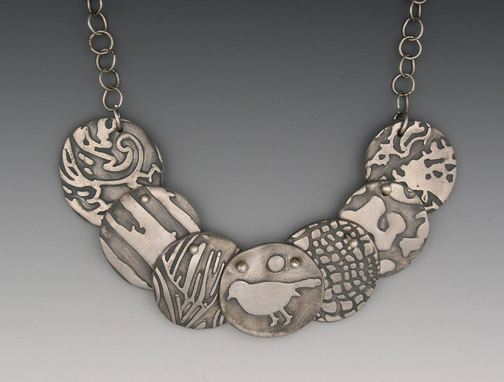
Chain-Circles Necklace

This was done using textures with a smooth, low relief. I find that this clay performs best when all or part of it has a smooth, matte finish. The color is silvery gray. Heavily textured pieces would look too dark.

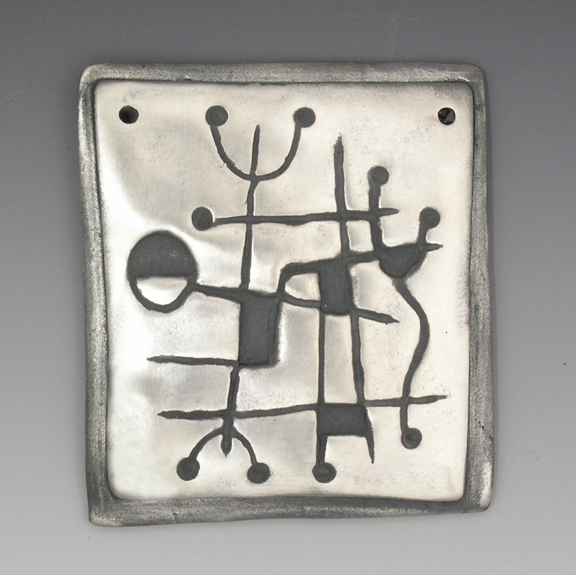
I made a piece similar to the Miró pin project in my book: The Handbook of Metal Clay: Textures and Forms. This time I did not texture the surface. After firing I sanded and matted it.

Miro Pin

And a belt ring, with no texture at all (I am still wearing my steel rings and they are not deformed or rusted). Rings like this (not hollow) shrink about 3.5 sizes. I made it size 11 on the step mandrel to get a 7.5 ring.

Belt Ring

After making this ring I couldn’t resist going back and trying my hollow, architectural rings.

House Ring

Here is a top view, just to get the idea. I wouldn’t call it wearable, but I had so much fun.

House Ring

This is the “Village” ring.

Village Ring

And here it is next to an old silver “Village” ring. This may give a sense of the color difference.

2 Village Rings

The silver ring is on the right. This hollow ring did not shrink as much as the belt ring, but I haven’t found consistent shrinkage yet for hollow rings.

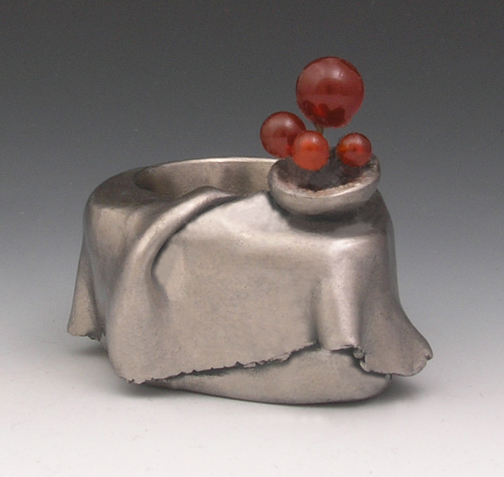
This is my “Table with Cherries”:

Table with Cherries

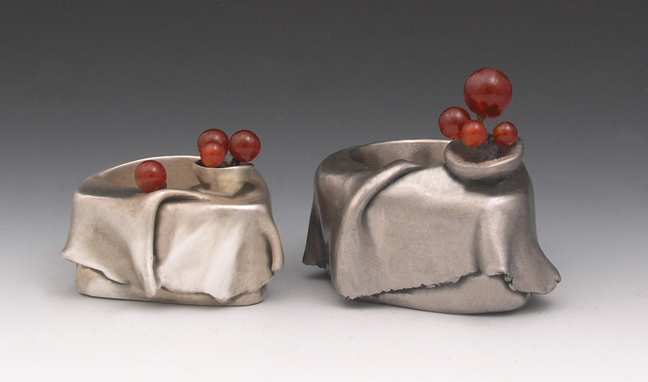
The cherries are half-drilled carnelian beads. I find the red color stunning in combination with steel.

And next, to a silver “Table with Cherries”:

2 Table Rings

Some tips about working with Pearl Grey Steel XT:

– Watch flat pieces as they dry. Flip them over when they start to curve. It won’t take long – they warp less than the earlier generation of Pearl Grey Steel.

– Burnish pieces before firing. It makes the sanding easier after firing and also highlights imperfections that may cause trouble after firing. It’s easier to fix now than later.

– When making rings, don’t wait for them to dry completely before you take them off the mold. They shrink tight around it and are hard to remove.

– When firing rings that are not hollow, like the belt ring, set them on a fiber paper covered with a thin layer of carbon. The carbon underneath the ring allows it to slide as it shrinks, and minimizes distortion.

Ring in Carbon

Roll a strip of fiber paper or ceramic tape and place it inside the ring to prevent carbon from getting inside the hole and deforming it. The fiber is soft and will not stop the shrinkage.

Inside the Ring

Hollow rings don’t seem to be affected much by the carbon.

Inside Carbon

Good luck!