Nov 1 2010

The Book is Here!

The Handbook of Metal Clay: Textures and Forms, 2nd Ed.

The Handbook of Metal Clay:
Textures and Forms,
2nd Edition

The second, revised and expanded edition of my first book: The Handbook of Metal Clay: Textures and Forms has arrived. All pre-orders have been shipped. Please let me know if your book does not arrive within a reasonable time.

My books (and my clay) are now available for sale in The UK, Europe and Australia from the following sources:

I have been asked what the difference is between the new edition and the first one. First, I brought the book up to date in light of my additional experience teaching metal clay. Second, the first edition was written before base metal clay showed up on the market. In the second edition all the projects can be done with either silver or base metal clay, and instructions are given as to how to make each silver project in copper and bronze.

Third, about 10 projects were added (after 3 books I’ve learned how to take better advantage of the space), and also lots of photos of pieces that were inspired by the projects. Many thanks to all the people who sent me their beautiful photos.

For those who are not familiar with my first book, it is suitable for both beginners and advanced students. Techniques are taught through projects. It is recommended to read it in the order in which it’s written, as new projects rely on previous ones. It is written to resemble the hand-on experience in the classroom.

And finally, the book is brand-free. The projects can be done with any brand or type of clay.


Oct 31 2010

Intensive Workshops at my Studio

I have been receiving many inquiries about intensive workshops at my studio. I was told that it is not easy for one interested person to organize a group for a workshop. So, to make it easier, I am setting up dates, and you can sign up if you like.

My available dates for now are:

  • December 4 – 8, 2010
  • January 8 – 12, 2011

The workshops are 5 days, Saturday though Wednesday. It is not required to take the whole 5 days, but days with less than 4 people may be canceled. The maximum number of participants is 8.

Most of the requests I have received are for caning and mokume-gane techniques. However, the program is not strict and people who want to learn other techniques are welcome to join. Learning how to fire base metal and tackle firing issues will be one of the main topics of the workshops. Another major subject the finishing process.

The studio is located in a central area in north Berkeley, (California), just a few minutes’ walk from grocery stores, drug stores, inexpensive restaurants and craft stores (!) There are also reasonably priced hotels just a short bus ride away, and more expensive B&Bs a few blocks away. There is a shuttle available from Oakland airport and BART (Bay Area Rapid Transit — our local subway/elevated train system) from SFO, so renting a car is not necessary.

If you would like to sign up or need specific information, please email me at hadar@pacbell.net.

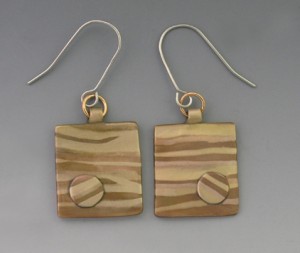
And just as an update, here are the first pairs of earrings I was able to make as a mirror image (well, almost) using mokume-gane techniques:


Oct 26 2010

Four Clays in One Firing

By now I have fired enough pieces that combine four metals (copper, bronze, White Bronze, and Pearl Grey Steel), that I can say for sure that they can be all fired together in one firing, using the firing schedule of White Bronze.

When I say one firing, I mean a firing that consists of 2 phases. I should also note that this only works with certain designs, such as those that you see in the photos below.

For example, if you were to make a piece of copper with overlays of White Bronze, or vice versa, the White Bronze would melt. The same will happen if you try inlay. In these cases it is always best to fire the high-temperature metal first, then add the low-temperature one and fire again.

Also, don’t try to make a Skinner Blend with copper and silver. It doesn’t work. (You live, you learn 🙂 )

I have not gotten to a point yet where I can give a precise definition of the type of design that does work. I am still experimenting. So for now I will just show examples.

The background for the piece above is made out of “scrap” clay, meaning a mixture of leftover clays.

The “black-and-white” piece below is a combination of Pearl Grey Steel and White Bronze.

And the following two photos are two sides of a hollow form (a rock).

Sanded rock 1


Oct 22 2010

More Mokume-gane and a Redesigned Website

Here is another mokume-gane design that I’ve been trying to achieve for a long time. If you look at the following photos, you’ll see the difference between these and the ones I showed in previous postings.

I’ve learned that this kind of look is not very successful with less than three metals. I’ve also learned that borrowing existing techniques from polymer clay does not work in most cases, since there is a major difference between polymer clay and metal clay: while polymer clay is baked at a low temperature, metal clay is fired at high temperatures, and that causes reactions between the metals involved in the design. That means that with metal clay, the design that you see before you fire a piece is not necessarily what you you will see after firing, and this needs to be taken into account when you design your piece.

There are a lot of other reasons why metal clay does not work like polymer clay, such as consistency, drying issues, available colors, etc. For all of these reasons, polymer clay techniques need to be adjusted to work with metal clay, or new techniques found that can yield similar results.

For example, this natural wood grain design is something I had to figure out for myself:

Although I am not going to stop experimenting, I think I have enough material now to start writing my fourth book. I don’t have a name for it yet, but it’s mainly about color effects in metal clay. If you have taken classes with me on this topic or intend to take classes within the next few months, you are most welcome to send me photos to be included in a book.

You can now see a “summary” of my experiments on my newly designed website (the new design was long past due; the old one was a terrible mess), especially in the sections “Mixed Metal Jewelry” and “Steel and White Bronze“.


Oct 11 2010

Instruction Manual Updated

The instruction manual for Hadar’s Clay™ has been updated. As you can see in the right-hand pane of this blog, instead of many separate files there is now one 33-page file. On the the title page you will find the date it was last updated. I also added a table of contents, which will make it easier for you to find the specific information you need.

The manual includes:


  • A discussion about the properties of the clay in general: storage, consistency, mixing instructions, drying, shrinkage, reconstitution, repair, the firing process, firing boxes, and test firing

  • The suggested firing schedule for each clay

  • A compatibility chart: which clays can be fired together in the same piece in one firing and at what schedule

  • Instructions for programming you kiln, demonstrated on the schedules for copper and bronze

  • An article about understanding metal clay and the firing process

  • And at the end, where it’s easy to find, a quick-reference table of firing schedules.

The firing schedules have changed

Or rather, have been simplified. All clays, with 2 exceptions, can now be fired using the same firing schedule. No slow ramping is required.

Phase 1

Ramp at 1800°F/1000°C to:

1000°F/538°C (top loader brick kiln)
1100°F/593°C (front loader muffle kiln)

Hold between 0:30-1:00 hour, depending on the size and number of pieces (no harm in holding even 1:30 hours).

Cool the box and the kiln down to room temperature.

Phase 2

Ramp at 1800°F/1000°C to:

1470°F/800°C (top loader brick kiln)
1520°F/827°C (front loader muffle kiln)

Hold for 2 hours.

The exceptions:

1. When firing White Bronze, the temperature in the second phase should be lower:
1170°F/632°C (top loader brick kiln)
1250°F/677°C (front loader muffle kiln)

2. When firing Steel (regular), the temperature in the second phase should be higher:
1800°F/982°C (top loader brick kiln)
1880°F/1026°C (front loader muffle kiln)

Optional

1. Bronze alone can be fired without cooling down to room temperature.

2. Copper and Pearl Grey Steel can be fired at higher temperature:
1580°F/860°C (top loader brick kiln)
1650°F/900°C (front loader muffle kiln).


Oct 8 2010

Storage of Mixed Clay,
and More about the Compatibility of Pearl Grey Steel

Storage of Mixed Clay

It turns out that mixed clay can be stored in the freezer. If you have mixed clay and cannot use it in the immediate future, just freeze it. It thaws quickly in the air (do not microwave!) and is as good as new.

This is particularly good news to people who do caning and mokume gane. If you have taken a class or a workshop with me on these techniques, you know that sometimes the canes we make are too long for what we want to do within the next few hours. So instead of getting stressed over using the rest of the cane, or turning it into mixed clay, just freeze the leftover cane! After warming a bit it will slice neatly and behave as fresh clay.

More about the Compatibility of Pearl Grey Steel

Pearl Grey Steel is compatible with White Bronze as well. I fired it in combination with White Bronze in one firing at the low temperature of 1170°F/630°C.

Here is a Skinner blend from dark gray to white. I took the photos on both white and black backgrounds so you can see that it is not a trick of the eye.

Before firing

Before firing

t-Skinner after white

And this is inlay of White Bronze in Pearl Grey Steel:

I am still in the process of finding out which ways of combining these two clays work best.

It seems that copper is the hardest clay to sinter. Pearl Grey Steel sintered at first firing using the White Bronze schedule. On the other hand, in the pieces below, in which copper in the main component, the copper did not sinter at first firing and I had to repeat the second phase of firing for the copper to completely sinter.

t-Copper-WB

That said, the leaves in the photo below – Skinner Blend with copper and White Bronze – sintered at first firing. There was no bronze in the leaves to begin with. The bronze color was created by a reaction between the copper and the White Bronze.

Finally, here is a charming piece created and photographed by Yolanda Nieuwboer from the Netherlands. It’s made from copper and Pearl Grey Steel.

Brfore firing

Brfore firing

After firing

After firing


Oct 5 2010

We Made the Kiln
Work for Us

This posting may be of interest to European users of metal clay and to people elsewhere who own very small kilns.

At the end of September I taught a workshop in the Netherlands, at Non!Soesa Creatif Studio. Before the trip, my hostess Otteline and I had corresponded extensively about the firing process, trying to make sure that the firing during the workshop would work fine. Otteline did a lot of test firings, took photos and documented her process, and I made suggestions as to how to improve the results.

Alas, there is only so much information you can convey via email. Something is always left out. When I first entered the studio and saw the kiln, I was in shock. I knew it was a kiln I hadn’t used before, but I never imagined how small it was. The dimensions of the chamber are 11.5 cm x 13 cm x 7 cm (4.5″x5″x3″).

Mini kilns 002

The chamber is made out of brick, the door is in the front, and so is the venting hole. This combination was totally unfamiliar to me.

We had 2 more identical kilns and another one of very similar dimensions. This fourth kiln has no venting hole, so we left the door open a crack.

Mini kilns 004

…and there were 17 people in the class.

Based on Otteline’s experiments, these kilns fire too hot if you use the schedule for muffle, front-door kilns. This is probably because of the bricks, which retain heat well, and because of the small space, which makes the chamber heat evenly, without wasting energy on just heating air. I was also informed that pieces near the back wall tend to crack.

I did one more experiment before the class began. I placed pieces slightly away from both the back and front wall, and did not avoid the center.

The boxes that were available to us were small stainless steel ones. I filled them with carbon as much as I could. Here is the schedule that we used. It worked just great:

Phase 1

Ramp for an hour to 538 °C (1000 °F).
(These kilns do not allow to ramp by temperature, only by time.)

Hold for 0:30 – 1:00 hour, depending on how much binder needs to burn out.

Cool to room temperature.

Ramp for an hour to 795 °C (1460 °F).

Hold for 2 hours.

Here is what Otteline made right after the class. It’s a combination of copper, bronze, and Pearl Grey steel.

I am often asked what I think the ideal kiln is for firing base metal clay. I am not sure what the answer is yet, but I am pretty certain that you can make any kiln work for you – as long as it has a digital controller – if you do just a few simple tests.

Testing

Fill your box with bronze test pieces, as many as you would fire in a regular batch.

As a starting point, use one of the firing schedules for bronze, as suggested in my instruction manual (2 firing schedules are suggested for 2 different types of kilns).

Under-firing

When the firing is over, check the pieces. Sand them with coarse sandpaper. If some of the surface does not become metallic as you keep sanding, the pieces have not sintered properly.

What to do? One thing you can do is raise the firing temperature. However, before you do that, try dividing the firing process into 2 phases. Cool the kiln and the pieces to room temperature after the first phase. This is the best way I have found to completely get rid of the binder. Moreover, when I fire this way, I find that I need to lower the temperature in the second phase.

Right after my workshop in the Netherlands I taught two workshops at Studio34 Beads in Rochester, NY. All four kilns were muffle, front-loader kilns. We fired in two phases and had to lower the temperature in the second phase to 1520°F (827°C). The results were great!

Over firing

If the bronze pieces curled, blistered or became textured, then the kiln was too hot in the second phase. You need to lower the temperature.

If pieces cracked, the binder was probably burning too fast in the first phase. Cover the pieces with more carbon, or slow the ramp.

I am currently updating my instruction manuals. Instead of a separate manual for each type of clay there will be only one manual (including a table of contents), which will cover all firing information. This includes test firing, making firing boxes, schedules, and programming instructions.


Sep 19 2010

Good News about Pearl Grey Steel, and Gradient Surfaces

This posting has two parts. Please be patient; it’s going to be long.

1. Firing Temperature of Pearl Grey Steel

No more high temperatures! It turns out that Pearl Grey Steel has the same sintering range as copper (1470°F/800°C – 1800°F/980°C). It can therefore be fired with copper and bronze in the same piece, at the low firing temperature of bronze.

How come I didn’t know this earlier? I guess I made the worst mistake one can make in research: making assumptions. I assumed that since the main ingredient in steel is iron, and iron’s melting point is so high, then the sintering temperature of Pearl Grey Steel must also be high.

How did I find out that this was not true? By mistake – which can sometimes be the best thing that happens in research. I accidentally included Pearl Grey Steel in a batch that was fired at the firing temperature of bronze, and I discovered that the Pearl Grey Steel sintered. I repeated this several times and it worked every time.

Here are some examples:

t-8

And here is Pearl Grey Steel with bronze only:

t-7

The firing schedule is the same as for my traditional Copper and Bronze Clay. It consists of 2 phases:

Phase I
Ramp at full speed to 1000°F/540°C (top loader); 1100°F/590°C (front loader)
Hold for 30 minutes to 1:00 hour, depending on the size of the pieces

Cool to room temperature. Remove ash and add more carbon if necessary.

Phase II
Ramp at full speed to 1470°F/800°C (top loader); 1520°F/830°C (Front loader)
Hold for 2:00 hours.

(I rounded off the numbers when translating them from Fahrenheit to Celsius.) Tip: once the first phase is over, take whatever box you use out of the kiln and place it outside in a shaded place, shielded from the rain.

By the way, I find this is the best firing schedule for bronze, copper, and Pearl Grey steel, whether fired by themselves or in combination with each other. With copper, too, it is unnecessary to go to high temperatures; I have had more success in sintering copper with this 2-phase schedule than with any other 1-phase schedule.

2. Gradient Surfaces

Although polymer clay is not my field of expertise, I have been studying a lot about polymer clay techniques to see if they can be adapted to metal clay. Some of them can, but with a few adjustments that are required mainly because metal clay is fired and not baked. The firing process can cause different (sometimes undesired) results when applying polymer clay techniques without these adjustments.

However, the technique for creating a gradient surface, known as Skinner Blend, can be applied in almost precisely the same way as with polymer clay. This technique produces a gradual transition from one color to another, and even to a third color.

Here are some examples. Starting from copper to bronze:

Copper to Bronze

This surface, once fired and finished, immediately brought to my mind the gradient paper I use for taking my photos. So, I just hung a tiny piece of jewelry on top of it.

"Cab" on gradient vbackgrounf - front view

Cab on gradient background - front view

Back view

Back view

t-2

This one is from steel to bronze:

Before firing

Before firing

After firing

After firing

And this one is from steel to copper to bronze:

Instructions on how to make the Skinner Blend can be found in almost any book about polymer clay.

Important note:: This technique will not work if one of the ingredients is silver or regular steel clay. I am about to start experimenting with White Bronze.


Sep 12 2010

Second Edition of My First Book, and Some New Work

The second edition of my first book: The Handbook of Metal Clay: Textures and Forms has finally gone to print and will be available by November. You can see the covers and the introduction on my Web store. Thank you for all the beautiful photos that you have sent me. I have managed to include almost all of them. I will post again when the book is out.

You can pre-order the book now. There is a discount of 25% for a minimum order of 12. Please see details here.

On another note, I’d like to share with you some of the work that I’ve been doing lately. Most of it has to do with caning and mokume gane effects.

The following are hollow forms. The third one is a combination of copper and White Bronze. The fourth photo shows solid bi-cone spherical beads.

t-Windows

Mokume mascara

Oval  cab

 width=

Ball and bicpne

The following demonstrate wood grain effects.

Woodgrain tube Earrings

Woodgrain rectangular earrings

Woodgrain lentils

Woodgrain bracelet

And these are striped designs:

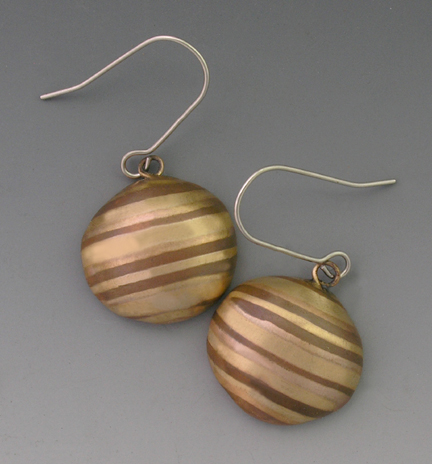
Striped dome earrings

Striped rock

Striped-squares

In the last four you can see a third, pinkish color. This is created by mixing bronze and copper clay.

And finally, two more magnetic clasps made from Pearl Grey Steel and bronze and copper.

Magnetic clasp

I’ve been asked whether I am going to teach some of these techniques in my next workshops. Absolutely – some techniques I am still working on, but I will certainly teach what I feel confident about.


Sep 1 2010

An Update to My Travel-Teaching Schedule

Three classes have been added to my travel-teaching schedule in 2010-2011.

November 15-16, 2010, Amado Territory Ranch, Arizona (30 miles south of Tuscon)
Contact: Expressive Art Studio

March 18-19, 2011, PMC Guild Chapter, Columbus, Ohio.
Contact: Carole Bucklew, BucklewC@xenos.org

April 8-10, 2011, Local Metal Clay Guilds and Chapters, Chicago, Illinois.
Contact: Patricia Weikersheimer, pbweikersheimer@yahoo.com

The file “Hadar’s Travel-Teaching Schedule” on the right pane of the blog has been updated with these changes.