Jan 15 2011

Travel-Teaching Schedule Updates and Carbon/Kiln Logistics

Please have a look at my Travel Teaching Schedule:

#9. Another back-to back workshop was added in Santa Fe, NM,
on April 25-27:

Contact: JoAnn Sartorius, joann@newmexico.com, (505) 660 6556

#15. Another back-to back workshop was added
in Philadelphia, on August 11-12:

Greater Philadelphia Metal Clay Guild, PA
Contact: Holly Gage, hgage1@ptd.net

#16. Two new back-to-back workshops will be held
in Rochester, NY, on October 7-8 and 9-10, at:

Studio 34 Creative Arts Center and Gallery
34 Elton St, Rochester, NY 14607
Phone: (585) 737-5858
Email: studio34artists@aol.com

Please note: At any venue, it is possible to take both back-to-back workshops. If you take the second workshop as well, you will be introduced to new material.

On another note, following Heidi Jo’s helpful request, I’ve added a search field to my blog, at the top of the right-hand pane.

Carbon/Kiln Troubleshooting

I would like to answer a question here that I am frequently asked. It seems to be common that after firing overnight, you find your box still hot, with most of the carbon gone. The fired pieces are exposed, and sometimes suffer from overheating or oxidation.

This can be caused by the type of carbon you use, or by your kiln, or both.

Some carbons stay hot for a very long time after the firing is over, regardless of the type of box you use – even if you take the box out of the kiln after the cycle is over and place it in a cool place. If this is the case, I suggest switching to another type of carbon. I asked a carbon manufacturer what the difference could be between carbons for our specific application of sintering powder metal. He referred my question to a technician, who never got back to me. This application is new to carbon manufacturers, and hopefully we will have better answers in the future. What he did say, though, is that different manufacturers follow different activation processes, and that I should find the carbon that works for me and stick with it, since the manufacturer is most likely to follow the same activation processes consistently. So I’m passing his suggestion on to you. I am not recommending any specific type of carbon here, since you are most likely using different brands of clay.

In the same way, some kilns stay hot long after the cycle is over. I have three kilns, and I use the same box and carbon in all of them, but one of them stays hot too long while the others do not. It does not mean that something is wrong with the kiln and that you need to switch kilns. All it means is that you need to be aware of it and handle your firing accordingly.

For example, in this kiln I try to avoid firing overnight. I take the box out immediately after the second phase. It saves my pieces and I don’t loose carbon.

When I have no choice but to fire all three kilns overnight, I cover the box in that particular kiln loosely with a fiber blanket or a fiber board with a hole in it. It helps to a certain extent, especially if I fill the box with extra carbon to begin with. I do lose some carbon, but the pieces are usually fine.

And a reminder: I receive a lot of questions about the firing schedule. You will find answers to a lot of your questions if you refer to my 33-page instruction manual, linked in the right-hand pane of this blog. It includes discussions of the boxes, the carbon, how to fire, a compatibility chart (what clays can be fired with others), kiln programming instructions, firing schedule, the firing process, a checklist, and more.


Jan 14 2011

Photos from January 2011 Intensive

The following photos show pieces that were created at my studio in a 5-day intensive in January. Let me say outright that I chose to show the work from this intensive not because I think it’s better than any other intensive, but because this time I held these people hostage and wouldn’t let them leave until they let me photograph their pieces.

We also agreed that names would not be mentioned, but if you have questions about certain pieces I will deliver the message.

The pictures are displayed in the order in which the they were taken. You can click on the photos to enlarge.

t-01

t-

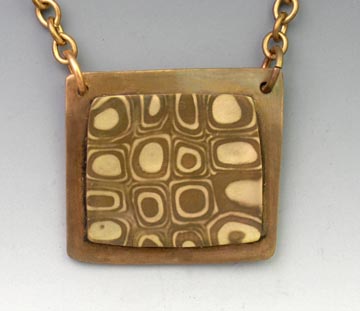
The background of the piece above was made from mixed clay that was left over from a different project. Depending on the composition of the mixed clay, you can get a range of colors, including the orange color shown in the photo.

Balling up wire was also discussed and practiced in the intensive. The piece above is connected to the chain with balled-up wire (at the bottom of the tubes), using a propane/oxygen torch.

t-18

The tube earrings on the bottom left show a natural wood grain pattern, which was also practiced in the intensive.


Jan 9 2011

How to Make Rose Gold Color in Metal Clay

Mix copper clay and White Bronze clay at a ratio of 6 to 1, as follows:

Roll a layer of copper clay, 6 cards thick.
Roll a layer of White Bronze clay, 6 cards thick.
Pick a cutter or a straw and cut 6 identical shapes out of the copper layer and 1 shape out of the White Bronze layer.

Mix the cutouts together into a chunk. Roll the chunk into a flat layer. Roll the layer into a jelly roll and fold it in half. Roll it flat again. Repeat until the color of the clay is even.

This clay fires at the same temperature as Quick-fire copper, bronze, and Pearl Grey Steel (see the instruction manual).

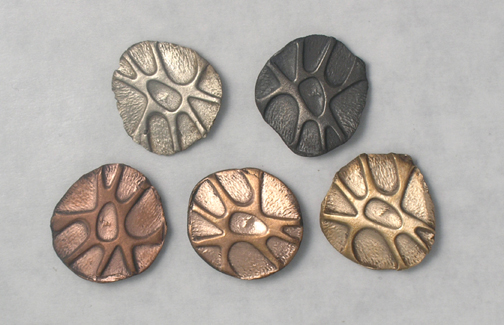
Here are all the colors side by side:

Here is the “rose gold” next to copper (copper on the right):

Here it is next to bronze (bronze on the right):

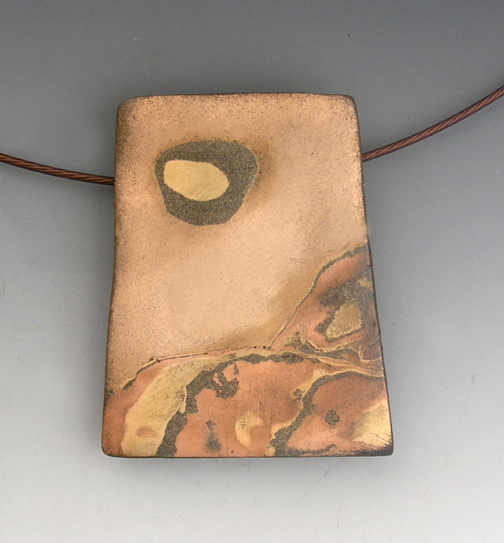
And here it is in a pendant.

This piece combines Quick-fire copper, bronze, and Pearl Grey Steel. The sky is a gradation from Pearl-Grey Steel to bronze. The sun is “rose gold”.


Jan 6 2011

New Classes in 2011

A new 3-day workshop has been added to my travel teaching schedule for 2011:

Santa Fe, NM, April 28-30, 2011
Contact: JoAnn Sartorius
joann@newmexico.com
(505) 660-6556

This workshop follows the one in Chicago, on April 8-10.

New Intensive Workshops at My Studio

June 4-8, 2011

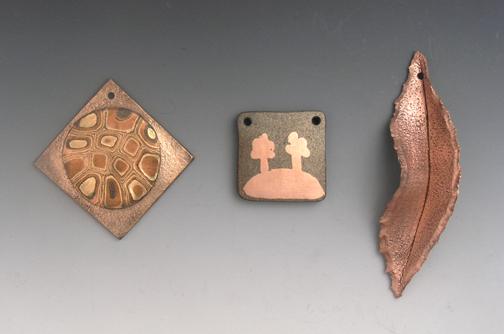
This class is offered by request and is intended for advanced students. The topic is Pictorial and Architectural. We will work on one or two pieces, flat or 3D, with one or two metals. Here are some samples:

t-Bro

May 7-11, 2011
July 2-6, 2011


Caning and Mokume-Gane in Metal Clay

These classes cover newly developed techniques for creating color effects in metal clay.

Learning how to fire base metal and tackle firing issues is one of the main topics of the workshops. Another major subject is the finishing process.

Here are some class samples:

The studio is located in a central area in north Berkeley, California, just a few minutes’ walk from grocery stores, drug stores, inexpensive restaurants and craft stores (!). There are also reasonably priced hotels just a short bus ride away, and more expensive B&B’s a few blocks away. There is a shuttle available from Oakland International Airport (SFO), and BART (Bay Area Rapid Transit — our local subway/elevated train system) is available from San Francisco International Airport (SFO), so renting a car is not necessary.

To download my Travel-teaching Schedule (including the Intensive Workshops at my studio), please click on “Hadar’s Travel-teaching Schedule” in the right-hand pane of this blog. If you would like to sign up or need specific information, please email me at hadar@pacbell.net.


Dec 10 2010

A Wish Come True

You may remember my blog post from a while ago, titled “Please Make Us a Box!.” It seems that my wish somehow came true. PMC Connection have just released a fiber firing box.

When I ordered it, it was already out of stock and I had to wait for a new shipment. Since I received it I’ve been able to do some experiments, and I’d like to share them with you.

The box is round, 6″ in diameter. It fits perfectly in my 6.5″ x 6.5″ x 4.5″ kiln.

I have plenty of room to take it out of the kiln hot using heavy-duty heat-protective gloves. I filled the box with more pieces than I usually do, placing pieces in the center as well as on the sides, and everything sintered perfectly.

By the way, this small kiln is my favorite. I think that for jewelry, the smaller the kiln, the better. Good distribution of heat, no waste of energy on heating just air. I just wish it were round. In my opinion, the circular shape of the box helps with even distribution of the heat.

Here is how it fits in my 8″ x 8″ kiln:

Again, I filled the box. In the center I placed 2 pieces, 4mm thick (about 15 cards). The rest of the pieces are about 2″ x 2″.

The thick pieces in the center fully sintered.

As you may remember, I never fire in the center in an 8″ x 8″ kiln. So, in spite of the smaller size of the box, it can be filled with almost as many pieces as a bigger box.

Important notes

1. If you fire in these boxes, you need to lower your sintering temperature (the temperature of the second phase), or your pieces will be over-fired. I lowered mine by 30°F/17°C in all three of my kilns.

2. The boxes hold the heat for a long time after the firing is over. That means that it takes them longer to cool down between phases. It also means that if you fire overnight without a lid, a lot of carbon will be burnt. My suggestion is, use the lid that comes with the box, but first drill a hole in it, about 1″ in diameter. That will reduce the amount of burnt carbon while letting all binder and contaminants escape. Without the hole, the carbon may not be able to burn, which helps to create a reduced atmosphere.

I am curious to know what happens if we set the kiln to fire one hour instead of two in the second phase. If the boxes stay hot for so long, maybe we can leave them in the kiln for the second hour with the kiln off? I’ll try it when I get the time. If you try, please let us know!


Nov 27 2010

In the Spirit of Thanksgiving

I’ve just seen a copy of the December issue of Jewelry Artist Magazine (Lapidary Journal). I would like to thank the magazine and Sharon Elaine Thompson for counting my work with metal clay powder among the 10 Most Influential Developments in the past decade “that have had or are soon likely to have the greatest impact on jewelry making today.” I feel surprised, happy, and grateful.

I would also like to thank you all for sticking with me throughout this journey, determined to make it work. I have learned a lot from your questions and from the problems you have encountered, and because of them I feel better equipped to continue my support.

Sharon Elaine Thompson mentions in the article that I borrowed a polymer clay technique to create a gradation of color. I talked to Elaine on the day I left to teach in The Netherlands; since then, and since my blog posting about the Skinner Blend, I have found another way of making a gradient surface, using the clay extruder. This technique will be presented in my next book, and I am happy to preview it here as a free project. I hope you make many beautiful things with this technique and send me photos for my new book.

Leaves with coper, bronze, White Bronze, and Pearl Grey Steel

Leaves with coper, bronze, White Bronze, and
Pearl Grey Steel

These leaves are made from copper, bronze, White Bronze and steel, each one representing a different type of gradation. A project for constructing these leaves can be found in the April 2010 issue of Jewelry Artist Magazine.

Gradation from Pearl Grey Steel, to bronze, and to copper

Gradation from Pearl Grey Steel, to bronze, and to copper

Gradation of copper to bronze

Gradation of copper to bronze


Nov 14 2010

Updates

1. My next travel-teaching class (the first in the new year) will take place in Puerto Vallarta, Mexico. It’s a 5-day workshop in a beautiful retreat, called Hacienda Mosaico. Arrival date is January 23, departure on the 29th. It’s going to be a small-size class in a relaxed atmosphere, room and board included. Here is the contact information.

The last time I taught such a class was in Norway. Six days in a row in a beautiful setting and view, with six people that had limited experience in metal clay. We started from basics, each day progressing with more advanced techniques, and at the end of the last day we were making complex mokume gane pieces. That was something to remember.

2. Which leads me to the next update: GlassForum, the place where I taught in Norway, is now the distributor of my clays in Scandinavia.

3. Speaking of intensive classes, the intensives scheduled at my studio are almost full.

I’ve been doing more testing with mokume gane. First I tried to work with larger areas, making my quilts and a “Squeeze Bead” (you can find the instructions for this form in my third book: Mixed Metal Jewelry from Metal Clay.

t-Bead1

The surface is so rich with detail that shaping it in complex designs like those folds above seems too much. The form competes with the color. Still, I wanted to do more with mokume gane that just flat panels. So here are my first attempts at incorporating mokume gane into a larger design.

This piece is made out of overlays, using copper, bronze, Pearl Grey Steel, and mixed clay.

In this one the surface is all flush. I used the same materials.

This is also all flush, made with all four metals. The larger area is White Bronze.


Nov 14 2010

Home-Made Extruder and Discs

When I updated my old website and launched the new one, some of the old files disappeared. One of them was a set of instructions for making your own clay extruder at low cost. These instructions are now available here. (You can always find the link to these instructions on my blog by searching for this posting in the archive. To access the archive, click on Archive in the top bar of this blog.)

For people who are new to metal clay, the instructions on making your own extruder also provide a general background on how to use extruders, and especially on how to use them with tube adapters.

Here is an addition to the instructions:

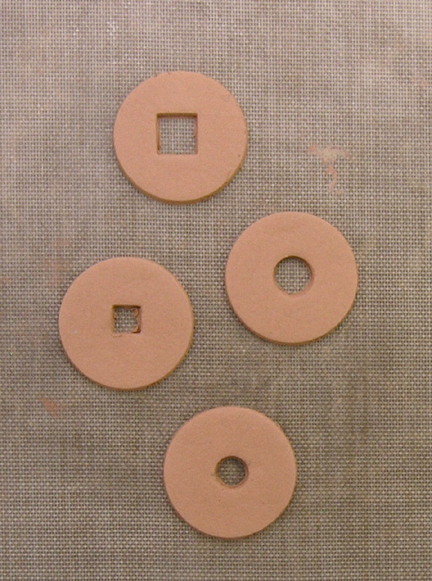
I have all the discs that come with commercial extruders, but sometimes I need a different shape or size. Nothing is easier than making your own disc out of metal clay. When only silver clay was available, I wouldn’t even have considered it, due to the cost. But with base metal clay, making your own extruder discs is cheap and efficient.

It’s best to use low-shrinkage clay (Quick-Fire).

1. Roll a layer of clay 6 cards thick. Cut circles using a circle cutter that has the same diameter as the extruder.

2. Using a smaller cutter, cut any shape in the circles. After drying, you can change or refine the cutouts with a file.

Next I am going to try making my own tube adapter.


Nov 7 2010

Class Updates, a Dress, and New Mokume-gane

Class Updates

1. By request I’ve added another 5-day intensive at my workshop. The dates are March 5-9. I will post a deadline soon, but please let me know as soon as possible if you would like to attend.

2. If you happen to be going to the Tuscon show, I will be teaching a 2-day workshop in Tucson at that time. The dates are February 2-3, 2011, and the location is Amado Territory Ranch (30 miles south of Tucson). Contact information: www.expressiveartsstudio.com or studio@expressiveartsstudio.com.

3. Another class has been added to my travel-teaching schedule, with the Greater Philadelphia Metal Clay Guild, August 13-14, 2011. UPDATE: There are now two workshops, back-to-back: August 11-12 and August 13-14, 2011. Please contact Holly Gage, at hgage1@ptd.net. Note: Plans are still in the works, and registration with Holly will start in January. Please contact Holly to be put on the list for more information.

And a note to my local students: because of the size of Thursday morning class, I added a class on Friday morning, 10 a.m. – 1 p.m. For this week only, class will take place on Friday only (not on Thursday, which is Veterans’ Day).

The Dress on my Book Cover

I have been asked what it is and how big it is. Sometimes I take her with me to workshops and people tell me they never imagined how big she was. It’s hollow, 4″ tall and 3.5″ wide at the bottom. I made it from the original silver clay, so it was 30% bigger before firing. It took about 5 months to construct. Here she is in my hand, so you can have an idea of the size:

More Mokume-gane

This is the kind of mokume-gane design that I have been trying to achieve for a long time. As opposed to the Skinner Blend, I have not been able to create this design by following instructions from polymer clay books and sites. So I had a lot of failures. I think the following are getting close to the natural mokume-gane designs that occur in nature.

Befor firing

Before firing

Aftwr firing

After firing

Before

Before

After

After

Befoe

Before

After

After


Nov 2 2010

Answers to Some Questions

Since I posted the information about the intensive workshops at my studio and the arrival of my book, I have been getting a lot of emails asking the same questions. So I am addressing them here.

About the workshops

What is the deadline for signing up?

The deadline for signing up for both workshops (December and January) is November 15th, 2010.

Is a deposit required?

A deposit is required by November 15th. You can pay here. Please choose December or January in the drop-down menu.

What will the class cover?

In general, the class covers mixed metal jewelry in metal clay. Not everyone needs to work on the same projects. The projects will be adjusted to your level and interest.

Is there a day-to-day plan?

No. You choose what you want to work on. There are a lot of projects to choose from. There will be a lot of demos and you are welcome to watch even if you are not working on the technique being demonstrated.

Should I purchase and mix my clay ahead of time?

It is not necessary. Everything is available at the studio. You can purchase the clay as you go. You can pay in your choice cash, by check, or through my Online Store directly from my studio computer). You can choose the clay you need on the spot, according to the projects you choose to work on.

What do I need to bring?

Your personal toolkit, your favorite tools and textures, and a clay extruder.

About the book

When will my book arrive?

We are doing our best to ship orders within one business day. According to the US Postal Service, delivery within the US should take 2-3 days. To other countries the post office states 6-11 days, but from my experience it can take a few weeks depending on your local mail delivery. If you are outside the US, your local postal service may be able to provide more information.

Am I allowed to sell pieces that were inspired by projects in your book?

Yes. As stated in the introduction to each of my books, you are welcome to make the projects for both personal and commercial use.

I am a teacher. Do you mind if I teach projects from your books?

Not at all. A credit will be appreciated, though.

What is the best way to read the book?

It’s best to read in the order in which the projects are presented. It was written with the purpose of simulating the hands-on experience in class.