Apr 9 2009

Project: Images in Bronze and Copper Clay


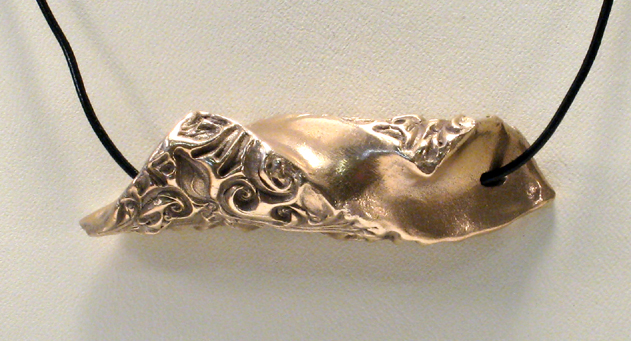
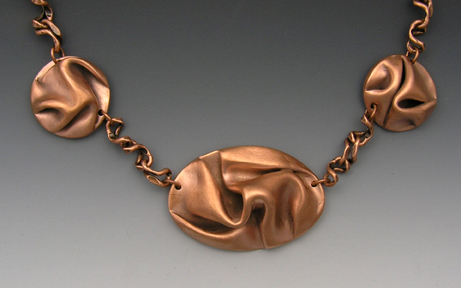
Here is another quick and easy way to combine bronze and copper clay. I made these with some popular rubber stamps. They are flat, smooth images and some of them can make pretty buttons.

1. Choose a rubber stamp, a PPP plate or another texture that has a very deep relief. You can use it as is, or make a mold from it and use the mold instead.

2. Roll a very thick layer (2 craft sticks or 16 cards) of bronze clay and press it into the mold, or into a part of the mold.

3. Cut off the excess from the layer and dry on a warming plate at 200°F – 250°F. Keep an eye on the piece as it dries. It will soon start to warm. Turn it over. When it starts warping again, flip it back over. Continue this until the piece stops warping. Alternatively, after the first two times, tape it down or lay a Corian block on it (see photos on the very bottom of this page: http://artinsilver.com/blog/page/2/ .

4. Press copper clay into the indentations of the pattern. (It doesn’t matter if some of the pattern disappears.)

5. Dry again, as in step 3. It will not warp this time.
6. Turn the piece over and sand it vigorously against a fine sanding pad or an emery board until the pattern reappears.

7. Fire according to the firing schedule on my blog.

8. Follow the finishing instructions in Part 2 of the project Necklace or Bracelet Combining Copper and Bronze Clay, available on my blog.

To download this project in printable PDF format click here.


Apr 2 2009

Testing the Strength of Fired Pieces

How strong should a piece of jewelry be? I guess the answer to this question has changed over the years as new media have appeared in the jewelry-making arena. One thing is sure: we don’t want any piece of jewelry to crumble when a customer tries it on. However, it’s important to remember that jewelry strength is never absolute, regardless of the medium: a piece made of glass can break if it falls on the floor; resin inlay may stick to your fingers in the hot desert; polymer clay jewelry may break with some pressure; paper jewelry may burn if it comes in contact with a lit cigarette.

In other words, there is nothing new about jewelry media that need to be treated with care. Metal clay is one of those media, and in that sense, base metal clay is no different than silver clay. Have you ever tried to test the strength of your silver pieces by breaking them with pliers, or even with your fingers?

Well, after “crash testing” was suggested, I did. I was able to break thin, fully sintered pieces with my fingers. The piece in the photo was made with low-shrinkage silver clay. It is (or was) 2″ x 1½”, constructed out of at least 3 layers, 3 cards thick. Fired in a kiln 2 hours at 1650°F. It easily broke with pliers, after just one bend. And as you can see, the cross section is not so attractive either.

I’ve sold many rings over my metal-clay career. Many of them were returned cracked or broken. I stopped selling metal clay rings, and if a student wants to make a ring for themselves, I tell them to treat it with care.

I don’t see why base metal clay should be different from silver clay in that respect. It is just as porous, and I would expect it to be even weaker because of the firing limitations. I don’t test my pieces with pliers anymore. When they come out of the kiln, I buff them lightly to see if they are fully sintered by looking for any powder underneath. If there is, I re-fire. I don’t try to bend them, either. With silver, copper, and bronze clay, I do all the bending before firing. With metal clay I never make bezels that need to be bent over a stone. I do finish my pieces vigorously. If they survive the finishing process, they are strong enough.

In fact, I started bending and breaking sheet metal to make my pieces, long before I began working with metal clay. One of the reasons I switched from metalsmithing to metal clay is the advantage of being able to do all the bending and joining with clay rather than with metal. Here are a pair of earrings and a ring that I made with sterling silver:


After constructing the ring and the earrings, I bent strips of sterling silver with two pairs of pliers until they cracked. I collected them and rearranged them like a puzzle, and soldered them back on the base structure. I repeated this many times with metal clay, and of course it was a lot easier.

So, sterling silver breaks with pliers. How about brass?

And if you don’t believe the photos, I’ll post a video clip! 🙂

I don’t know where this idea of breaking jewelry with pliers originated, but I am sure that a lot of professional jewelers would shudder at the thought of their creations being “crash tested.” After all, if all jewelry were that sturdy, there would not be a field of expertise called jewelry repair.

I was asked to send my comments on Tim McCreight’s article about bronze clay prior to its publication. Here is what he says on page 6. I did not comment on this because I thought he was right:

“Thicker pieces that have been cut open often reveal a brown powder that is most likely a mixture of copper and tin powder that did not sinter. This hollow core is not itself a problem as long as the outer shell is thick enough to provide the strength required to the piece.”

Well, last night I finished this piece, which is 2″ x 1½”, 5 mm thick. I finished it until my fingers were bleeding. There is no way I am going to crash test this piece!

Inside

Inside


Apr 1 2009

Archive


Mar 31 2009

Combining Bronze and Copper Clay

Inside

Inside
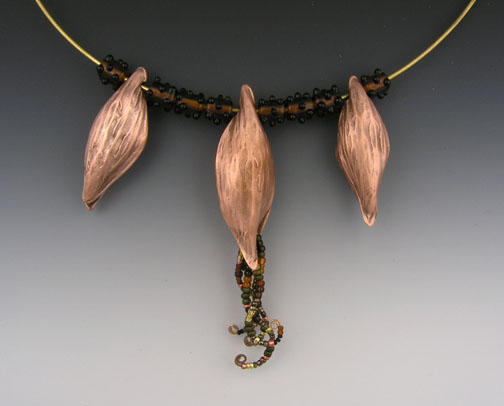
Woodgrain Sphere

Woodgrain Sphere

View on Rock


Mar 25 2009

Bronze and Copper Clay are Compatible!

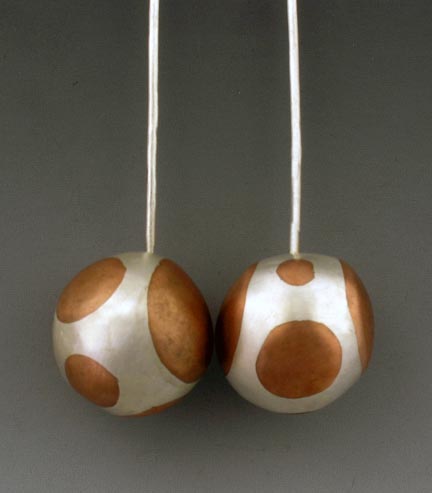
Hadar’s Clay™ bronze and copper clay powder can be fired together using the same firing schedule. They don’t interfere with the sintering of each other, they fuse together well, and the contrast is sharp and beautiful. Please read the article “Combining Bronze and Copper Clay” on the right.


Mar 24 2009

Gallery

This gallery is dedicated to artwork created with Hadar’s Metal Clay powder. Click on the photos for a larger view. If you hover over the photos you will see the artist’s information. If you would like to display your work in this gallery email your photos to hadar@pacbell.net.


Mar 22 2009

About Core Material

I have been dreaming of making this piece for years, ever since it was served as an hors d’oeuvre at a dinner party I was invited to. I’ve just figured out how to make this stuffed pasta pouch and wanted to make it in bronze. However, I had to use core material.

Core material, too, does not burn well inside carbon. I had problems firing cork clay and spaghetti. However, as with glycerin, if you cover it with just a little carbon and fire without a lid for the first phase of the firing schedule, it will burn just fine.


Mar 22 2009

Flexible Clay

The photo above is a 4-stranded braid made out of flexible copper clay, by Hope Weiner.

Bronze and copper clay powder make wonderful flexible clay. In fact, they are even nicer to work with than flexible silver clay. They feel like soft leather, and stay this way for a long time. The directions for making flexible clay are the same as in ny book: The Handbook of Metal Clay: Textures and Forms.

However, glycerin does not burn well in carbon. When you fire flexible clay, make sure to cover the pieces with a very thin layer of carbon for the first phase of firing. Don’t use a lid. To be on the safe side, you can either extend the length of the first phase, or repeat the second phase twice.

These photos show some more flexible clay pieces that I made out of bronze clay powder.


Mar 22 2009

About Repair

Silver clay is easy to repair. The fresh low-shrinkage clay applied to fired silver seems to stick pretty well. This is not the case with bronze and copper clay. Fresh clay doesn’t stick, and if it does, once it’s dry it tends to separate and peel off. So here is what I’ve found:

Applying the Clay

Spit helps to adhere fresh clay to fired clay. Place some saliva on the spot to be repaired and the clay will stick and won’t peel off when it’s dry. You can smooth the repaired area with some saliva on you finger, but please, if there’s clay on your finger, don’t put it back in your mouth!

Firing

When you do a small repair, the first phase of firing can be replaced with torch firing. Fire the repaired area with a torch for about 30 seconds, then move on to the second phase. That saves a lot of time and energy. You can put aside a few pieces that need repair, torch fire them and then fire them together according to the directions for the second phase of the firing schedule.


Mar 20 2009

Combining Silver and Copper Clay


The file “Combining Silver and Copper Clay” on the right side of the screen describes experiments with firing silver and copper clay in a single piece. It shows which combinations work, which don’t, and which work some of the time.

I am in the process of preparing a similar file on combining bronze and copper clay. Hope to post it next week.


Uncategorized  (301)


There are 301 posts in 1 categories with 2885 comments (plus 2758233 spam comments).

Simple Archive by Sterling Adventures